Choosing between EB-1A or NIW as an Indian professional requires a cold calculation of wait times and evidentiary bars. This 2026 framework provides the data you need to decide.
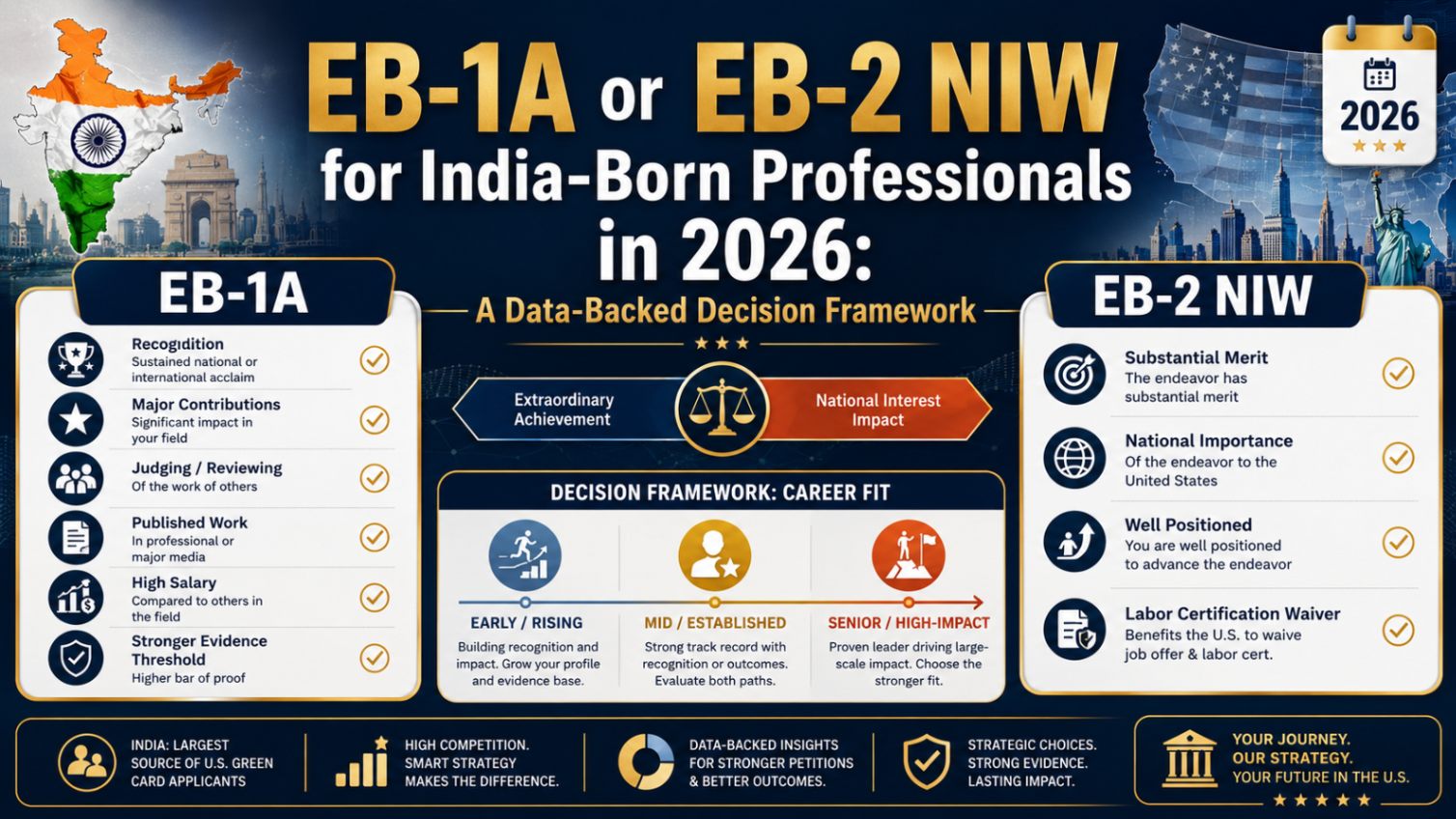
EB-1A or EB-2 NIW for India-Born Professionals in 2026: A Data-Backed Decision Framework
For Indian-born professionals, the choice between EB-1A and EB-2 NIW is not primarily an evidentiary question. It's a mathematical one. The EB-2 category for India-born applicants carries a backlog so severe that an approved NIW petition filed in 2026 confers status-maintenance benefits rather than a realistic path to a green card within any near-term horizon. The EB-1A, which falls under EB-1 rather than EB-2, moves on a separate and significantly faster track. For most India-born professionals whose goal is permanent residency rather than indefinite H-1B extensions, the EB-1A is the only viable path to a green card within a window measured in years rather than decades.
The Priority Date Reality in 2026
Understanding the decision requires understanding how the visa bulletin works. USCIS approves an I-140 petition when the evidentiary standard is met, but a green card cannot be issued until the applicant's priority date becomes current under the State Department's monthly visa bulletin. Each employment-based preference category has a per-country annual cap, and demand from India-born applicants in the EB-2 category consistently exhausts that cap, causing the backlog to extend rather than clear.
As of the most recent visa bulletins, India-born EB-2 Final Action Dates reflect a backlog measured in decades. An applicant filing an NIW petition in 2026 can expect an I-140 approval but will then wait for a priority date that may not become current in their working lifetime under current demand and allocation patterns.
The EB-1 category runs on a separate track. India-born EB-1 priority dates have historically been significantly more current than EB-2, though they are no longer consistently current. Recent bulletins have placed EB-1 India Final Action Dates in the 2021–2022 range, meaning an applicant who receives EB-1A approval today could expect to wait roughly two to three years for green card issuance rather than the multi-decade theoretical wait in EB-2. That gap is the primary reason Indian professionals with profiles that can support an EB-1A petition should prioritize that category.
Comparative Framework
| Feature | EB-1A | EB-2 NIW |
|---|---|---|
| Standard | Sustained national or international acclaim; top of the field | Substantial merit, national importance, well-positioned to advance the endeavor |
| Sponsorship | Self-petition | Self-petition |
| Estimated green card wait (India, 2026 filing) | Approximately 2–4 years | Theoretically decades under current demand |
| Education requirement | None | Advanced degree or exceptional ability |
| Labor certification | Waived | Waived |
| Primary utility for India-born applicants | Green card pathway | Priority date preservation and H-1B extension eligibility |
Why the NIW Is a Strategic Holding Pattern, Not a Destination
Filing an NIW petition without a plan to eventually upgrade to EB-1A is a plan to remain on H-1B status indefinitely. That said, the NIW serves two specific functions for India-born professionals that make it worth filing regardless of whether the backlog clears.
First, it establishes a priority date. Under the American Competitiveness in the Twenty-First Century Act (AC21), a professional with an approved I-140 and a non-current priority date can extend H-1B status in three-year increments beyond the standard six-year maximum. An NIW approval filed in 2026 protects work authorization while the EB-1A case is being built. Second, priority date portability allows the earlier NIW priority date to be transferred to a subsequently approved EB-1A petition under 8 C.F.R. § 245.25(a), provided the new petition is in the same or a similar occupational classification. An Indian professional who files an NIW in 2026 and receives EB-1A approval two years later doesn't lose the earlier date — they carry it forward, which can mean the difference between a two-year wait and a four-year wait.
The implication: filing an NIW early and building toward EB-1A is a better sequencing than waiting until the EB-1A profile is ready before filing anything. The priority date is the scarce resource. Every month without a pending I-140 is a month that doesn't count.
The EB-1A Evidentiary Standard
The Kazarian two-step governs EB-1A adjudications. Step one: does the evidence satisfy at least three of the ten criteria at 8 C.F.R. § 204.5(h)(3)? Step two: does the full record demonstrate sustained national or international acclaim placing the applicant among the small percentage at the very top of the field? Both steps require attention; most Indian professional petitions that fail do so at step two, where meeting criteria in form without establishing genuine field-level distinction leads to a final merits denial.
High salary. For Indian professionals in technology or finance, this is frequently the most objective criterion. USCIS benchmarks compensation against the specific occupation code and geographic market using Bureau of Labor Statistics Occupational Employment and Wage Statistics data, with private surveys from Radford/Aon providing supplemental granularity for specialized tech roles that BLS groups broadly. A Staff Engineer in San Francisco earning total compensation above the 90th percentile for that specific title and market satisfies the criterion — but the documentation has to include total compensation (base, RSUs, bonus) not just base salary, paired with the specific survey data establishing the benchmark.
Critical role in a distinguished organization. Vague titles don't satisfy this. The evidence needs to show what specifically the applicant's work produced and why the organization's outcome in a particular area depended on their involvement. A letter from a C-suite executive that identifies a specific technical decision, names the outcome it produced in financial or operational terms — server cost reduction of $2 million annually, a product feature that directly contributed to a funding round — and explains why that outcome required this particular engineer's expertise is qualitatively different from a letter confirming strong performance. The former is probative evidence. The latter is a character endorsement.
Scholarly authorship. Citation volume matters less than citation pattern. Five papers with 500 citations from independent researchers at unaffiliated institutions across multiple years is a stronger argument than 50 papers with 50 citations. USCIS adjudicators have become attentive to citation clustering — citations that all occur within a short window from a single research group are likely to be flagged as a credibility concern rather than evidence of field-wide influence. Web of Science, Scopus, and the NIH's iCite tool all provide citation data with enough institutional metadata to demonstrate independence and geographic spread.
When to Pivot from NIW Profile-Building to EB-1A
Indian professionals who have a 2024 or 2025 NIW priority date should use 2026 to run a gap analysis against the EB-1A criteria. The question is which three criteria are closest to being supportable with high-quality, independently verifiable evidence — and what would need to happen over the next 12 months to get there.
The most common gap is between technical capability and external visibility. Engineers who are genuinely exceptional in their field but whose work has been entirely internal to their employer often satisfy the technical standard for EB-1A without having the public-facing evidence it requires. That transition — from making consequential internal contributions to generating evidence that extends beyond the employment relationship — is the practical work of EB-1A preparation. Contributing to open-source projects that develop an independent adoption record, speaking at industry conferences whose program committees are selective rather than open, serving as a reviewer for technical journals or on conference program committees by invitation, publishing research that becomes independently cited — these activities produce the kind of documentation that survives the Kazarian final merits determination.
Common Petition Errors
The distinguished reputation gap. Over-reliance on a critical role argument without establishing the organization's distinguished reputation is a recurring problem. For startup employees, the company's reputation isn't self-evident. Venture capital funding from institutional investors with documented reputations, competitive industry awards, coverage in recognized trade publications, and named enterprise clients all contribute to a distinguished reputation finding. Without that foundation, the critical role argument has nowhere to stand.
Volume over quality. A 1,000-page exhibit package where the strongest evidence — a licensed patent, a major industry award — is buried under training certificates and internal performance reviews imposes a navigational burden on the officer that often results in an RFE. Adjudicators spend limited time on each file. The petition should be organized so that the most significant evidence is visible and contextualized, not obscured by volume. Curating exhibits to the strongest documentation for each criterion and providing clear cross-references in the cover letter is more effective than submitting everything available.
Filing Strategy for India-Born Professionals in 2026
The practical recommendation for Indian professionals whose profiles are anywhere near the EB-1A threshold is to file both petitions — NIW now to lock in a priority date, EB-1A as soon as three criteria are supportable with defensible evidence. The two filings complement each other: the NIW provides the priority date and H-1B extension eligibility; the EB-1A provides the faster-moving green card pathway once approved. If the EB-1A is denied, the NIW priority date is preserved and can support a future EB-1A refiling after additional evidence is developed.
The cost of delay in this context is concrete. Every month without a filed I-140 is a month that doesn't count toward a priority date. Given the EB-2 India backlog, a 2024 priority date and a 2026 priority date are functionally equivalent in terms of wait time — both are effectively indefinite without an EB-1 approval. But for the purposes of H-1B extension eligibility and eventual EB-1A priority date transfer, the earlier date is more valuable.
Frequently Asked Questions
Can EB-1A and NIW petitions be filed concurrently? Yes. There is no regulatory prohibition on seeking multiple immigrant classifications simultaneously. For Indian professionals, concurrent filing is a standard strategy: the NIW establishes a priority date immediately, and the EB-1A, if approved, will use that earlier date under the portability provision at 8 C.F.R. § 245.25(a) if filed in the same or similar occupational classification.
Is the NIW worth filing for an Indian professional with a 2026 priority date? Yes, for two reasons that are independent of the green card wait. First, an approved I-140 enables H-1B extensions beyond the six-year cap under AC21, providing employment authorization stability while the EB-1A case is developed. Second, the 2026 priority date may become relevant if EB-2 India dates advance unexpectedly due to policy changes or demand shifts — or, more practically, if the date is transferred to an approved EB-1A petition. The NIW filing costs relatively little compared to the strategic value of the priority date it creates.
What citation count is needed for EB-1A in 2026? USCIS has no published threshold, and the relevant comparison is always relative to the applicant's specific sub-field and career stage. In molecular biology, hundreds of citations may be expected for a researcher claiming field-level influence. In a specialized engineering sub-field with a smaller active researcher population, 50 to 70 independent citations from unaffiliated institutions might place an applicant in the top tier. The petition has to establish that benchmark using independently verifiable data — citation percentile rankings from Web of Science or iCite, field-normalized impact metrics from Scopus — rather than asserting significance without comparison.
How does the final merits determination affect EB-1A outcomes? It's the stage where most strong-on-paper petitions fail. An officer who acknowledges that three criteria are satisfied can still deny the petition at final merits by finding the overall record doesn't demonstrate someone at the very top of the field. The cover letter needs a dedicated section that synthesizes the individual criteria evidence into a comparative argument — what the applicant's citation percentile is relative to peers, why the organizations they contributed to are distinguished, and why the combination of their achievements, taken together, reflects something other than strong professional competence. That argument has to be made explicitly; it doesn't follow automatically from criterion satisfaction.
For Indian professionals, the most consequential immigration decision in 2026 isn't which petition to file — it's when to start. Every month without a filed I-140 is a month the priority date clock isn't running. Filing an NIW now to establish the date, while building toward the EB-1A evidentiary threshold over the next 12 to 18 months, is the standard approach that maximizes the value of both pathways.
A VangaVault profile assessment reviews the current record against EB-1A and NIW standards and returns a written gap analysis within 48 hours, identifying which criteria are currently supportable and what a viable EB-1A case would require. Schedule a consultation to start that evaluation.
Get Immigration Insights Delivered to Your Inbox
Practical guidance on EB-1A, EB-2 NIW, O-1A, and U.S. immigration — no spam, unsubscribe anytime.