Many applicants believe an O-1A approval makes an EB-1A green card a certainty. We examine the critical differences in evidentiary standards and the 'Final Merits' trap.
How O-1A Evidence Differs From EB-1A Evidence Even When the Criteria Look Similar
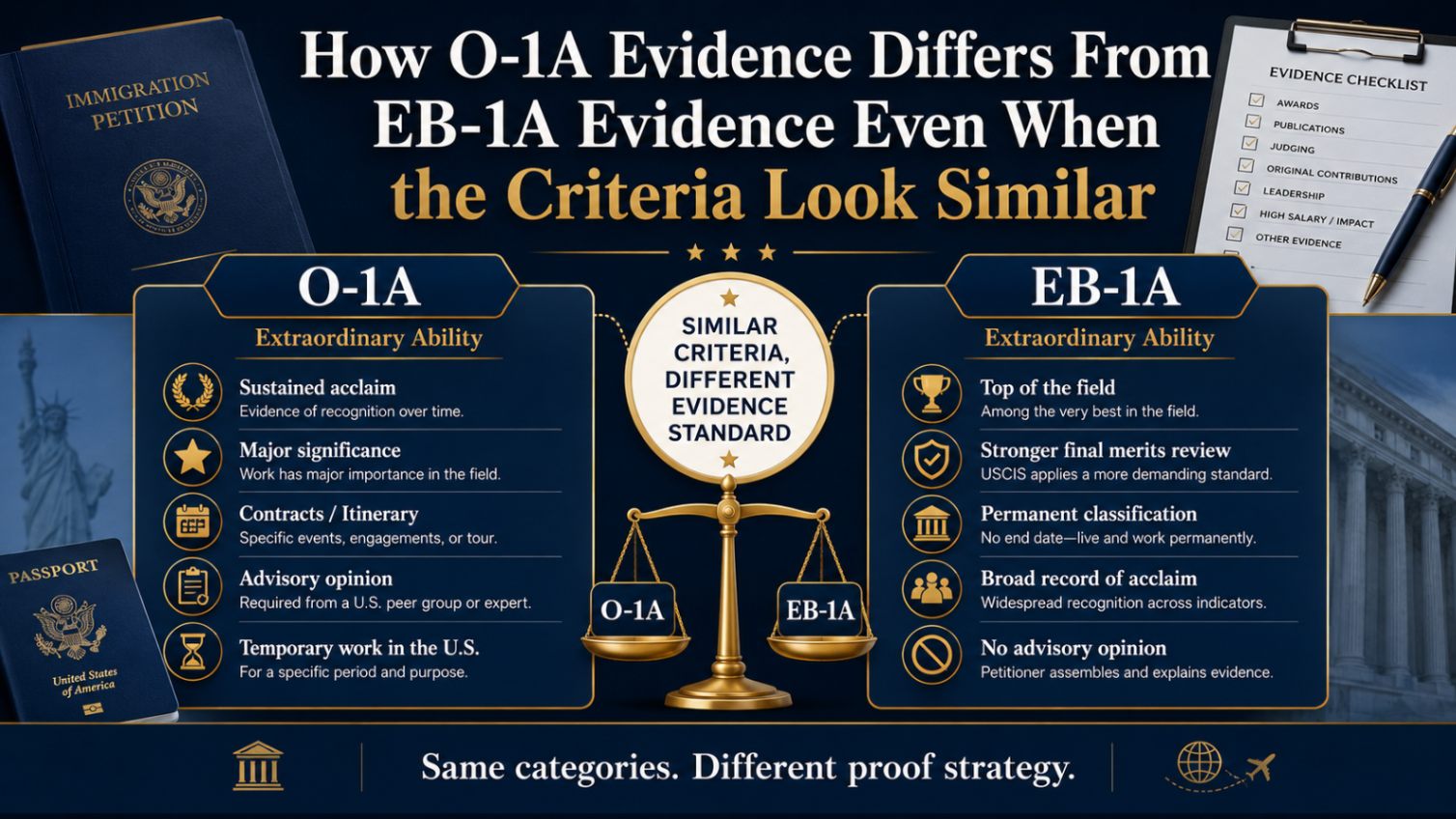
An O-1A approval is not a preview of EB-1A success. The criteria read similarly — both require extraordinary ability, both use a nearly identical list of evidentiary categories — but the adjudicative standard applied to those criteria is materially different. USCIS has said as much explicitly: an O-1A approval does not bind an EB-1A adjudicator, and officers are instructed to evaluate the EB-1A petition independently.
The gap shows up most clearly at the Final Merits Determination. For O-1A petitions, clearing three criteria typically produces an approval. For EB-1A petitions, clearing three criteria advances the case to a second-stage review where the officer evaluates whether the totality of the evidence demonstrates someone at the very top of their field — not just a highly accomplished professional. Many applicants who held O-1A status comfortably find that the evidence that supported the temporary visa does the same job less effectively when permanence is at stake.
Why the Same Criteria Produce Different Outcomes
The statutory language for O-1A and EB-1A is nearly identical: both require showing the applicant is "one of the small percentage who have risen to the very top of the field of endeavor." The difference is in how USCIS applies that language in practice.
O-1A adjudication is tied to a specific employment context — a defined role, a defined employer, a defined period. The evidence is evaluated against the question of whether this person is qualified to do this specific work at this level. EB-1A adjudication removes those anchors. The question becomes whether the person's career record, taken as a whole, establishes sustained national or international acclaim. "Sustained" is the operative word. A strong recent year justifies an O-1A. A sustained trajectory of achievement at the top of the field is what justifies permanent residence in the first category.
| Criterion | O-1A Evidence Level | EB-1A Evidence Level |
|---|---|---|
| Judging | Invitation and completion record for peer review or panel participation | Consistent multi-year record at prestigious venues; documentation of selection criteria showing the applicant was recruited for their expertise |
| Scholarly Articles | Publication in peer-reviewed journals relevant to the field | Independent citation rate above sub-field average; evidence the work changed field-wide practices |
| Critical Role | Lead or important role on a specific project or within a specific employer | Role shown to be essential to the organization's overall reputation or success; C-suite documentation with named outcomes |
| High Salary | Compensation above the average for the role and metro market | Compensation in the top 1–5% nationally for the occupation, benchmarked against independent labor data |
| Original Contributions | Original work demonstrating professional competence and usefulness | Work that has been independently implemented or cited; adoption by parties outside the applicant's employer |
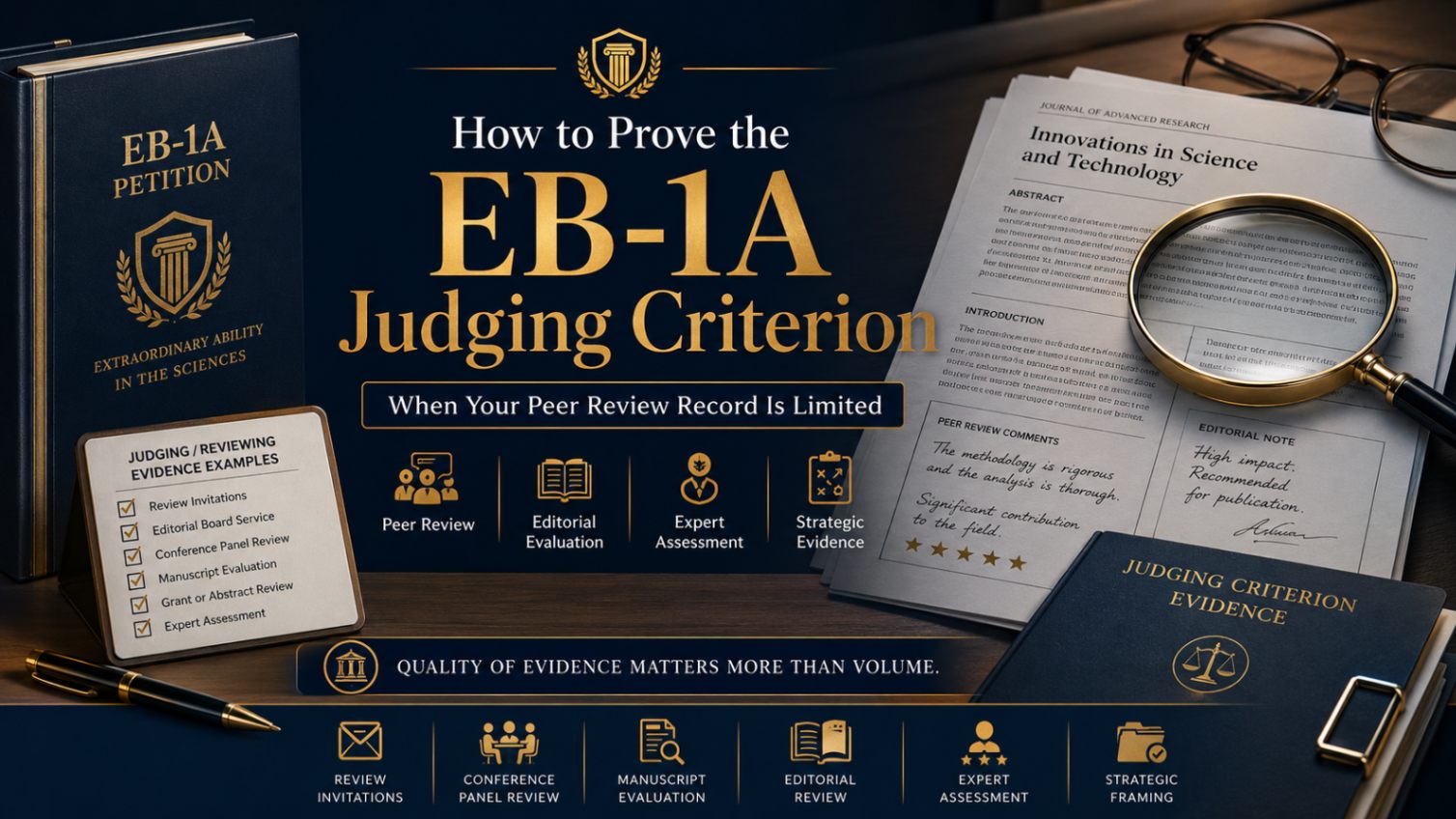
Judging the Work of Others
For O-1A purposes, a documented record of peer review — invitation emails, acknowledgment letters, completed review logs — is generally sufficient to satisfy the criterion. The officer is verifying that the activity occurred, not interrogating why the applicant was selected.
For EB-1A, the selection basis matters as much as the activity itself. An officer reviewing a peer review record at the Final Merits stage is asking: was this person invited because the journal's editors determined they were among the most qualified reviewers in this specialty, or because the journal needed any qualified volunteer and the applicant signed up? The answer to that question determines whether the peer review record supports a claim of extraordinary ability or merely confirms the applicant's professional credentials.
Bridging this gap requires documentation the O-1A petition typically doesn't include: the journal's reviewer selection criteria, an editor's letter explaining that the applicant was specifically recruited based on published expertise, and a record of reviewing that spans multiple years rather than clustering in a pre-filing window. For high-prestige venues — journals with impact factors above 8, top conference program committees with single-digit acceptance rates — the selection itself is the evidence. For mid-tier venues, the selection rationale must be supplied explicitly.
Scholarly Articles and Citation Context
Publication in a peer-reviewed journal satisfies the scholarly articles criterion at stage one for both O-1A and EB-1A. The divergence happens at stage two.
For O-1A, publishing in recognized journals demonstrates professional competence at a high level. For EB-1A, the Final Merits officer asks what happened after publication: did the field engage with the work? The citation record answers that question — but only when presented with context that makes the numbers meaningful to a non-specialist adjudicator.
Independent citations from researchers at unconnected institutions matter more than total citation count. Clarivate's Essential Science Indicators and Scopus's Field-Weighted Citation Impact (FWCI) provide sub-field percentile rankings that translate citation numbers into a benchmark the officer can evaluate without subject matter expertise. An FWCI of 2.0 means the work is cited at twice the world average for comparable papers in the same field and year — a statement that doesn't require the officer to know anything about the field's citation culture to interpret.
The citation trajectory matters too. An O-1A petition can be supported by publications whose citation records are still developing. An EB-1A petition benefits from papers with multi-year citation histories showing the field has continued to engage with the work — not just an initial burst of attention that didn't sustain.
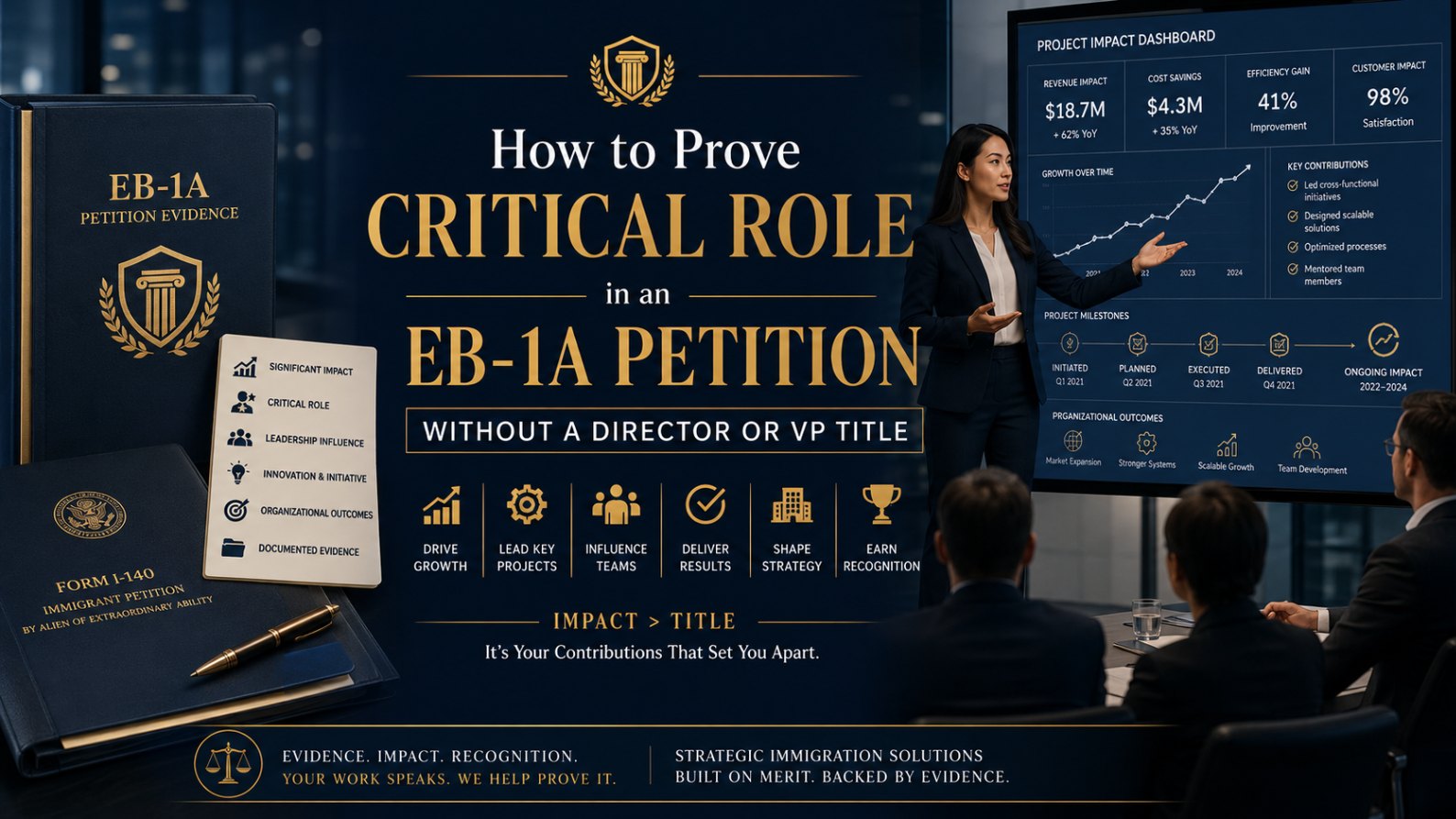
Critical Role Evidence
O-1A critical role evidence centers on the employer's own assessment of the applicant's importance to a specific project or initiative. The officer is evaluating whether the role is genuinely lead or critical within the organizational context of the petitioner. An employment letter from the VP of Engineering describing the applicant's technical leadership on a specific product is the standard form of this evidence for O-1A purposes.
For EB-1A, the frame expands significantly. The question is whether the applicant's role was critical to the organization itself — to its reputation, its direction, its commercial success — not just to a specific project within it. The evidence needs to come from the most senior level of the organization, describe specific decisions the applicant made and named outcomes those decisions produced, and connect those outcomes to the organization's standing in the field.
An organizational chart showing reporting structure and a CEO letter that says "the applicant led Product X, which generated $Y in revenue and was cited as the primary driver of our Series C close" is the type of evidence that works at EB-1A stage two. A VP letter that says "the applicant was an outstanding contributor to our engineering team" is O-1A evidence applied to an EB-1A standard — and it won't survive the Final Merits review.
High Salary: Local Market vs. National Standard
O-1A salary comparisons are typically made against the local or regional market — OES data from the Bureau of Labor Statistics for the specific metropolitan statistical area, or O*NET wage data for the occupation code and location. Showing that compensation is above the local market average for the role is generally sufficient to clear the criterion at the O-1A level.
EB-1A salary evidence requires a national comparison. The standard is compensation significantly higher than others in the field — nationally, not locally. A software engineer in San Francisco earning $350,000 may be at or near the local market rate for senior positions at major technology companies. Against a national distribution for the same occupation code, that figure looks different. Both calculations need to be made, and the national comparison needs to demonstrate top-tier status, not just above-average standing.
Private compensation surveys — Radford, Mercer, Levels.fyi for technology roles — provide national distribution data that BLS occupational surveys don't always capture at the granularity EB-1A petitions need. Equity holdings require independent valuation documentation. Total compensation, not base salary alone, is the figure that should be benchmarked, with clear documentation of each component.
The Final Merits Determination: Where O-1A Holders Frequently Stall
Under Kazarian v. USCIS, 596 F.3d 1115 (9th Cir. 2010), EB-1A adjudication involves a two-stage process. Stage one is the technical criteria check. Stage two — the Final Merits Determination — evaluates whether the totality of the evidence demonstrates someone at the very top of their field.
For O-1A petitions, meeting three criteria is close to the finish line. For EB-1A petitions, it's the starting point for the harder analysis. Officers reviewing EB-1A cases at stage two will regularly acknowledge that the criteria are technically satisfied and then find that the evidence, taken together, describes a highly competent professional — not someone at the top of the field in the sense the EB-1A standard requires. The denial language often reads: "While the petitioner has demonstrated scholarly publications, peer review activity, and high compensation, these activities are standard for professionals at this career level and do not establish that the petitioner is among the small percentage at the very top of the field."
This is where the reframing work happens. Evidence that establishes criterion satisfaction at stage one needs to be presented, in the cover letter and supporting documentation, in terms of what it demonstrates about the applicant's standing relative to peers. Not "the applicant has published in Journal X" — but "the applicant's work in Journal X has been cited by researchers at 14 independent institutions across 9 countries and has been described in two subsequent review articles as the current standard methodology for this class of problems." The criterion is the same. The argument being made is entirely different.
Sustained Acclaim and the Prospective Benefit Requirement
O-1A is tied to a defined employment period. Sustained acclaim in the EB-1A sense — a career trajectory that shows the applicant has been at or near the top of their field over a meaningful span — is not required for the temporary visa. A strong recent period can justify an O-1A. The EB-1A requires a longitudinal record.
For self-petitioned EB-1A cases — which don't require an employer sponsor — there is an additional showing: that the applicant will continue to work in their area of expertise and that this work will substantially benefit the United States prospectively. An O-1A petition, anchored to a job offer, handles this implicitly. An EB-1A self-petition requires addressing it explicitly: a personal statement describing the planned work, the field context that makes that work significant to the United States, and the applicant's track record of producing outcomes at the level the petition claims.
Transitioning an O-1A Record into EB-1A Evidence
The practical implication of everything above is that an O-1A petition should not be submitted as an EB-1A petition with a different cover page. Each piece of evidence needs to be reframed for the higher standard, and in many cases the underlying evidence itself needs to be supplemented or replaced.
Expert letters drafted for an O-1A focus on the applicant's qualifications for a specific role. EB-1A letters must shift to the applicant's impact on the field — written by independent experts who can describe specific ways the applicant's work affected their own research or practice, with language that reflects independent assessment rather than professional endorsement.
Citation data that was presented as a count should be presented as a contextualized percentile analysis. Salary evidence benchmarked against the local market should be re-run against national distribution data. Peer review history that demonstrates activity should be supplemented with documentation of the selection rationale — why this applicant was asked, not just that they were.
The same experts who wrote O-1A letters can write EB-1A letters. But the letters need to answer a different question: not whether this person is extraordinarily qualified for this role, but whether this person's career has placed them among the small percentage at the top of their field, and what specific evidence from that career demonstrates it.
Frequently Asked Questions
Does an O-1A approval guarantee EB-1A approval? No. USCIS officers adjudicating EB-1A petitions are not bound by prior O-1A approvals, and the policy manual explicitly states that each petition is evaluated on its own merits. The higher evidentiary bar at the Final Merits Determination stage means that evidence sufficient for O-1A approval regularly falls short of EB-1A approval.
Can the same recommendation letters be used for both petitions? The same experts can be used, but the letters should not be resubmitted unchanged. O-1A letters are typically framed around the applicant's fitness for a specific role in a defined period. EB-1A letters need to demonstrate that the applicant's career record places them at the top of their field — with specific examples of impact on the broader professional community, not just on the petitioning employer.
Why was an EB-1A denied after O-1A approval? The most consistent reason is the Final Merits Determination. The officer concedes that criteria are technically met but concludes that the evidence, taken together, reflects high professional competence rather than extraordinary ability. This happens when evidence is presented to satisfy criteria rather than to build a narrative about field-wide standing — a distinction that matters less at the O-1A stage and considerably more at the EB-1A stage.
Do citation counts matter more for EB-1A? Not just the count — the independence and context of the citations. O-1A adjudicators are primarily evaluating whether the applicant is a credentialed professional working at an advanced level. EB-1A adjudicators at stage two are evaluating whether the field has recognized the applicant's work as significant. An independent, international citation record with substantive engagement — other researchers building on the work, not just listing it in a bibliography — is what addresses that question.
A VangaVault profile assessment identifies which criteria in the current record are EB-1A ready at stage two and which require stronger impact documentation, and delivers a written gap analysis within 48 hours. Start your assessment here.
Get Immigration Insights Delivered to Your Inbox
Practical guidance on EB-1A, EB-2 NIW, O-1A, and U.S. immigration — no spam, unsubscribe anytime.