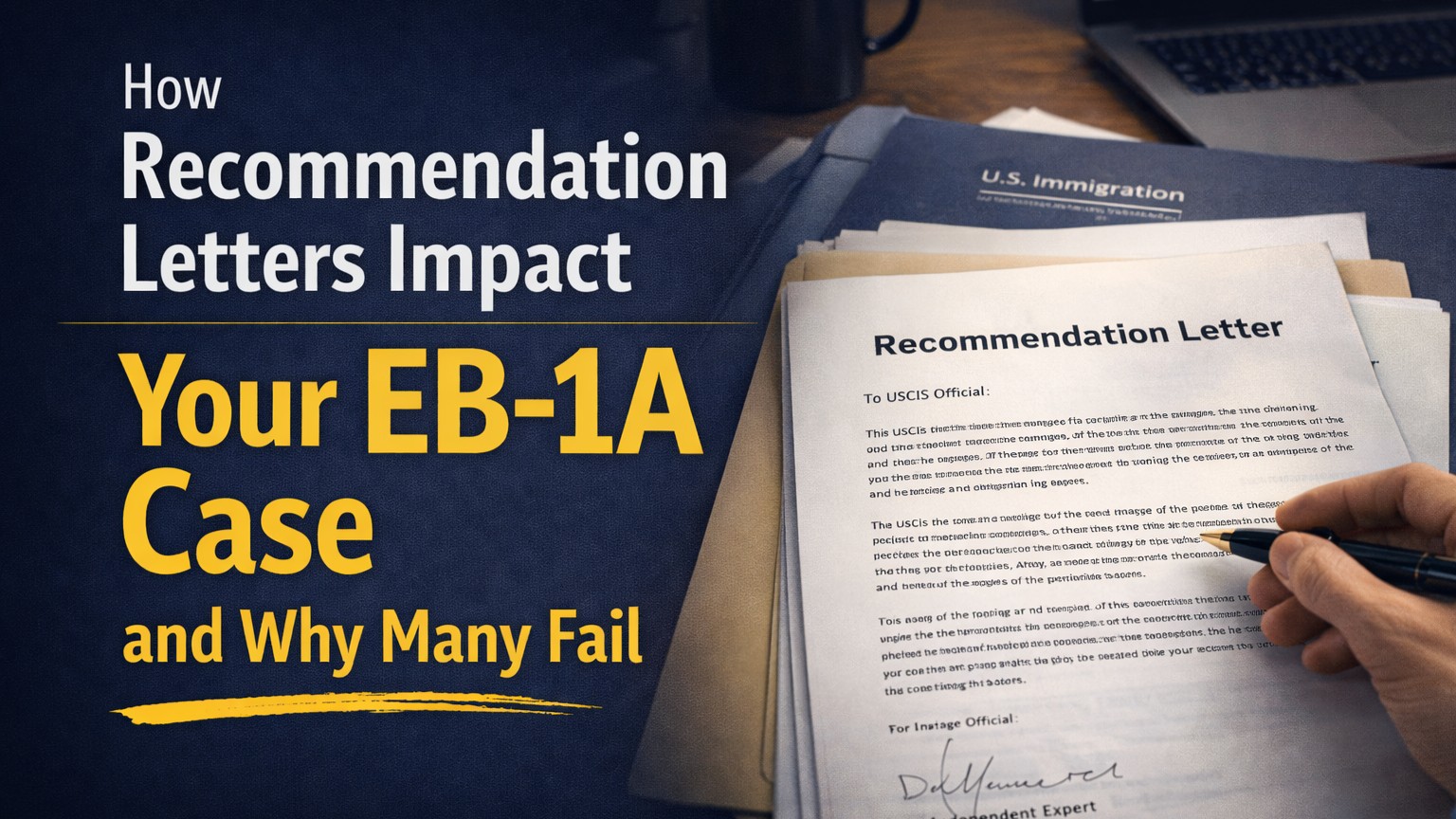
A recommendation letter is not a replacement for hard evidence, but it provides the context USCIS needs. Learn how to select independent experts and avoid the common traps that trigger an RFE.
How Recommendation Letters Impact Your EB-1A Case and Why Many Fail
Recommendation letters are the most misunderstood component of an EB-1A petition. Applicants either treat them as the centerpiece of the case — as if a glowing endorsement from a respected professor substitutes for documented evidence — or they treat them as an afterthought, collecting signatures on boilerplate text that could apply to anyone. Both approaches produce the same result: an RFE that questions whether the applicant actually has the standing they claim.
The letters serve a specific function. Primary documentation — patents, citation records, salary data, organizational charts — establishes what happened. Letters from qualified experts establish why it matters. That distinction shapes everything about how they should be selected, drafted, and positioned within the petition.
Why Letters Are Secondary Evidence, Not Primary Proof
USCIS is explicit on this point: recommendation letters alone cannot establish eligibility. The evidence comes first. The letter explains it.
If an applicant claims authorship of influential scholarly work, the evidence is the publication record and the citation count. A colleague's letter saying the research was groundbreaking doesn't make it groundbreaking — the 340 citations in peer-reviewed journals do. What the letter can do is explain, from an expert's perspective, that those 340 citations represent a fundamental shift in how the field approaches a specific problem, and that researchers at competing institutions have restructured their methodologies around the applicant's findings.
This distinction matters most for the original contributions criterion, which is where the letter's role is most critical and most frequently misunderstood. A granted patent is a legal document. It proves novelty — nothing more. What satisfies the "major significance" requirement is a letter from an independent CEO or CTO explaining that the patented process was licensed and implemented, that it reduced their operational costs by a specific percentage, and that it has since been adopted as standard practice across their segment of the industry. Without that external validation, the patent sits in the petition as evidence of paperwork, not impact.
Why Independent Recommenders Carry Disproportionate Weight
USCIS draws a clear line between dependent and independent recommenders, and adjudicators treat these two categories very differently.
Dependent recommenders — PhD advisors, direct supervisors, longtime collaborators, co-authors — know the applicant's work in detail, which makes their technical explanations useful. But their objectivity is compromised by the relationship. A supervisor has professional reasons to want their employee to remain in the country. A thesis advisor has reputational reasons to speak well of their graduate's work. Adjudicators account for this, and the weight assigned to these letters reflects it.
Independent recommenders are experts who know of the applicant's work through publications, conference presentations, or products — not through any direct professional relationship. No shared employer. No co-authored papers. No time at the same institution. When someone with no professional obligation to the applicant states that the applicant's methodology is now used in their own lab because it outperforms every available alternative, that carries a fundamentally different evidentiary weight than anything a supervisor can say.
The clearest version of an independent letter opens with something like: "I have never met or collaborated with this researcher. I became aware of their work through their 2021 paper on CRISPR delivery mechanisms, which my team has cited in three subsequent publications because it solved a problem we had been working on for four years." That's the framing USCIS finds credible.
If a recommender has to explain away a prior collaboration — "while we did co-author one paper in 2019, I am writing independently here" — the letter loses its independent status. A 50/50 split between dependent and independent recommenders is a reasonable baseline. If the citation count is on the lower side, skew further toward independent sources.
The Three Ways Letters Destroy Otherwise Strong Petitions
The Template Problem
When three recommenders from three different countries use the same sentence structures, the same unusual phrasing, and the same sequence of points, adjudicators draw the obvious conclusion: the applicant wrote the letters and sent them for signature. This happens more than attorneys like to admit, and it's one of the fastest ways to collapse a petition's credibility entirely. Officers don't just discount the letters — they start questioning the rest of the file.
Each letter needs to reflect the author's voice, their specific vantage point, and their individual relationship to the applicant's work. A professor at MIT and a VP of Engineering at a manufacturing company should not sound like they used the same template. If they do, the petition has a problem.
The Specificity Gap
Vague praise is legally inert. "The applicant made significant contributions to cybersecurity" tells an adjudicator nothing they can evaluate. "The applicant identified a flaw in the X.509 certificate validation protocol that had persisted undetected for over a decade, and the patch they developed was subsequently adopted by three major certificate authorities" gives the officer something to work with. One is an opinion. The other is a verifiable claim that can be cross-referenced against the exhibits.
Every letter should point to at least one specific event, publication, product, or outcome — something that appears in the petition's exhibit list and can be independently verified.
Circular References and Unsupported Claims
This one generates RFEs directly. An officer reads that the applicant is "widely cited across the field," pulls up the Google Scholar profile in the exhibit, and finds 14 citations. Now the letter doesn't just fail to help — it actively damages the petition by suggesting the recommender either doesn't know the applicant's record or is deliberately exaggerating it.
Every factual claim in a recommendation letter must be supported by documentary evidence elsewhere in the petition. If a letter mentions an award, the award certificate and selection criteria are in the exhibits. If it references a high salary, the compensation data is there. If it says the methodology was adopted by competitors, the licensing agreement or the industry trade coverage is attached. Letters that outrun the evidence create exactly the credibility problem they were meant to solve.
How to Select Recommenders Strategically
Four to six well-constructed letters outperform twelve repetitive ones, consistently. The selection criteria:
Independent industry leaders — CTOs, VPs, or founders at organizations that adopted or were affected by the applicant's work, with no prior professional relationship to the applicant. Their letters address commercial impact in concrete terms.
Journal editors or editorial board members — People who can speak from personal experience to the applicant's contributions to peer review and the standing of their published work within the field. An editor-in-chief explaining why they specifically seek out a reviewer — not through a mass solicitation platform but because of the reviewer's published expertise — is credible evidence for the judging criterion.
Senior academics at globally recognized institutions — Professors at research universities with international standing who know the applicant's work through citations, conference presentations, or published papers. Their letters address scholarly impact and influence on the research direction of others.
Government or agency officials — Relevant where the applicant's work has influenced public policy, received federal funding, or been referenced in regulatory guidance. Not every case has this, but where it exists, it's among the strongest evidence available.
Comparing Effective and Ineffective Letters
| Feature | Weak Letter | Strong Letter |
|---|---|---|
| Author relationship | Direct supervisor or long-term collaborator | Independent expert with no prior professional ties |
| Language | Adjectives and subjective praise | Technical, comparative, data-specific |
| Focus | Personality and work ethic | Impact of specific outputs on the field |
| Claims | "One of the best in the industry" | Explains how the field operates differently because of the applicant's work |
| Evidence alignment | References work that doesn't appear in exhibits | Directly tied to specific exhibits by name or description |
What Letters Do at the Final Merits Stage
Under the Kazarian framework, meeting three criteria is the first gate. The second — the final merits determination — is where the petition is either won or lost, and it's where letters matter most.
At this stage, the adjudicator isn't counting credentials. They're asking whether the totality of the evidence demonstrates someone who has reached the very top of their field and maintained that standing. Letters provide the connective tissue that turns a collection of exhibits into a coherent argument. They help the officer understand that 200 citations aren't just a number — they represent a methodology that peer researchers have incorporated into their own work because it solved a problem that existing approaches hadn't.
Without that narrative, an officer can look at a technically complete petition and conclude that while the applicant meets the criteria, the overall record doesn't rise to the level of extraordinary ability. The letters bridge that gap, but only when they're written by the right people, about the right things, in specific and verifiable terms.
Two points on letter construction that matter at this stage:
Don't use legal language. Asking a scientist or engineer to write that the applicant demonstrates "extraordinary ability" or "sustained national acclaim" is counterproductive. It sounds coached. Officers know what immigration attorney language looks like, and when a molecular biologist uses it, the letter loses authenticity. The recommender's job is to speak as a domain expert. The legal arguments belong in the attorney's cover letter.
Establish the author's authority upfront. A recommendation letter is only as credible as the person signing it. The first two paragraphs need to establish who the author is, why their opinion on this subject carries weight, and what their own record of achievement looks like. If an officer has to independently search for the recommender to determine whether their endorsement means anything, the letter has already underperformed. Include a short CV or bio for each recommender as a separate exhibit.
Keep letters current. A letter drafted three years ago for a different purpose doesn't demonstrate sustained acclaim — it demonstrates that someone once had a positive opinion of the applicant. All letters should be dated within six months of the filing date, written specifically for this petition, and reflect the applicant's standing as of now, not as of a prior position or project.
Frequently Asked Questions
How many recommendation letters does an EB-1A petition require?
There's no statutory minimum, but most approved petitions include four to seven. More than that tends to produce redundancy and gives the adjudicator less reason to read carefully. The goal is letters that each address a distinct aspect of the applicant's influence — one covering original contributions, one covering peer review standing, one covering commercial impact — not a stack of letters that restate the same general praise from different email addresses.
Can a PhD advisor write a recommendation letter for an EB-1A?
Yes, and their technical knowledge of early research and original contributions can be genuinely useful. But the letter is classified as dependent, and it carries the credibility limitations that come with that. It should be paired with independent letters from experts who have no supervisory or collaborative history with the applicant. Relying primarily on the thesis advisor's letter to establish impact is a structural weakness in the petition.
Do letters need to come from U.S.-based experts?
No, and they shouldn't all come from the U.S. The "national or international acclaim" standard is easier to demonstrate when recommenders are distributed across multiple countries where the applicant's work has been recognized or adopted. A petition where every letter comes from colleagues in the same country makes it harder to argue for the international dimension of the applicant's influence.
What if the recommender isn't widely known outside their field?
Name recognition is less important than the specificity and credibility of what they write. A highly cited researcher in a narrow specialty — someone whose opinion on that specialty's leading contributors carries genuine weight within that community — can write a more convincing letter than a famous generalist who doesn't know the applicant's work in detail. The author's CV establishes their authority. Their letter demonstrates how they know the applicant's work and why, from their expert position, it matters.
Moving Forward
The most productive first step is an honest assessment of the existing professional record — not against a generic checklist, but against how USCIS has actually adjudicated similar cases. A VangaVault profile assessment identifies which criteria are currently supportable with strong evidence, where the gaps are, and what type of recommender is needed to address each one. A written feasibility analysis and timeline estimate are delivered within 48 hours. Schedule a consultation to get that assessment started.
Get Immigration Insights Delivered to Your Inbox
Practical guidance on EB-1A, EB-2 NIW, O-1A, and U.S. immigration — no spam, unsubscribe anytime.