Understand the specific mistakes that trigger an RFE or denial in EB-1A petitions. We break down how USCIS evaluates evidence and what adjudicators actually look for.
The Most Common Reasons EB-1A Petitions Receive RFEs or Denials
The petitions that fail aren't usually missing documents. They're missing credibility. USCIS adjudicators reviewing EB-1A cases aren't counting achievements — they're asking whether those achievements would exist if the applicant weren't applying for a visa. When the answer looks like "probably not," the Request for Evidence follows quickly.
The pattern shows up in case after case: an applicant with a genuinely strong career decides to pad the petition with rushed peer reviews, paid press placements, and recommendation letters that read like they were written from the same template. Each of those additions doesn't just fail on its own — it quietly undermines the legitimate evidence around it, and suddenly a petition that should have been approved is defending itself against an RFE that questions the entire record.
The Core Problem Driving an RFE or Denial
USCIS uses what's called the Kazarian framework to evaluate EB-1A petitions. Step one: does the applicant meet at least three of the ten regulatory criteria? Step two: does the full body of evidence — taken together — demonstrate that this person has risen to the very top of their field?
A lot of petitions clear step one and collapse at step two. The reason is almost always the same. The evidence is technically present but lacks genuine prestige. Three peer reviews don't mean the same thing as three years of consistent reviewing for a top-tier journal. A media feature doesn't mean the same thing whether it ran in MIT Technology Review or a website that charges placement fees.
Adjudicators learn to spot the timing tells. Forty peer reviews completed in a sixty-day window directly before filing is not what a recognized expert's review history looks like — it's what a petition-building sprint looks like. Officers are trained to recognize this, and when they see it, everything else in the file starts getting scrutinized differently.
What USCIS Actually Evaluates Across Each Criterion
Awards and prizes. The officer doesn't just confirm that an award exists. They look at the criteria used to select recipients, the reputation of the judging body, and whether the award carries recognition outside the applicant's immediate employer or university. Student awards don't qualify. Neither do internal company recognitions, or awards anyone can receive by paying a nomination fee and submitting an application.
Association memberships. This criterion trips up a large number of petitioners. Joining IEEE or a professional society by paying annual dues and holding a relevant degree does not satisfy it. The standard requires that recognized experts evaluate candidates before admission, and the association's own bylaws must reflect that. If membership is essentially open enrollment with a credential checkbox, USCIS won't count it.
Published material about the applicant. The article has to be primarily about the applicant and their specific work — not their employer, not a team project they happened to be part of. Officers verify publications using third-party traffic and circulation data. Cision and SimilarWeb are common tools. If the platform has no verifiable readership, no independent editorial guidelines, or if the content reads like a press release, the criterion fails. The applicant's name in a headline isn't enough.
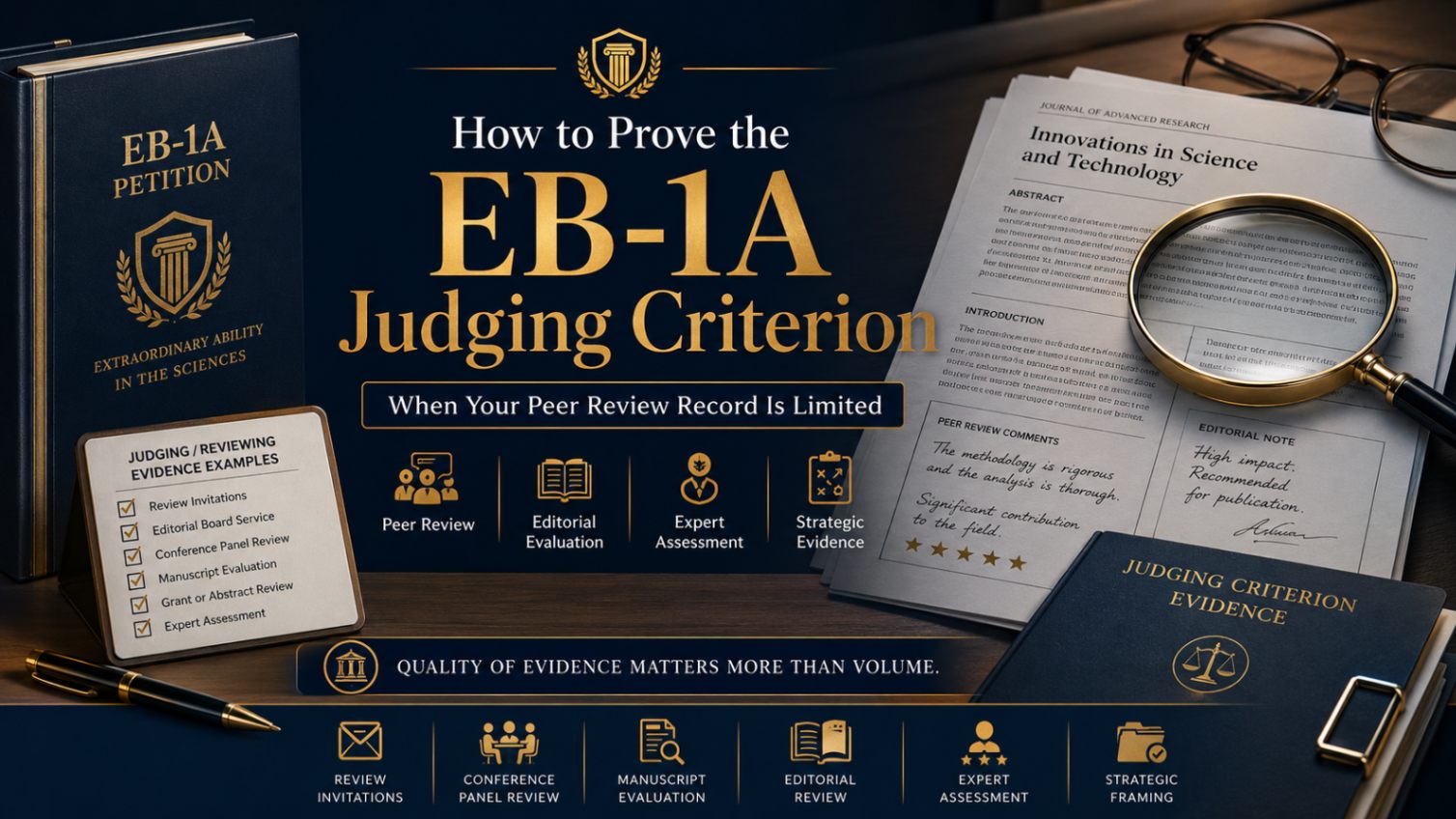
Judging the work of others. Volume matters less than selection. A formal editorial board appointment at a journal with an impact factor above 5, held for several years with a consistent reviewing record, is strong evidence. Fifty reviews for predatory open-access journals completed over two months is not. Officers look at the prestige of the venue, how the applicant was selected, and whether the engagement looks sustained or manufactured.
Original contributions of major significance. This is the criterion USCIS scrutinizes hardest, and it's where the most petitions fall short. The word "major" is doing real work in that phrase. Filing three patents before submitting is paperwork, not impact. What satisfies this criterion is proof that the broader industry took notice: licensing agreements with independent companies, citation records showing other researchers built on the work, clinical guidelines that shifted because of a published study, a methodology that competitors implemented. The letters supporting this criterion need to come from people who have no professional obligation to praise the applicant — and they need to describe specific, documented adoption, not general admiration.
Scholarly authorship. Google Scholar citation counts are one of the first things officers check. A paper published four months before filing with zero citations doesn't demonstrate that the field considers the work influential. Publication history matters too. An applicant claiming extraordinary ability in a field where their first paper appeared in the year they filed has a credibility problem that the petition itself can't solve.
Leading or critical role. Job titles don't satisfy this. An organizational chart showing where the applicant sits, combined with a letter from a C-suite executive describing specific decisions they made and measurable outcomes those decisions produced, is the standard. Revenue growth numbers, product launch metrics, a funding round the investor explicitly credited to the applicant's work — those carry weight. A human resources verification letter listing job duties does not.
High salary. Compensation needs to be benchmarked against independently sourced labor data — Bureau of Labor Statistics, relevant salary surveys — for the specific job title and geographic market. Equity holdings require independent financial documentation showing actual value. The applicant's pay stub alone isn't enough.
What Authentic Evidence Actually Looks Like
The distinction between strong and weak evidence isn't subtle once you've seen both.
For peer reviewing, strong evidence is a five-year record of reviewing for journals where the editor-in-chief explains — in a letter — that they specifically sought out this applicant because of published research that other specialists in the field cite regularly. Weak evidence is an account on Publons created eight months before filing, with reviews clustered in a single window, for journals with impact factors under 1.5 that accept review volunteers through mass emails.
For original contributions, strong evidence includes a patent licensing agreement with two Fortune 500 companies, accompanied by a letter from one company's VP of Engineering explaining that the patented process reduced manufacturing costs by a specific percentage and has since become standard practice across the industry. Fourteen subsequent patent applications from competitors citing the original work confirms that the field engaged with it. Weak evidence is a former manager's letter saying the applicant wrote highly complex internal code, with nothing external to show the broader industry noticed.
For published material, strong evidence is an independently reported feature in a recognized trade publication — the journalist found the applicant through their publicly available work and reached out, the article includes quotes from competitors or peers, and the publication has verifiable circulation data. Weak evidence is a 400-word profile in an online outlet with no subscription base, no editorial staff listed on the About page, and language that matches the applicant's LinkedIn bio almost word for word.
For leading or critical roles, strong evidence is a CEO letter specifying that the applicant's product roadmap decisions directly drove the growth metrics that justified a Series C funding round — with the investor deck included and the relevant sections highlighted. Weak evidence is a generic employment letter confirming title, start date, and a list of job responsibilities that could apply to anyone at that level.
EB-1A vs. EB-2 NIW vs. O-1A — Choosing the Right Path
Filing the wrong petition type is one of the more avoidable causes of denial. The three main high-skilled pathways have genuinely different standards, timelines, and use cases.
| Visa | Eligibility Standard | Key Evidence Types | Processing | Best Fit |
|---|---|---|---|---|
| EB-1A | Top small percentage of the field globally | Prestigious awards, independent media coverage, original contributions with documented industry adoption | 15 business days with Premium Processing | Established experts with verifiable, independently documented acclaim |
| EB-2 NIW | Advanced degree or exceptional ability, plus national interest showing | Business plan, proof of national benefit, track record of past success in the relevant area | Varies by visa bulletin; Premium Processing available (45 business days) | Professionals whose specific work serves a U.S. national interest that would be harmed by requiring a job offer |
| O-1A | Extraordinary ability in sciences, education, business, or athletics | Similar evidentiary criteria to EB-1A, slightly lower scrutiny in practice | 15 business days with Premium Processing | Experts who need U.S. work authorization quickly and have an employer or agent sponsor |
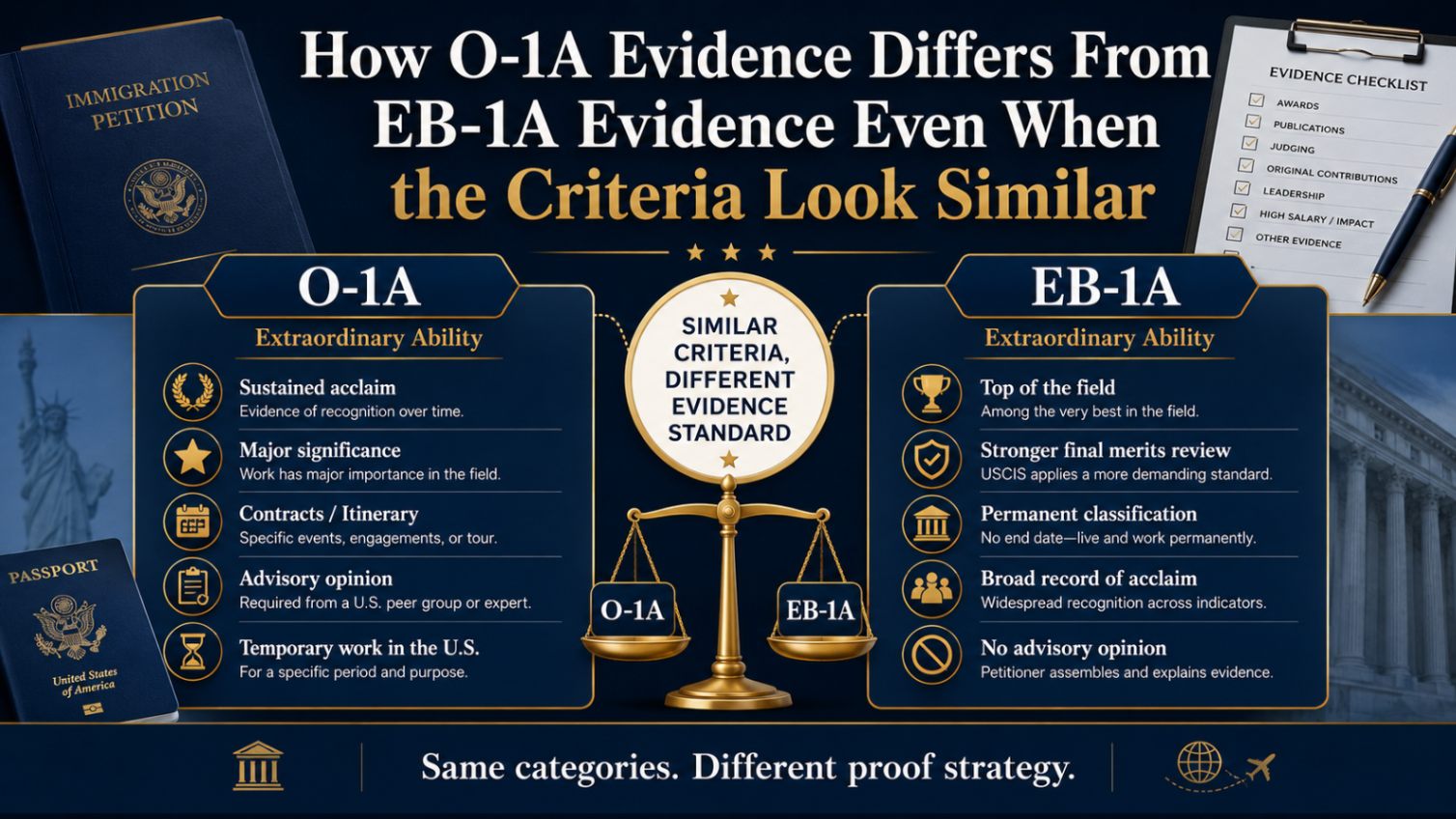
The practical difference between EB-1A and O-1A is permanence and sponsorship. O-1A requires a petitioning employer or agent and grants temporary status. EB-1A allows self-petitioning and leads to a green card. Applicants who aren't yet at the EB-1A evidentiary threshold sometimes use an O-1A to work in the U.S. while building the record they'll eventually need for the permanent visa.
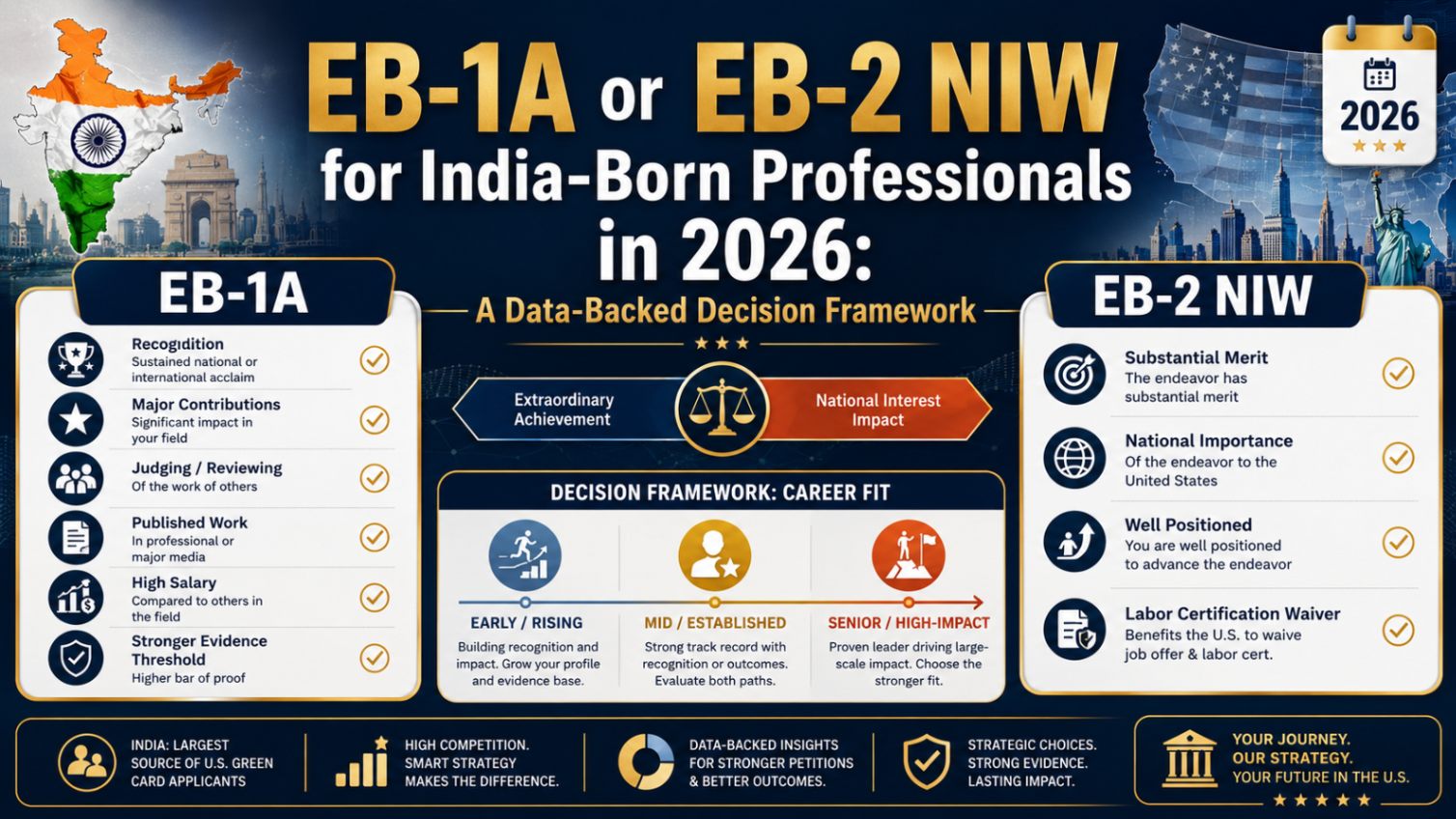
EB-2 NIW is worth serious consideration for professionals whose work benefits the public but who lack the kind of widespread external recognition EB-1A requires. Early-stage founders, specialized researchers, and engineers working on problems with demonstrable national importance have filed successful NIW petitions without the high-profile credentials that EB-1A demands.
Frequently Asked Questions
Does peer reviewing count toward EB-1A? Yes, under the criterion for judging the work of others — but only when the activity reflects genuine selection by a respected institution. The journals must be recognized within the field, the applicant's involvement should show continuity over time rather than a pre-filing spike, and the impact factor of the journals matters. Officers look at how the applicant was selected: invited by the editor based on published expertise, or signed up through a mass solicitation platform.
Can patents that aren't commercialized satisfy the original contributions criterion? Filing a patent proves an idea was novel enough for the USPTO to grant protection. It doesn't prove the field cares about the idea. USCIS has been consistent on this point: the criterion requires evidence that the contribution has actually influenced the field — through licensing, industry adoption, citations in subsequent patent applications, or documented implementation by independent entities. Provisional filings made weeks before the petition submission date, with nothing showing anyone plans to use the invention, won't satisfy it.
What's the difference between EB-1A and O-1A? Both require extraordinary ability, but the similarity ends there. O-1A is a nonimmigrant visa — it grants work authorization temporarily and requires a sponsoring employer or authorized agent. EB-1A is a permanent immigrant classification that allows self-petitioning and results in a green card. Adjudicators apply stricter scrutiny to EB-1A because the stakes are different. An O-1A approval doesn't predict EB-1A approval.
How many criteria are required for EB-1A? A minimum of three out of ten, or evidence of a single major internationally recognized award — a Nobel Prize, Fields Medal, or equivalent. Meeting three criteria is the threshold for the first step of review, not the finish line. The final merits determination looks at the whole record and asks whether it collectively demonstrates someone at the top of their field. Technically satisfying three weak criteria rarely survives that review.
What are the most common reasons USCIS denies EB-1A petitions? Weak or purchased media placements, generic recommendation letters that describe rather than document, and rushed pre-filing credential activity top the list. Many petitions pass the initial criteria review and fail the final merits determination because the evidence, while technically responsive, doesn't hold up when scrutinized as a coherent career narrative. Officers are looking for a record that would exist whether or not the applicant needed a visa. When the evidence only makes sense as petition prep, the denial reflects that.
How to Move Forward
Before filing anything, an honest assessment of the existing record against actual adjudication trends — not a theoretical checklist — is worth more than any individual piece of evidence. The cost of an RFE isn't just the attorney fees to respond. It's months of delay, credibility damage that carries into the final merits review, and the risk of a denial that closes the EB-1A pathway temporarily.
A VangaVault profile assessment reviews the CV and any existing evidence to identify specific gaps, and delivers a written feasibility analysis with a custom timeline estimate within 48 hours. Schedule a consultation to start that evaluation.
Get Immigration Insights Delivered to Your Inbox
Practical guidance on EB-1A, EB-2 NIW, O-1A, and U.S. immigration — no spam, unsubscribe anytime.