Many applicants mistakenly believe a glowing recommendation letter can replace objective evidence. Learn how USCIS evaluates petitions and what authentic proof actually requires.
Why Recommendation Letters Cannot Save Weak EB-2 NIW and EB-1A Petitions
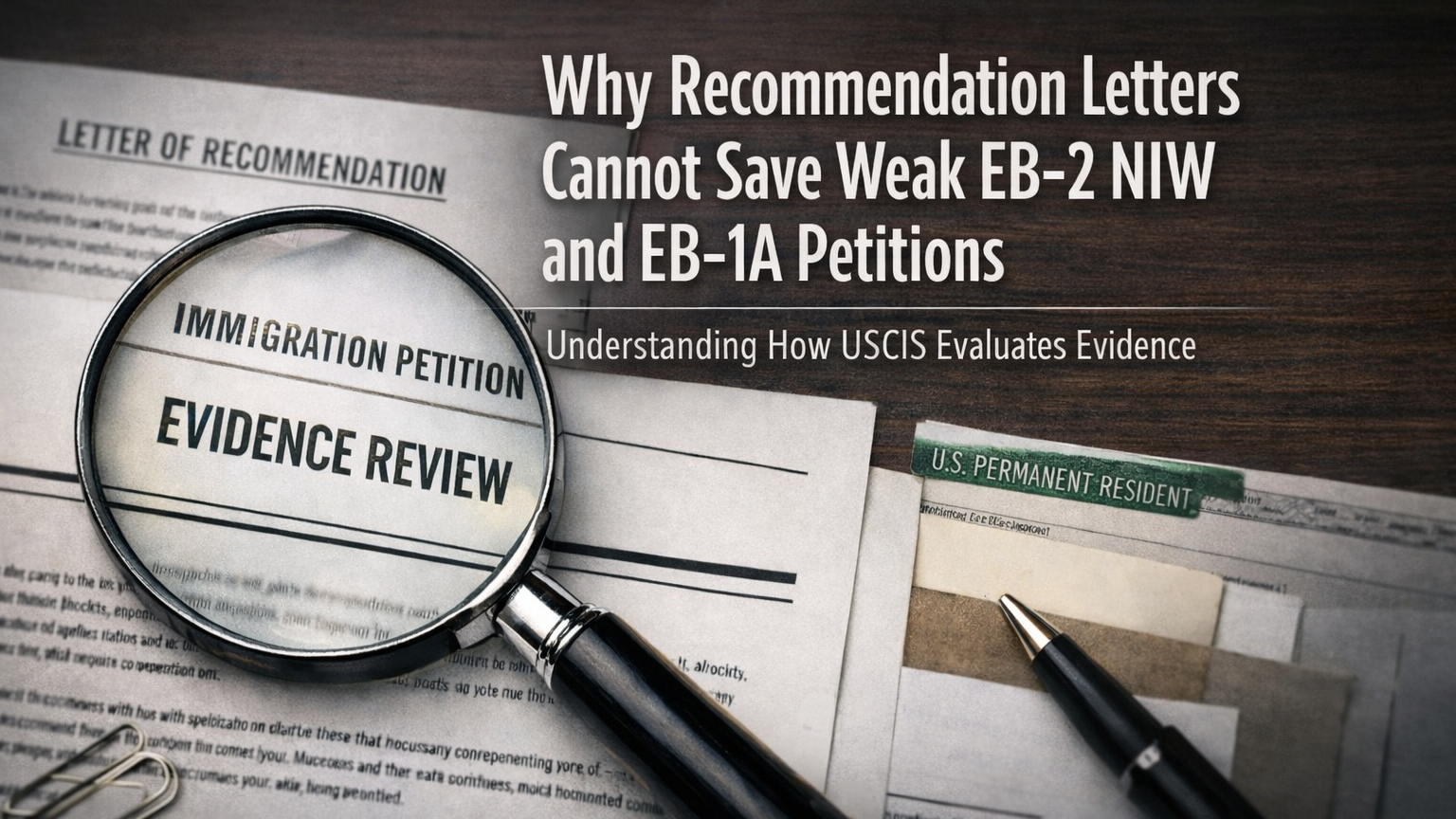
There's a specific kind of petition that arrives at USCIS looking thorough — thick with letters from accomplished professionals, each one attesting to the applicant's impact, originality, and national importance. And then it gets denied.
The reason isn't that the recommenders weren't credible or that the letters were poorly written. The reason is that letters aren't evidence of impact. They're opinions about impact. USCIS adjudicators are trained to make that distinction, and when a petition is built primarily on expert endorsements rather than documented outcomes, the RFE language is almost formulaic: the letters, while considered, do not constitute independent documentary evidence of the claimed achievements.
This matters because a lot of applicants only discover this after filing. The pattern is predictable — a gap in objective documentation gets papered over with additional letters from increasingly prominent signatories. The gap doesn't close. It just gets more expensively framed.
The Opinion-Stacking Problem
Opinion-stacking happens when an applicant lacks hard metrics — active citation counts, license agreements, deployment records, documented revenue attributable to their work — and attempts to compensate by accumulating endorsements from high-profile figures.
The underlying logic is understandable. If a senior VP at a Fortune 500 company writes that the applicant's methodology transformed their operations, surely that carries weight. It does carry some weight — as context for evidence that already exists. As a substitute for evidence that doesn't exist, it carries almost none.
When an expert writes that a software engineer's system saved a previous employer millions of dollars, USCIS expects to see the financial documentation, deployment records, or project data that would allow an officer to independently verify that claim. The expert's willingness to assert it doesn't make it documentarily proven. If the underlying records don't exist or can't be obtained, the claim doesn't survive the adjudication.
Letters function best as a navigational tool — directing the officer's attention through dense factual documentation, explaining why a specific set of records demonstrates major significance, connecting technical evidence to field-level impact in terms a non-specialist adjudicator can evaluate. When a letter is doing that work, it's genuinely useful. When a letter is introducing facts that exist nowhere else in the record, it's a liability.
What USCIS Actually Evaluates
For applicants assessing both EB-2 NIW and EB-1A eligibility — which is a common and often strategically sensible approach, since EB-1A carries no per-country visa bulletin backlog — understanding what adjudicators actually look for across each criterion clarifies why letter-heavy petitions consistently underperform.
Awards. Officers examine the judging criteria, the geographic scope of the competition, and how many people competed. Internal company recognitions don't qualify. Student travel grants don't qualify. The award needs to demonstrate that a body of recognized professionals, operating independently of the applicant's employer, evaluated a competitive field and selected this person. Media coverage announcing the recipients is standard supporting documentation.
Memberships. Annual dues and a relevant degree are not enough. The association's bylaws need to confirm that recognized experts evaluate candidates based on substantive career contributions before granting admission. Organizations where anyone with a credential and a credit card can become a member don't satisfy this criterion. IEEE Fellow status, election to the National Academy of Sciences, or equivalent bodies where nomination, peer review, and formal vote govern admission are the benchmark.
Published material. The coverage needs to be primarily about the applicant and their specific work — not their employer, not a project they were one of many contributors to. Officers verify circulation using third-party sources. A feature in a publication with no verifiable readership, no independent editorial staff, or content that reads like a press release the applicant wrote doesn't satisfy the criterion. What does: independently reported coverage in a recognized trade publication or major media outlet, where a journalist researched the story, conducted an interview, and wrote something that couldn't have been produced by the applicant.
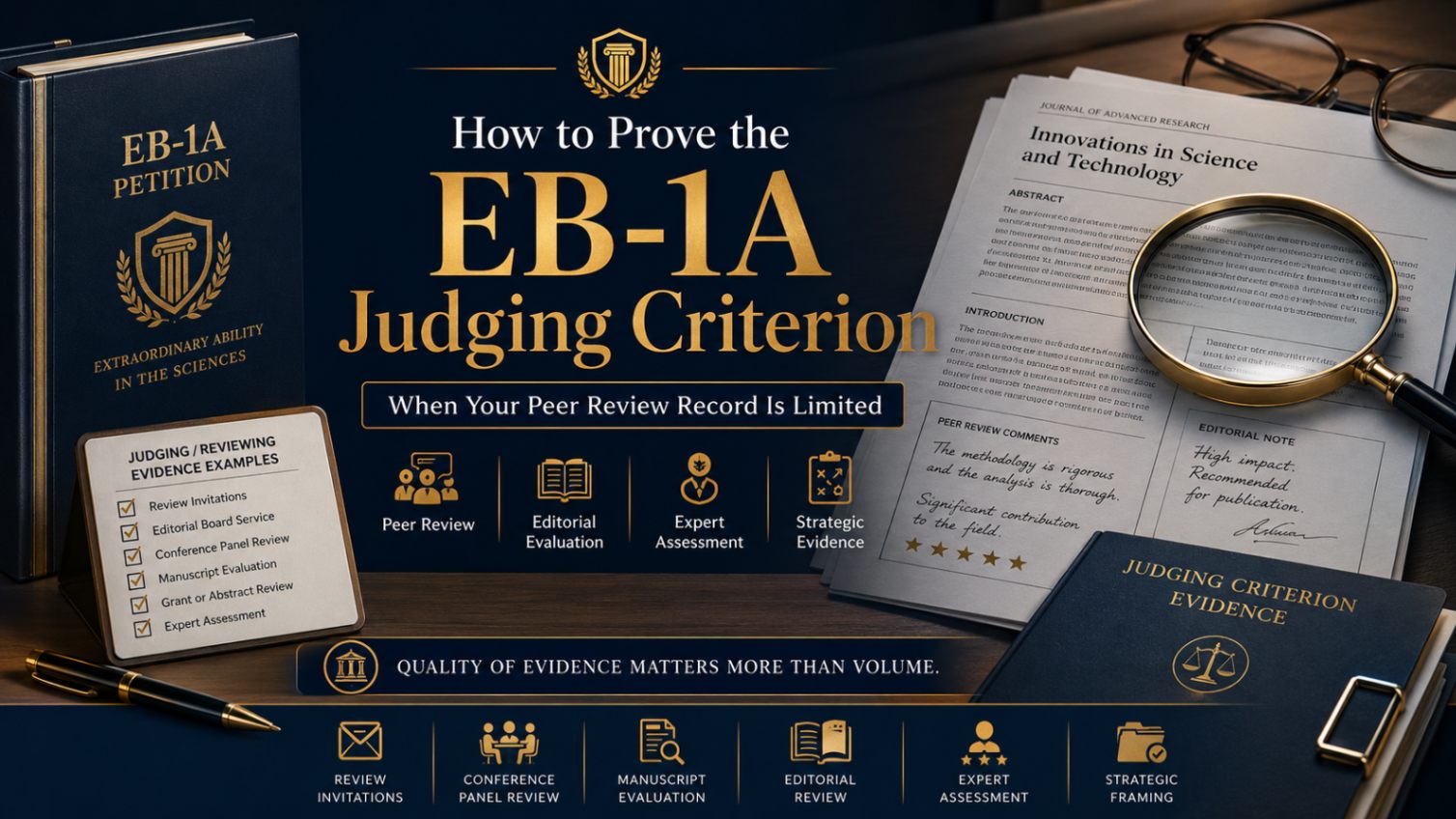
Judging. An invitation to review isn't enough. USCIS requires confirmation that the reviews were actually completed — correspondence from journal editors confirming receipt, review tracking records, or editorial letters requesting the applicant's specific expertise on technically complex submissions. The prestige of the venue matters. A record of reviewing for high-impact journals in the field over multiple years, particularly where the editorial relationship reflects genuine ongoing reliance, is what strong evidence looks like.
Original contributions. This is where the letter-versus-evidence distinction is sharpest. A former manager's letter stating that an applicant's algorithm "completely changed how we process data" describes an outcome but doesn't prove it. Strong evidence for this criterion is external and independently verifiable: GitHub repository data showing thousands of forks by unaffiliated developers, executed license agreements with independent companies, clinical guidelines or regulatory standards that adopted the applicant's methodology, or citation records showing independent researchers built directly on the work. The letters from those unaffiliated CTOs or research directors confirm and interpret what the documentary record already shows — they don't replace it.
Scholarly articles. Officers check the journal's peer-review process, impact factor, and editorial board. The applicant's authorship position matters. First-authored publications in peer-reviewed journals with consistent independent citation records are strong. Self-published content, unreviewed opinion pieces, and corporate blog posts don't qualify.
Exhibitions. This criterion applies primarily to the arts and requires proof that the venue itself is distinguished and that the exhibition was curated rather than open. Promotional materials naming the applicant as a featured creator, combined with independent documentation of the venue's reputation, are the standard. Trade show participation doesn't satisfy this criterion for most applicants.
Leading or critical role. Job title is not organizational evidence. What satisfies this criterion is a combination of structural documentation — organizational charts, cap tables where relevant — and outcome-based letters from executives that tie the applicant's specific decisions to measurable results. A twenty percent increase in annual revenue tied to a product line the applicant launched is a documentable claim. An employment verification letter describing daily responsibilities is not. The organization also needs to demonstrate a distinguished reputation independently, through media coverage or financial reporting that exists outside of materials the applicant produced.
High salary. Compensation needs to be benchmarked against objectively sourced wage data — Bureau of Labor Statistics figures, Foreign Labor Certification Data Center statistics, or reputable compensation surveys — for the applicant's specific job title and geographic market. W-2s establish what the applicant earns. External data establishes what that figure means relative to peers. Equity counts if independent financial documentation confirms its actual value.
Commercial success in the performing arts. This criterion applies narrowly: box office receipts, certified record sales, platform-verified streaming data. Business founders and engineers who attempt to use company revenue to satisfy it will face rejection. USCIS explicitly limits this criterion to the performing arts.
What Authentic Evidence Looks Like in Practice
The distinction between letter-dependent and document-supported petitions becomes concrete when specific examples are compared directly.
For original contributions, a weak petition provides a former manager's letter asserting that the applicant's machine learning model transformed the company's data processing. A strong petition provides the GitHub repository showing thousands of forks by unaffiliated developers, alongside letters from three independent CTOs at competing companies confirming they integrated the open-source model into their commercial products. The letters in the strong petition explain and contextualize something the officer can independently verify. The letter in the weak petition is the only thing establishing the claim.
For judging, a manufactured petition submits a screenshot of an email invitation to review a single conference paper. A strong petition provides a verified Web of Science researcher profile showing thirty completed reviews over two years for journals in the top quartile of the field, plus a letter from the editor-in-chief describing the criteria used to select reviewers and explaining why this applicant was specifically recruited.
For leading or critical role, a weak petition uses employment verification language confirming the applicant was "essential to the team." A strong petition includes the organizational chart showing the applicant managed fifty engineers, press coverage attributing a documented revenue increase to the specific product line they launched, and a board-level communication explicitly crediting the applicant's strategic direction.
For published material, a weak petition submits a paid press release distributed through a wire service. Officers identify and discount pay-to-play media quickly and consistently. A strong petition provides an independently reported long-form article in a major publication — with the publication's media kit confirming its circulation and editorial standards — written by a journalist who found the story through the applicant's work and interviewed independent sources.
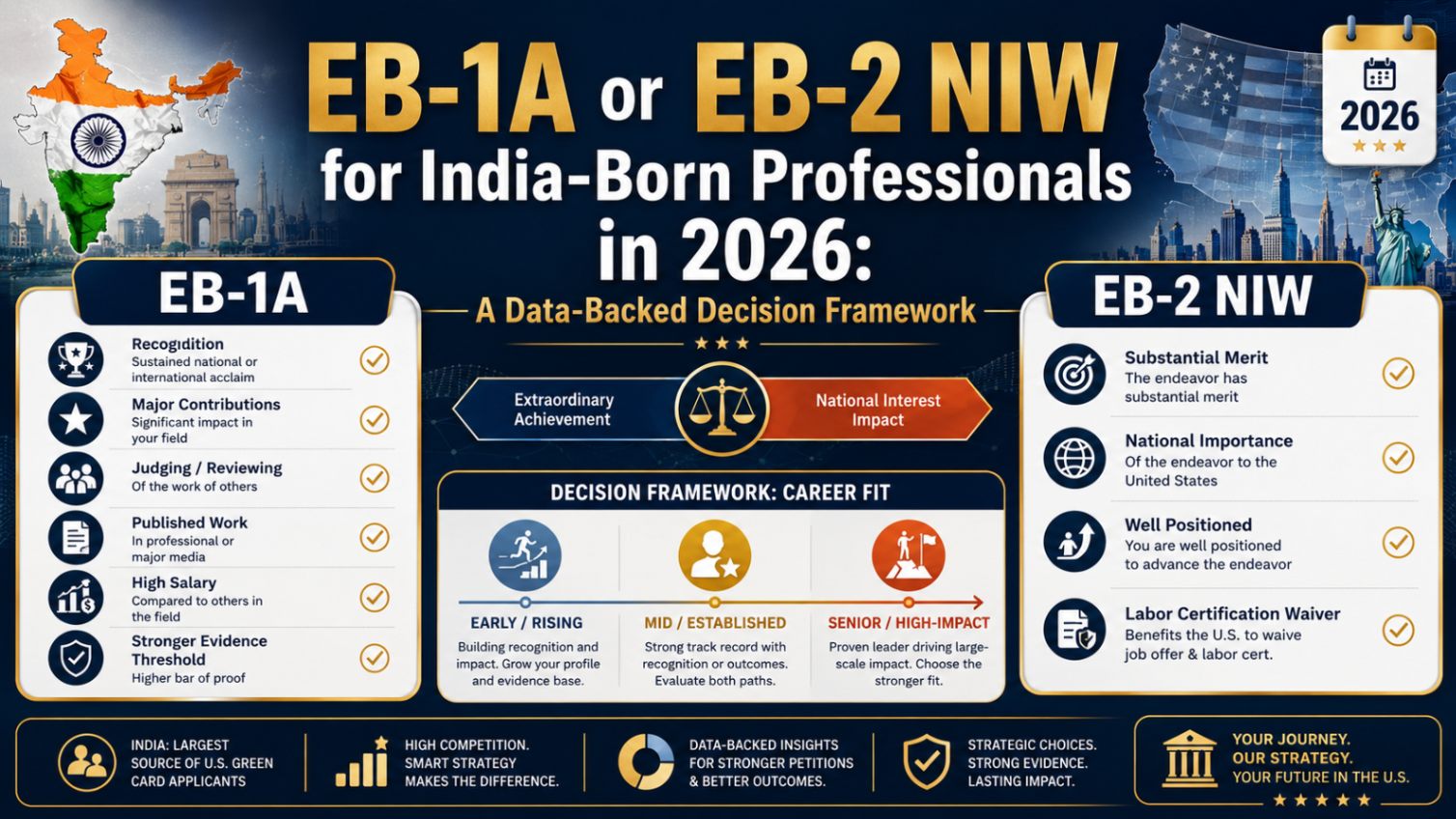
EB-1A vs. EB-2 NIW vs. O-1A — Choosing the Right Path
| Visa | Eligibility Standard | Key Evidence | Processing | Best Fit |
|---|---|---|---|---|
| EB-1A | Extraordinary ability — top fraction of the field | Major awards, independent citation record, significant original contributions with documented external adoption | 15 business days (Premium Processing) | Established experts with verifiable recognition extending well beyond their employer |
| EB-2 NIW | Advanced degree or exceptional ability, plus Dhanasar national interest showing | Project implementation records, government interest documentation, independent expert evaluations | 45 business days (Premium Processing); subject to visa bulletin | Professionals whose specific work carries documented national benefit and external adoption |
| O-1A | Extraordinary ability — nonimmigrant | Similar criteria to EB-1A, somewhat less strictly adjudicated | 15 business days (Premium Processing) | Professionals needing immediate U.S. work authorization while building toward a permanent visa |
Frequently Asked Questions
Does peer reviewing count toward EB-1A? Yes, under the judging criterion — but the evidence needs to confirm that reviews were actually completed. Invitation emails alone aren't sufficient. Officers want editorial confirmation of completed reviews, and they check the journals' impact factors and the applicant's selection process. A sustained review history for recognized journals, where the editorial relationship reflects ongoing reliance on the applicant's expertise, is substantially stronger than a volume of reviews completed in a compressed pre-filing window.
Can uncommercialized patents satisfy the original contributions criterion? Filing a patent establishes novelty. It doesn't establish major significance. USCIS treats patent filing as standard industry practice and requires evidence that the invention has been implemented or licensed by independent parties. A provisional patent filed shortly before submission with no downstream use documented carries minimal weight.
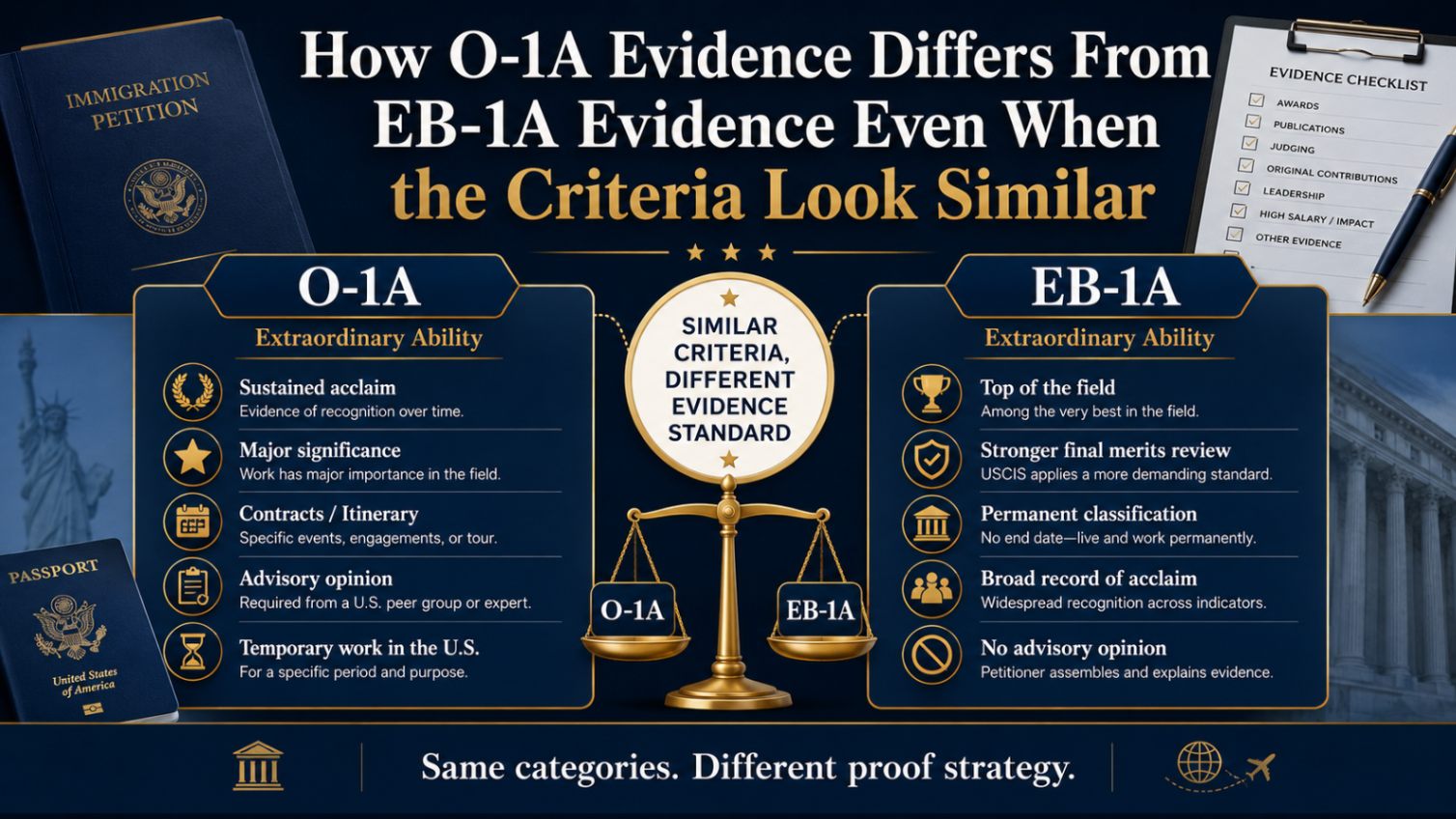
What's the difference between EB-1A and O-1A? The EB-1A is an immigrant classification leading to permanent residence and allowing self-petitioning. The O-1A is a nonimmigrant visa requiring employer or agent sponsorship and granting temporary work authorization. Both use similar evidentiary criteria, but adjudicators apply stricter scrutiny to the permanent visa. Many professionals secure the O-1A first to establish U.S.-based work authorization while continuing to build the evidentiary record the EB-1A requires.
How many criteria are required for EB-1A? Three of the ten regulatory criteria, or evidence of a single major internationally recognized award. Meeting three criteria is the threshold for the first analytical step, not the end of the review. The officer then conducts a final merits determination asking whether the full record demonstrates sustained national or international acclaim. Three technically satisfied but weak criteria frequently don't survive that review.
What most commonly drives EB-1A denials? Failure at the final merits determination is the most common outcome for petitions that technically satisfy the initial criteria threshold. The underlying pattern is almost always the same: evidence that demonstrates employer-specific impact without any proof that the broader field engaged with the work. When the entire record can be explained by "this person did their job well," the extraordinary ability standard isn't met. Letters describing the applicant as influential don't close that gap. Only externally verified documentation of field-level impact does.
Next Steps
If the current petition record is built primarily on expert opinions rather than independently verifiable documentation, the right move is to stop before filing. An RFE response is more expensive than building the record correctly in the first place, and a denial creates additional complications for future filings.
The practical next step is a gap assessment — identifying specifically which criteria have strong documentary support, which have letters without underlying records, and what evidence would need to exist before the petition is ready. During a VangaVault profile assessment, we review your CV and existing documentation to produce a written analysis of exactly where the record stands today and what it needs before filing makes strategic sense. You receive that analysis within three business days.
Get Immigration Insights Delivered to Your Inbox
Practical guidance on EB-1A, EB-2 NIW, O-1A, and U.S. immigration — no spam, unsubscribe anytime.