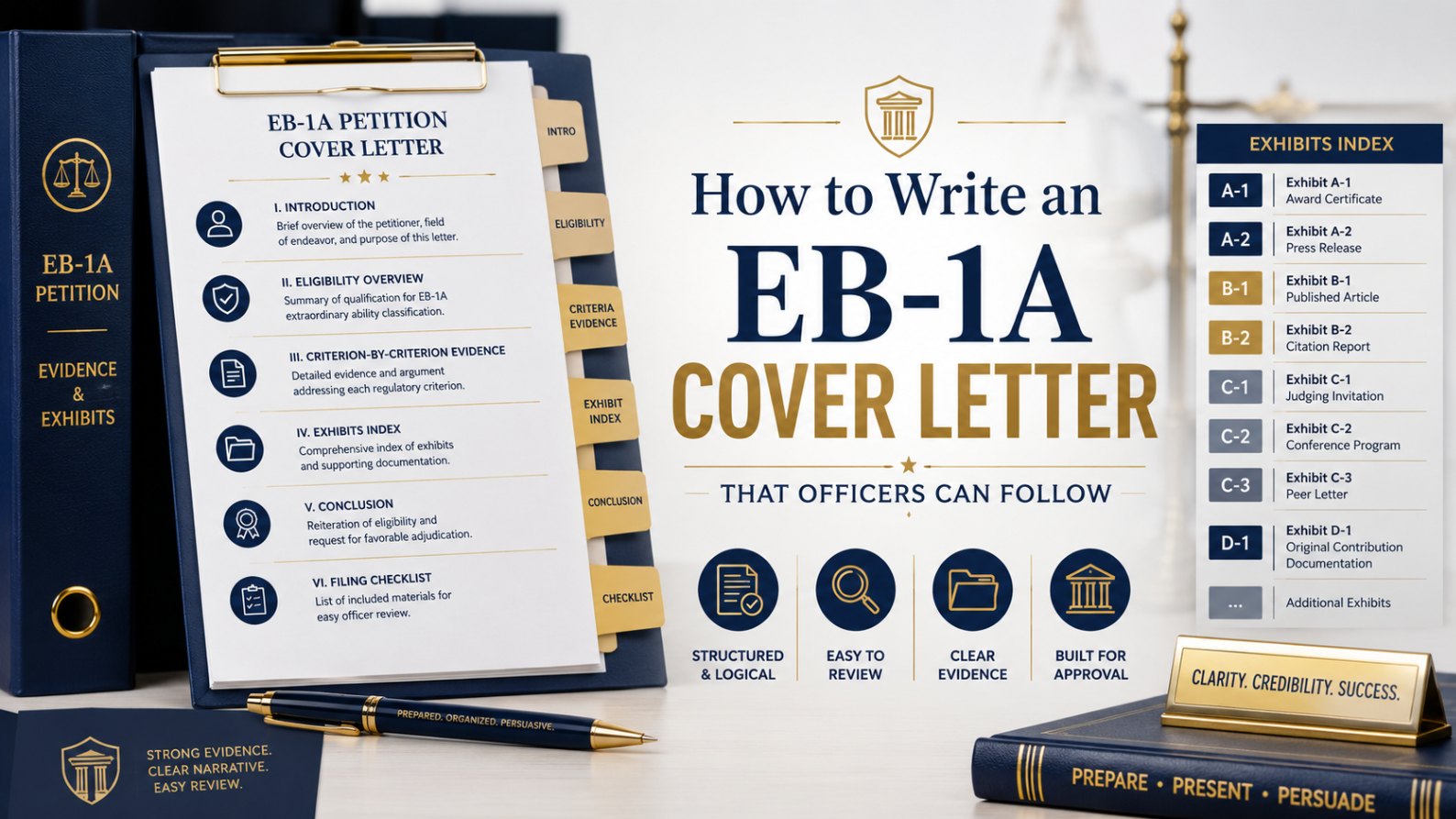
An effective EB-1A cover letter serves as a roadmap for the USCIS officer. This guide explains how to structure your petition to avoid RFE notices.
How to Write an EB-1A Cover Letter That Survives Adjudication
The cover letter is the first document a USCIS officer reads, and in a 500-page petition package, it's doing the most important structural work. Not because it's persuasive in the way an attorney's brief is persuasive — but because it determines whether the officer can find and understand the evidence at all. A petition with strong underlying credentials fails when the officer can't connect a specific exhibit to a specific legal criterion without guessing. The cover letter's job is to eliminate that guesswork entirely.
USCIS officers reviewing EB-1A petitions are generalists. They handle cases across multiple visa categories, often spending less than an hour on initial review of a petition that took months to assemble. An officer who has to search through unlabeled exhibits to understand why a particular patent matters to the "original contributions" criterion will default to an RFE before they default to approval. The cover letter controls the path between the evidence and the legal standard — when it's written well, the officer's job is essentially done for them.
Structure: Three Arguments in a Specific Order
The most common structural failure in EB-1A cover letters is mixing three distinct legal arguments together into a single undifferentiated narrative. Each argument has to stand on its own, addressed in sequence.
First: Criterion satisfaction. The petition must establish that the applicant meets at least three of the ten regulatory criteria set out at 8 C.F.R. § 204.5(h)(3). The cover letter should have a labeled section for each criterion being claimed, using the regulatory language as the section heading rather than a paraphrase of it. Under each heading, the argument follows a fixed pattern: identify the specific exhibits that satisfy the criterion, explain what each exhibit shows, and close the gap between the document and the regulation explicitly. An officer presented with a patent filing and no accompanying explanation will not independently conclude that it demonstrates "original scientific or business-related contributions of major significance." That inference has to be drawn in writing.
Second: Final merits determination. Since the Ninth Circuit's 2010 decision in Kazarian v. USCIS, 596 F.3d 1115 (9th Cir. 2010), meeting three criteria is the threshold, not the finish line. The officer then conducts a final merits determination — an evaluation of whether the full record, taken together, demonstrates sustained national or international acclaim. USCIS incorporated the Kazarian framework into its policy manual, and adjudicators are required to apply it. A cover letter that addresses only the criteria and leaves the final merits argument implicit will often fail at this step, because officers can and do concede criterion satisfaction while still finding the overall record insufficient.
This section of the letter is where the quality argument lives. It's not enough to show that the applicant has published articles, received a competitive salary, and reviewed papers for journals. The letter has to explain what those achievements mean in the context of the field — how the citation record compares to peers at the same career stage, what the selection criteria for a particular award are and why being chosen matters, why the journals that invited the applicant to review chose them specifically rather than recruiting through open solicitation.
Third: Prospective national benefit. EB-1A self-petitions require a showing that the applicant will continue working in their area of extraordinary ability and that the work will substantially benefit the United States. This isn't a speculative section — it should be grounded in concrete plans: the type of work to be pursued, the institutions or companies the applicant intends to work with or for, and the connection between those future activities and the achievements already documented in the petition. Vague statements about contributing to the field carry no weight here.
Comparison of Approaches
| Feature | Effective | Ineffective |
|---|---|---|
| Technical language | Uses concrete analogies and outcome metrics accessible to a non-specialist | Uses domain-specific jargon that requires subject matter expertise to evaluate |
| Evidence linking | Cites exhibit number and page for every claim | Mentions achievements without directing the officer to supporting documents |
| Argument structure | Follows the Kazarian two-step explicitly, criterion section then final merits section | Lists accomplishments chronologically, like a résumé |
| Tone | Objective and evidence-grounded | Relies on superlatives — "world-class," "groundbreaking" — without documentary proof |
| Formatting | Short paragraphs, bold callouts for key facts, evidence tables at each criterion section | Long unbroken text blocks that require reading in full to extract key facts |
| Focus | Impact of the work on the field | Length or volume of the applicant's career output |
Translating Technical Work for a Non-Expert Audience
Officers are not expected to know what "asynchronous Byzantine fault tolerance in decentralized systems" means or why it matters. If the significance of a technical contribution requires domain expertise to understand, the cover letter hasn't done its job.
The right framing leads with outcome, not mechanism. Not: "Developed a novel consensus algorithm for distributed ledger systems operating under adversarial network conditions." Instead: "This protocol enabled transaction processing at 100,000 operations per second, compared to the industry standard of 2,000 at the time of publication. It has since been adopted by three Fortune 500 companies (Exhibit 12, pp. 4–6)." The officer now has a benchmark they can evaluate — a factor of 50 improvement, verified by named adoption — without needing to understand the underlying cryptography.
Every technical achievement in the petition needs this translation. If the officer has to search externally to understand what a claimed contribution means, the narrative has already slipped out of the petitioner's control.
Using Recommendation Letters Strategically
Recommendation letters are probative but not objective, and USCIS treats them accordingly. They can't carry a criterion on their own. A cover letter that leads with what recommenders say about the applicant, rather than with objective data the recommenders are contextualizing, inverts the evidentiary hierarchy.
The right approach: establish the objective fact first — citation count, adoption metrics, award selection criteria — and then use the expert letter to explain what that fact means in the context of the field. A two-sentence pull from a prominent independent researcher explaining why a specific methodology changed clinical practice carries different weight than a full letter of praise from a former supervisor. The former is an expert providing field context for a verifiable fact. The latter is a character endorsement.
Recommenders whose letters are most useful for the final merits determination are those who encountered the applicant's work independently — through published research, through an industry conference, through a technology the recommender's own organization implemented. Their perspective on the significance of the work carries the credibility that comes from having no personal stake in the outcome.
Addressing the Final Merits Determination Explicitly
This is where self-filed petitions most commonly fail. Proving that publications, judging activity, and high compensation exist is not the same as proving the applicant belongs to the small percentage at the top of their field. Officers are explicitly permitted to find the evidence insufficient at the final merits stage even after conceding criterion satisfaction, and they use that latitude regularly.
The final merits section of the cover letter has to provide comparative context for every major claim. Reviewed papers for ten journals sounds like a lot in isolation. If the letter also shows that the applicant was selected by name by the editor-in-chief of a journal with an impact factor in the top 5% of the field — because of a specific prior publication that generated 300 independent citations — it sounds like what it actually is: evidence of recognized expertise, not self-initiative.
Citation rates require the same treatment. A raw count means nothing without a reference point. If the applicant has 400 citations and the field-weighted citation average for researchers at the same career stage is 80, that comparison belongs in the letter, drawn from an independently verifiable source like Web of Science, Scopus, or the NIH's iCite tool. The officer needs the benchmark to make the finding — and if the letter doesn't supply it, the officer draws their own conclusions.
Formatting for Readability Under Time Pressure
Officers are not reading every word of a 30-page cover letter sequentially. Paragraphs longer than six or seven lines get skimmed. Key facts buried in dense prose get missed.
The most effective structural tool is an evidence table at the beginning of each criterion section — a three-column format listing exhibit number, document title, and a one-sentence statement of what the document proves. This closes the gap between claim and evidence immediately: the officer reads the assertion, sees the exhibit reference, and has a plain-language explanation of what the exhibit shows before they've reached the next paragraph. They don't have to flip back to a general index or infer the relevance themselves.
Bold text should be used sparingly but intentionally — for award names, key metrics, and exhibit references that an officer scanning the page will still catch. A table of contents at the front of the letter, with section headings that match the physical tabs in the exhibit folder, converts a long document into a navigable reference rather than a linear read.
Handling Evidentiary Weaknesses
Weaknesses in a petition are better addressed directly in the cover letter than left for the officer to discover and interpret independently. If citations are concentrated in a single high-impact paper rather than distributed across a body of work, the letter should explain that: the paper introduced a methodology that shifted the field's direction, subsequent researchers built on it rather than producing parallel work, and the citation pattern reflects influence rather than inconsistency. That framing preempts the officer's most likely negative reading.
The same applies to any criterion where the evidence is technically responsive but qualitatively thin. Acknowledging the limitation and providing the context that explains why it doesn't undercut the overall record is more credible than presenting the evidence as though the limitation doesn't exist. Officers notice gaps. A letter that explains a gap retains control of the narrative; a letter that ignores it cedes that control.
Frequently Asked Questions
How long should the EB-1A cover letter be? A well-constructed letter typically runs 15 to 30 pages. That range reflects what's needed to argue the criteria, develop the final merits determination, and address prospective national benefit with enough specificity to be useful. Letters above 40 pages usually contain biographical material that belongs in the exhibits rather than the letter, or repetitive descriptions that dilute the core argument. Length isn't a proxy for strength — precision is.
Is using a template acceptable? Templates are useful for structure. They're a liability for content. Officers reviewing thousands of petitions recognize boilerplate language, and a letter that reads generically signals that the final merits argument hasn't been tailored to the applicant's actual record. The structure can follow a template; every specific claim, comparison, and criterion argument has to be written for this applicant in this field with this evidence.
Does the letter need to explain the technical field? Yes — briefly, and in the first section before the criteria arguments begin. A one-paragraph overview written for a non-specialist audience gives the officer the context they need to evaluate why specific contributions matter. Without that context, an officer reviewing research in a specialized medical subfield has no basis for assessing whether a particular publication is significant within that field or unremarkable. The overview doesn't need to be comprehensive; it needs to be sufficient for the officer to follow the criterion-level arguments that follow.
What is the most common mistake in EB-1A cover letters? Submitting evidence without explaining how it satisfies the specific regulatory language of the criterion being claimed. A professional organization membership card submitted under the associations criterion is useless unless the letter explains that the organization requires outstanding achievements for membership, as evaluated by recognized experts in the field — and identifies where in the exhibit that selection process is documented. The bridge between the document and the regulation has to be built explicitly, in writing, every time.
A useful first step before drafting is categorizing existing evidence against the ten regulatory criteria to identify which three or more can be supported with objective documentation today. From there, the cover letter structure follows: criterion sections, each with an evidence table and a legal argument; a separate final merits section providing comparative context for the overall record; and a prospective national benefit statement grounded in specific planned activities.
A VangaVault profile assessment reviews the existing record against current USCIS adjudication patterns and returns a written gap analysis within 48 hours. Schedule a consultation to start that evaluation.
Get Immigration Insights Delivered to Your Inbox
Practical guidance on EB-1A, EB-2 NIW, O-1A, and U.S. immigration — no spam, unsubscribe anytime.