If your temporary work visa is nearing its end, you need a plan that doesn't rely on employer sponsorship or the lottery. We explain how to qualify for EB-1A.
Developing an EB-1A Immigration Strategy Before Your H-1B or OPT Expires
Most professionals on H-1B or OPT status start thinking seriously about permanent residency too late. Not a few weeks too late — years too late. By the time the urgency becomes undeniable, the options have already narrowed, the backlogs have already deepened, and the evidentiary record that EB-1A requires hasn't been built yet. The strategy has to start early, and it has to be built around what USCIS actually evaluates — not what feels like an impressive resume.
For skilled professionals who want to avoid being tethered to an employer's PERM timeline, EB-1A is the fastest route to a green card. But "fastest" is relative. The underlying record it requires — documented influence on a field, independently verified by people who have no professional obligation to praise you — takes 12 to 24 months to develop properly. That timeline starts now, not after the fifth year of an H-1B.
Why Starting Late Is Often Fatal
The conventional employer-sponsored route — EB-2 or EB-3 through PERM labor certification — looks straightforward until you examine the backlog data. For Indian and Chinese nationals, the wait for an EB-2 visa number currently runs over a decade in many cases. The PERM process itself takes 12 to 18 months before an I-140 is even filed, and if that PERM isn't in motion at least 365 days before the H-1B's six-year cap, the applicant can lose the ability to extend their status and may be forced to leave the country.
EB-1A sidesteps the entire PERM process. There's no labor certification, no employer sign-off, and no waiting for a job offer to survive a departmental reorganization. The applicant self-petitions. The tradeoff is evidentiary: the standard isn't minimum qualifications or even advanced expertise. It's proof that you've reached the top of your field, and that the field itself has taken notice.
That proof doesn't get built in the months before filing. It gets built over years of strategic professional activity.
The Two-Step Test Every EB-1A Petition Must Pass
The 2010 Kazarian v. USCIS decision established the evaluation framework USCIS still uses today. Every I-140 petition for EB-1A goes through two sequential reviews, and failing either one ends the case.
Step One: Meeting at Least Three Criteria
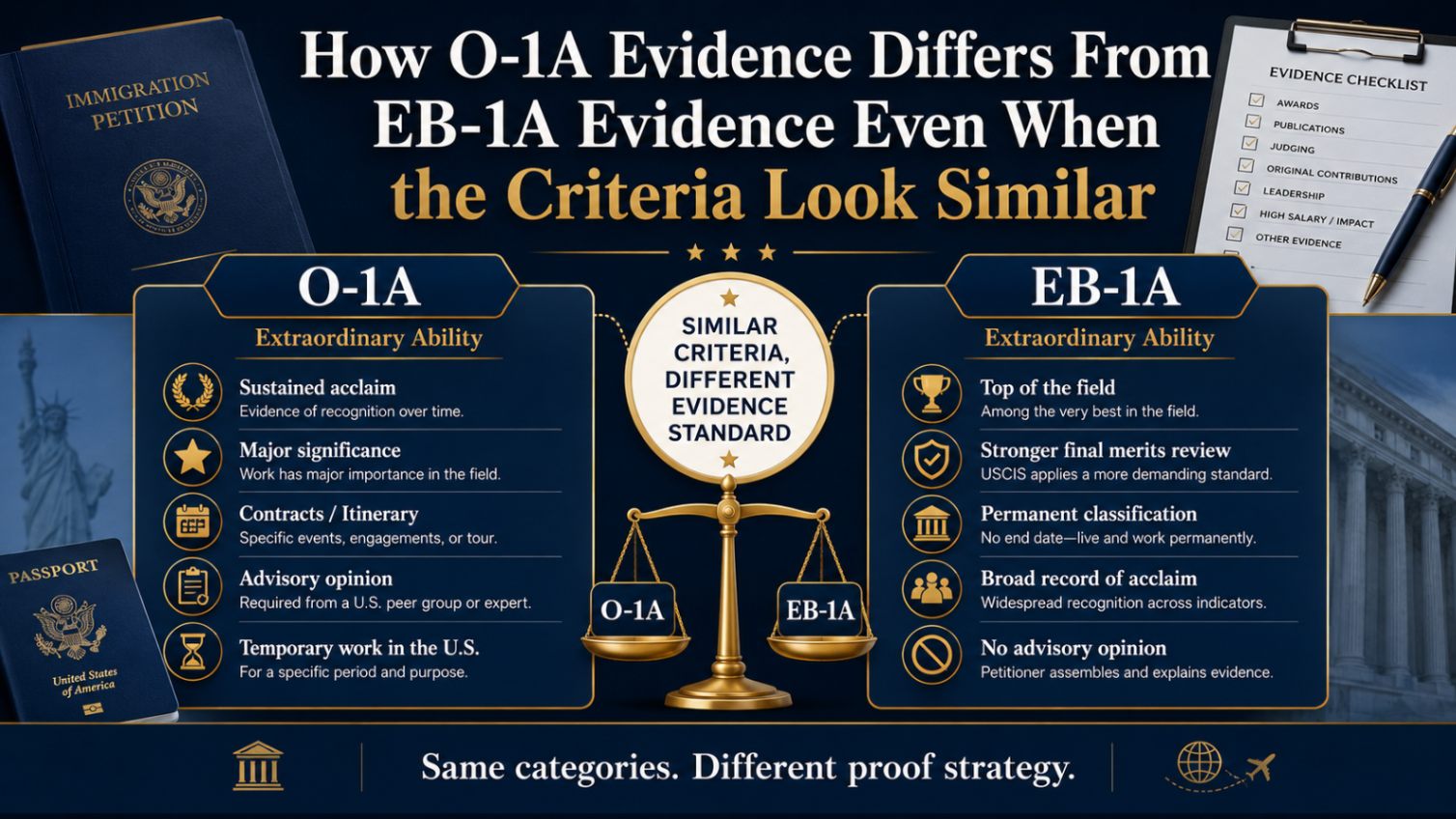
USCIS has ten regulatory criteria for EB-1A. An applicant must satisfy at least three — or present evidence of a single major internationally recognized award, such as a Nobel Prize or Fields Medal. The ten criteria cover things like peer review work, original scholarly or scientific contributions, leading or critical roles in distinguished organizations, high salary relative to peers, and published material about the applicant in major media.
The instinct many applicants have is to reach for as many criteria as possible. That's often counterproductive. A petition with weak evidence across six criteria is harder to defend than one with strong, specific, independently documented evidence for three. Adjudicators notice when applicants are stretching. Submitting a marginal award or a Publons account with 40 reviews clustered in two months raises credibility questions that spill over into the rest of the file.
Step Two: Final Merits Determination
Clearing three criteria gets the petition past the initial gate. It doesn't win the case. The adjudicator then evaluates the totality of the evidence to determine whether it demonstrates sustained national or international acclaim — the kind that would exist regardless of whether a visa petition was being prepared.
This is where petitions with technically valid but contextually weak evidence tend to collapse. An award from 2018 with nothing notable since doesn't demonstrate sustained acclaim. A peer review record that doesn't begin until six months before filing doesn't either. The adjudicator is looking for an upward trajectory of genuine recognition that leads naturally to the filing date, not a burst of activity that ends there.
Comparing the Permanent Residency Pathways
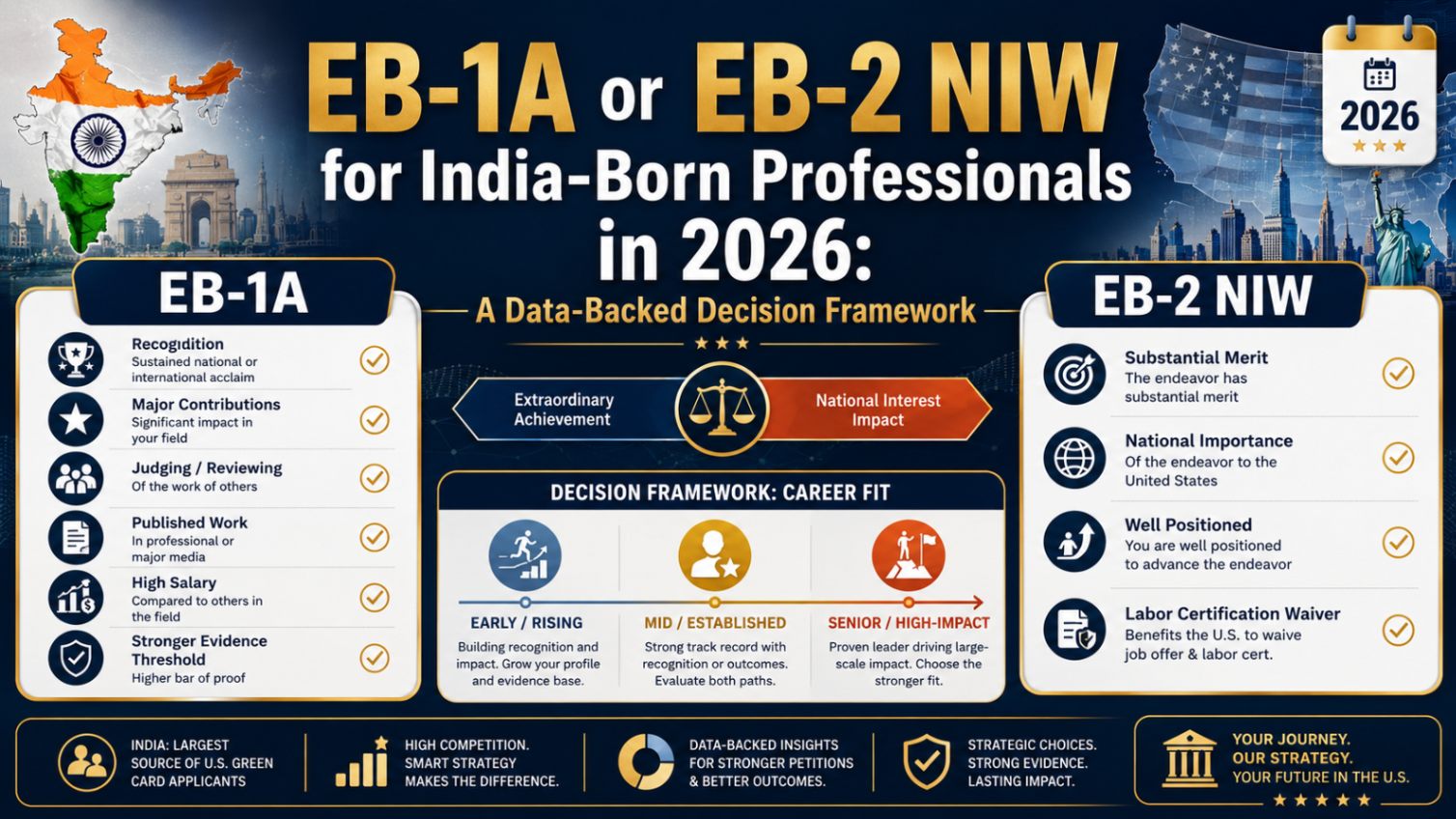
| Feature | EB-1A (Extraordinary Ability) | EB-2 NIW (National Interest Waiver) | EB-2 / EB-3 (PERM) |
|---|---|---|---|
| Employer Required | No | No | Yes |
| Labor Certification | Not required | Waived | Required |
| Standard of Proof | Top of the field | Well-positioned to advance a U.S. national interest | Minimum qualifications for the role |
| Premium Processing | 15 business days | 45 business days | 15 business days |
| Priority Date Availability | Often current (backlogs emerging for India, China) | Backlogged for several nationalities | Heavily backlogged |
EB-2 NIW deserves more attention than it typically gets. For professionals whose work serves a demonstrable U.S. national interest — early-stage founders, specialized researchers, engineers in sectors the government has prioritized — NIW can succeed without the level of external recognition EB-1A demands. The timeline is longer and the priority date situation is messier, but for applicants who aren't yet at the EB-1A evidentiary threshold, it's often the right intermediate step.
Building the Evidence That Actually Works
Peer Review and Judging
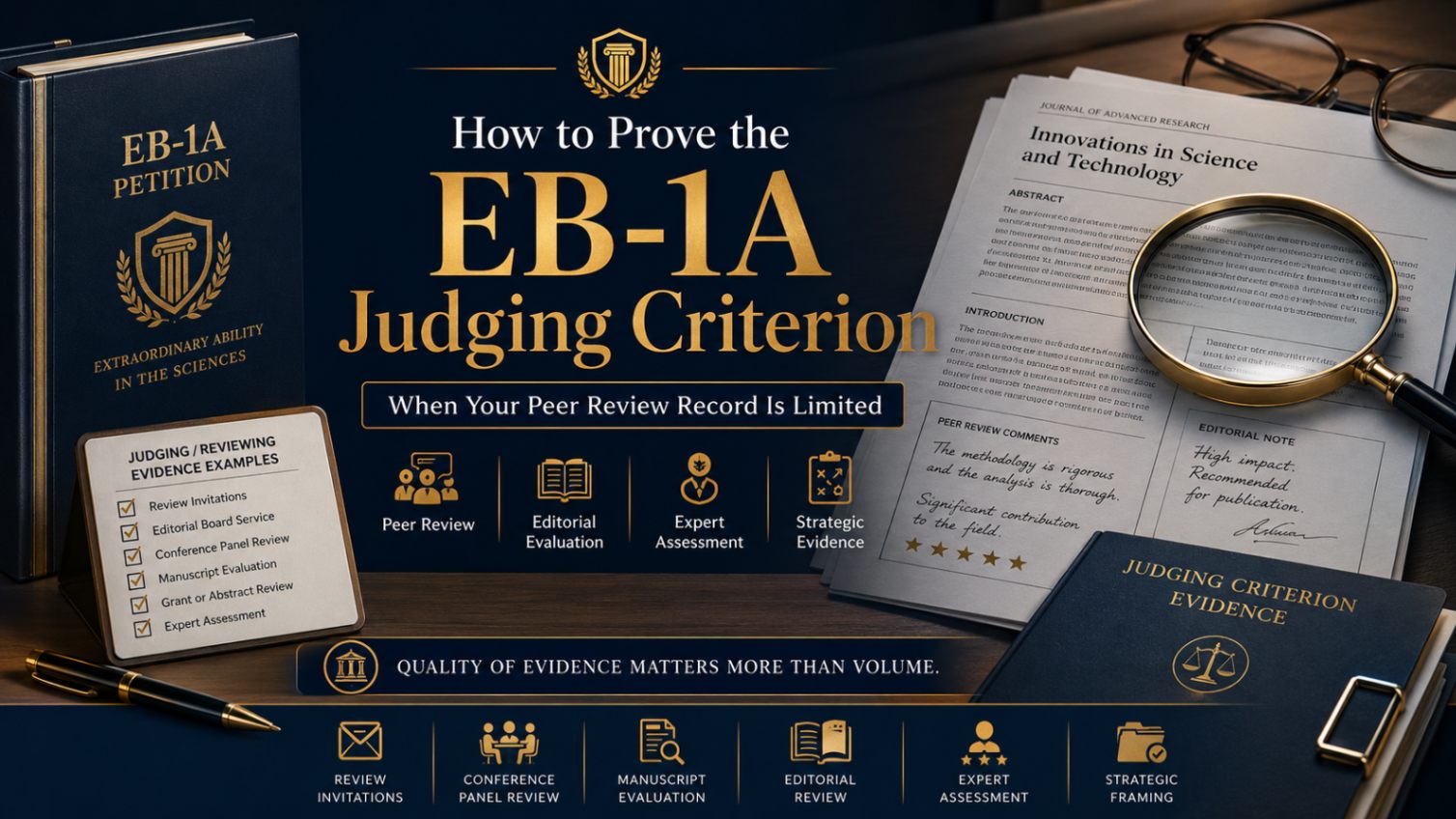
The criterion for judging the work of others is accessible to most researchers and many technical professionals — but accessible doesn't mean easy to satisfy well. Officers look at three things: the prestige of the venues where the reviewing happened, the process by which the applicant was selected, and whether the activity shows continuity or a pre-filing sprint.
Reviewing for journals in the top quartile of their field by impact factor carries weight. Being specifically recruited by an editor because your own published work is recognized in the field carries more. Completing 40 reviews for open-access journals over 10 weeks because someone suggested it for the petition carries almost none — and the timing makes it worse, not better. Aim for a track record of 5 to 10 reviews annually for journals where impact factor is above 5, ideally stretching back at least two to three years before filing.
Leading or Critical Roles
Title is a starting point, not proof. A CTO title at a company with no distinguished reputation satisfies the letter of this criterion but rarely its spirit. What adjudicators want to see is causal evidence — your decisions produced specific, measurable outcomes for an organization that has documented standing in its industry.
That means executive letters written with specificity: not "she was a valued member of our team" but "the architecture she designed reduced infrastructure costs by $2.3M annually and became the technical foundation for our Series B pitch." Pair those letters with organizational charts, independent press coverage of the company, and whatever documentation traces the outcome directly to the applicant's work. Generic employment verification letters are a waste of space in an EB-1A petition.
Original Contributions of Major Significance
"Major significance" is the phrase that eliminates most candidates, and rightly so. The question isn't whether the work was original — USPTO grants patents to original ideas that nobody uses. The question is whether the broader field demonstrably changed because of it.
In research, citation counts matter — but context matters more. One citation in a landmark review paper that discusses the methodology in detail is worth more than ten citations that include the paper in a bibliography without discussion. In technology, evidence that a framework was adopted by independent companies, that an open-source library accumulated thousands of stars from developers at unrelated organizations, or that a methodology became standard practice in a measurable way — that's what satisfies this criterion. Letters from former managers describing internal code complexity do not.
Timing the I-140 Filing
If current status expires in 12 months, the evidence gathering window is effectively the next four months. That leaves time for a thorough attorney review, a response buffer for an RFE, and enough margin to consider whether a parallel O-1A makes sense as a bridge while the I-140 processes.
EB-1A's Premium Processing option — 15 business days for an initial decision — is a genuine advantage over most other pathways. But premium processing doesn't insulate a petition from an RFE. When the adjudicator has questions about the final merits determination, the RFE clock starts running, and the response needs to be substantive. Petitions that pre-emptively include independent expert letters and objective third-party data — citation records, salary surveys, licensing agreements — tend to generate fewer RFEs and survive them more cleanly when they do occur.
Priority Dates and What an Approved I-140 Actually Does for You
The priority date for an EB-1A is the I-140 filing date. Historically, EB-1 dates have remained current, meaning there was no meaningful wait for a visa number after approval. That's changed for Indian and Chinese nationals, where backlogs have begun to develop — though EB-1 still moves substantially faster than EB-2 or EB-3 for those nationalities.
An approved I-140, even when the priority date isn't yet current, has real value beyond the green card itself. It allows the holder to port that priority date to a different category if circumstances change. It also enables H-1B extensions beyond the standard six-year cap under AC21 provisions, which matters significantly for anyone whose priority date may be years out.
Mistakes That Derail Otherwise Viable Petitions
Waiting for a senior title before filing. USCIS evaluates the record of external recognition, not the org chart position. A Senior Engineer with 200 citations, two licensed patents, and a track record of peer review for top journals is a stronger EB-1A candidate than a VP with a long employment history and no external validation of their influence. File when the evidence is ready, not when the title arrives.
Relying on internal awards. "Engineering Excellence Award" and "Employee of the Year" recognitions prove nothing about national or international acclaim. They prove the applicant's employer values their work, which the adjudicator already assumes. The awards criterion requires proof that external bodies — independent of the employer — recognized the applicant as outstanding in the field.
Defining the field incorrectly. The "field of endeavor" framing matters more than most applicants realize. Too narrow and there's no recognized national community to have achieved acclaim within. Too broad and it becomes impossible to demonstrate placement in the top small percentage. A machine learning researcher who defines their field as "artificial intelligence" is competing against every AI professional on earth. One who defines it as "transformer-based models for protein structure prediction" has a more defensible claim to being among the elite — if the evidence supports it.
Frequently Asked Questions
Can an EB-1A be filed while still on F-1 OPT?
Technically, yes. But the immigrant intent issue is real. F-1 is a nonimmigrant classification premised on the intention to leave the U.S. after the authorized period ends. Filing an I-140 signals the opposite intention, which can create problems when renewing F-1 status, traveling internationally, or applying for a subsequent OPT extension. Most applicants wait until they hold H-1B or O-1A status — both of which permit dual intent — before filing the I-140. This isn't a hard rule, but violating it creates complications that are difficult to resolve retroactively.
Is there a citation threshold that guarantees EB-1A approval?
No. USCIS evaluates citation counts relative to the norms of the specific field and career stage, not against a universal number. In theoretical mathematics, 50 citations might represent exceptional output. In molecular biology, 500 might be unremarkable. What matters is whether the applicant's citation record is demonstrably higher than peers with comparable years of experience — and whether the citing papers treat the work as influential rather than merely listing it in a bibliography.
What happens after an EB-1A denial?
A denial doesn't close the pathway permanently. Many applicants receive an RFE or denial on a first filing, use the officer's feedback to identify specific evidentiary gaps, and refile 12 to 18 months later with a substantially stronger record. A denial also doesn't prevent pursuing EB-2 NIW or maintaining H-1B status through a different employer's PERM process in parallel. The strategic response to a denial is to treat it as a detailed critique of the petition and address each point specifically, not to abandon the pathway.
Is a PhD required for EB-1A?
No. The EB-1A category is explicitly open to business, the arts, and athletics alongside academia and research. In business and technology, extraordinary ability is demonstrated through high compensation benchmarked against the field, critical roles at organizations with distinguished reputations, and original contributions with documented industry adoption. Many successful EB-1A petitioners — software architects, founders, creative directors — hold no advanced degree. What they hold is an external record of recognition that USCIS can verify independently.
Realistic Next Steps
An honest gap analysis of the existing professional record against actual USCIS adjudication standards — not a self-assessment against a checklist — is the most useful first step. A VangaVault profile assessment reviews the CV and available evidence samples, identifies which criteria are currently supportable and which require further development, and delivers a written feasibility analysis with a custom timeline estimate within 48 hours. Schedule a consultation to get that assessment started.
Get Immigration Insights Delivered to Your Inbox
Practical guidance on EB-1A, EB-2 NIW, O-1A, and U.S. immigration — no spam, unsubscribe anytime.