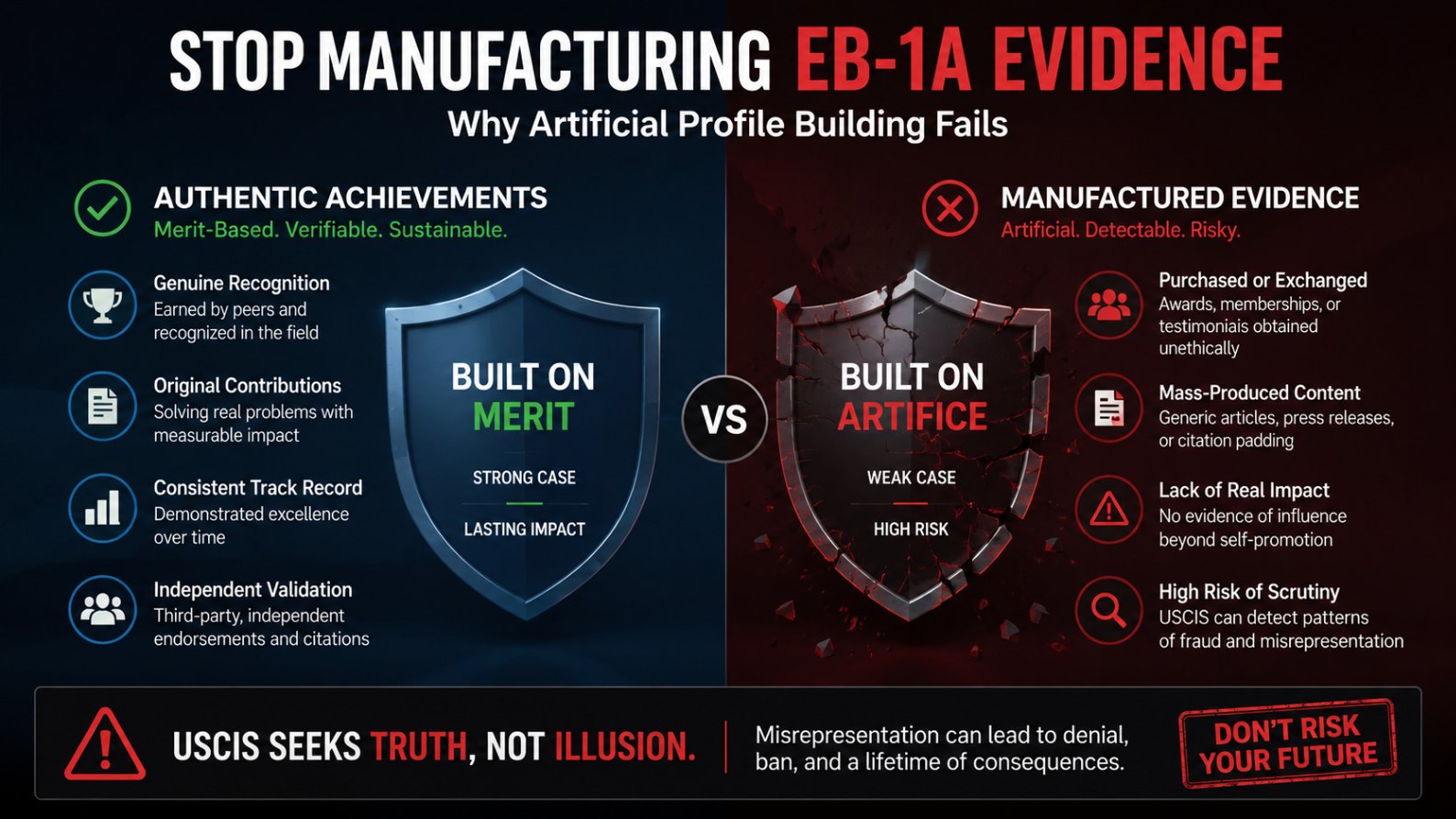
Many applicants waste thousands trying to force an EB-1A approval through artificial means. Learn why manufactured evidence raises red flags and how USCIS evaluates sustained acclaim.
Stop Manufacturing EB-1A Evidence: What I've Learned From Real Cases
I need to be honest with you about something I see almost every week. Smart, accomplished professionals come to me with meticulously assembled EB-1A petitions that look perfect on paper—until you look closer. That's when you see the problem: everything is too perfect, too recent, too obviously done for the petition.
Last month, I reviewed a case where the applicant had published three scholarly articles in the six months before filing. Sounds good, right? Except all three were rushed submissions to journals they'd never worked with before. The research was solid, but here's what USCIS saw: a desperate scramble to check boxes. They labeled it manufactured evidence, and the petition got an RFE that was brutal to overcome.
This is what I mean by manufactured evidence, and I want to explain what USCIS actually looks for—because it's not what most people think.
What "Manufactured Evidence" Really Means
Here's the thing that most blog posts won't tell you: manufactured evidence isn't about fake documents or lying. It's about intent. USCIS adjudicators are trained to spot activities that exist solely to support your petition, not because they're genuine parts of your professional life.
I've seen this pattern dozens of times:
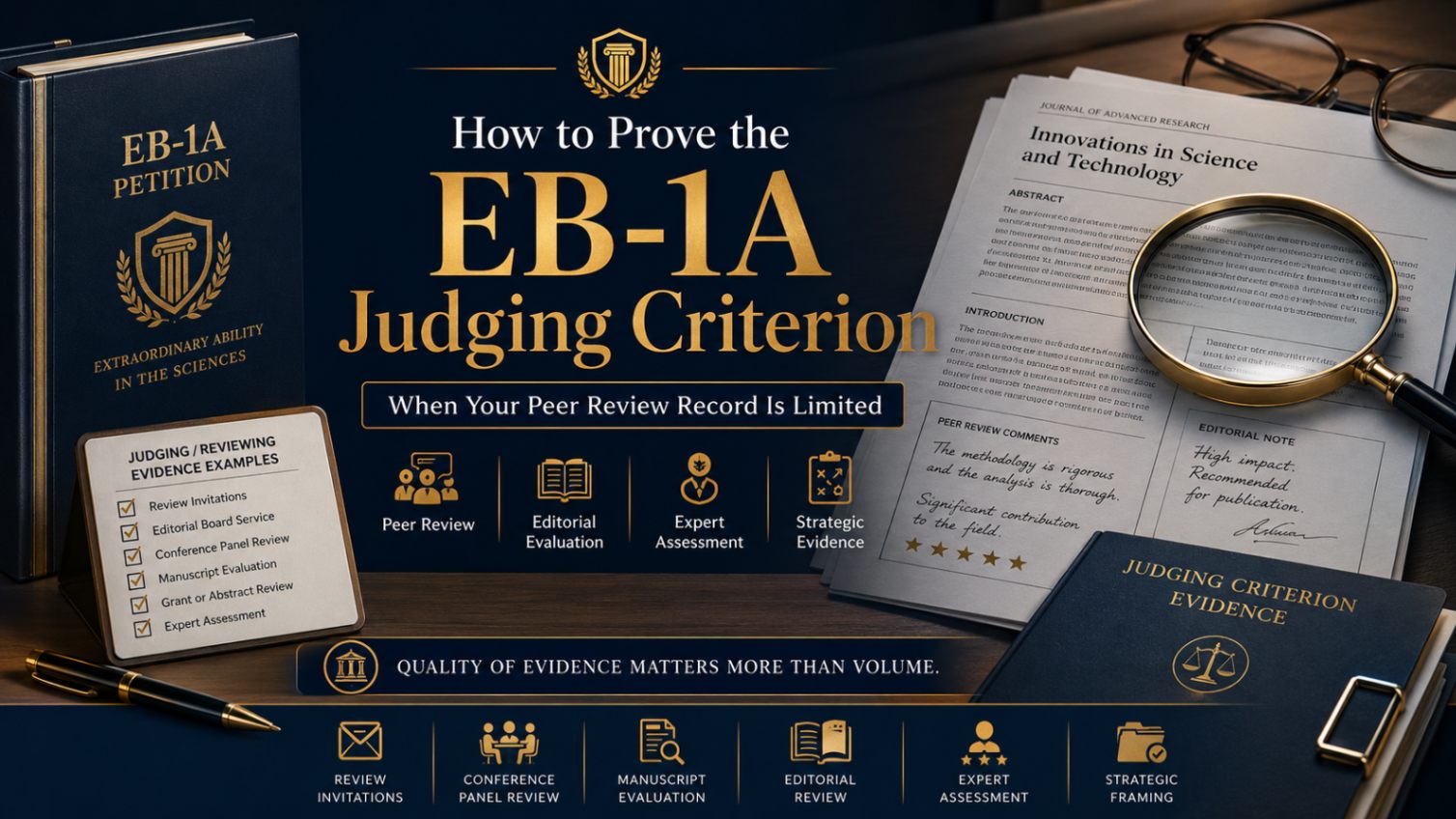
The Six-Month Sprint: Someone realizes they need peer reviews, so they sign up for every journal platform available and complete 40-50 reviews in 8-10 weeks. The dates tell the whole story. When an officer sees that your entire peer review history falls within a 60-90 day window right before filing, they know exactly what happened. You weren't asked to review because of your expertise—you volunteered because you needed the credential.
The Suddenly Published Scholar: You've been working in your field for 8 years, but your first scholarly article appears 4 months before filing. Then another one 2 months before filing. The work might be legitimate, but USCIS sees a red flag: Why now? Why so rushed? If you were truly a leading expert, where's the publication history from years 1-7 of your career?
The Instant Patent Filer: Three provisional patents filed in the 90 days before submission, all without any evidence of commercialization, licensing discussions, or practical application. I get it—someone told you patents count as "original contributions." But filing a patent is just paperwork. What USCIS wants to see is whether anyone in your industry actually uses your invention.
The common thread? Timing. When everything important in your profile happens in the months immediately before filing, it screams "I'm building a case" instead of "I've built a career."
How USCIS Actually Scrutinizes Your Evidence
Let me walk you through what happens on the other side of your petition. USCIS adjudicators aren't just reading your documents—they're investigating them.
I learned this the hard way when one of my early clients got an RFE that asked for proof of circulation numbers for a magazine feature we'd included. The publication looked legitimate, had a professional website, claimed 50,000 readers. The officer Googled it, found zero independent verification, discovered it was essentially a pay-to-play platform, and rejected the entire criterion.
Here's what they actually do:
They Cross-Reference Dates Obsessively: Every piece of evidence is timestamped in their review. They create a timeline. If 70% of your achievements cluster in a 6-month window, that timeline looks suspicious. Think about it from their perspective—why would someone with "sustained national acclaim" suddenly have all their major accomplishments happen right before they need immigration approval?
They Google Everything: That prestigious award? They'll look up the selection criteria. That industry association? They'll check the membership requirements. That media feature? They'll verify if it has an independent editorial board or if it's sponsored content. I've seen officers cite the exact same articles I cite in petitions—but they use them to prove the opposite point, showing that the publication accepts paid placements.
They Evaluate Context, Not Just Credentials: An applicant recently submitted evidence of being a "keynote speaker" at five conferences. Sounds impressive. The officer looked up each conference. Three were internal corporate events, one was a paid speaking slot at a small regional gathering, and one was legitimate. Instead of counting five speaking engagements, USCIS counted one—and questioned why the applicant tried to inflate the others.
They Assess Impact, Not Volume: This is critical. Filing 10 patents doesn't prove extraordinary ability. Publishing 15 articles doesn't prove it either. What proves it? Citations. Licensing deals. Industry leaders writing letters that say, "We implemented her methodology across our entire organization." Impact is measurable, specific, and comes from other people, not from you.
What Actually Counts as Manufactured vs. Authentic
Let me give you real examples from cases I've worked on, because the difference is stark.
Judging/Peer Review: Manufactured vs. Authentic
Manufactured: A software engineer signs up on Publons, accepts every review invitation that comes through automated emails, completes 45 reviews for journals he'd never heard of before, all within 10 weeks before filing. The journal impact factors range from 0.3 to 1.2. None of the editors personally requested his review—it was all through mass solicitation systems.
Authentic: A biomedical researcher has been reviewing for the same 3-4 high-impact journals (impact factor 8+) for the past 5 years. She averages 6-8 reviews per year. The editor-in-chief of Nature Biotechnology writes a letter explaining that they specifically seek her out because of her 2019 paper on CRISPR applications, which has 340+ citations. She didn't ask to be on the reviewer list—they recruited her.
See the difference? One is volume with no context. The other is sustained, selective engagement from respected gatekeepers in the field.
Published Material: Manufactured vs. Authentic
Manufactured: An entrepreneur pays a PR agency $3,500 to place him in "Top 50 Tech Innovators Under 40" in an online magazine with no subscription base and no newsstand presence. The article is 400 words of generic praise written by someone who never interviewed him. The publication's "About Us" page lists no editorial staff.
Authentic: A machine learning engineer gets profiled in MIT Technology Review because a journalist independently discovered her open-source library that's been adopted by Google and Microsoft. The 2,000-word feature includes quotes from competitors praising her work. She didn't pitch the story—the journalist found her through GitHub activity and reached out.
The first example is bought. The second is earned. USCIS knows the difference because they verify these publications.
Original Contributions: Manufactured vs. Authentic
Manufactured: A mechanical engineer files three provisional patents in the two months before submitting his petition. The patents describe legitimate inventions from his work at a large corporation, but there's no evidence anyone plans to use them. No licensing discussions. No commercial implementation. Just three USPTO filing receipts dated 45, 38, and 22 days before the petition submission.
Authentic: A chemical engineer holds one granted patent from 2021. That patent is licensed to two Fortune 500 companies with executed agreements showing $400K in licensing revenue over 3 years. An executive from one company writes a letter explaining how the patented process reduced their manufacturing costs by 18% and has become industry-standard practice. The patent has been cited in 14 subsequent patent applications by competitors.
One person filed paperwork. The other changed how an industry operates. That's the distinction USCIS makes.
Critical Role: Manufactured vs. Authentic
Manufactured: A senior manager submits his job description showing he "leads a team of 12 engineers" and "oversees product development." His title is Director of Engineering. His letter of recommendation from his CEO uses generic language: "valuable team member," "consistent performer," "important to our success."
Authentic: A product lead at a Series B startup provides evidence that she designed and launched the company's flagship product, which grew from 0 to 500K users in 18 months and directly resulted in a $35M Series C funding round. The CEO's letter specifies: "Without [her] strategic insight into user retention mechanics, we would not have achieved the growth metrics required to secure our Series C. Our lead investor specifically cited her product roadmap during investment diligence." She includes the investor's deck with highlighted sections referencing her work.
One person did their job well. The other person fundamentally altered the trajectory of their organization. USCIS distinguishes between competent performance and extraordinary impact.
The Articles and Evidence USCIS Flags as Manufactured
Based on what I've seen in RFEs and denials, here are the specific types of evidence that trigger scrutiny:
Scholarly Articles Published Within 12 Months of Filing: If you're submitting an article published in the last year as evidence, USCIS will ask: Why is this your first publication? Where are the earlier ones? What's the citation count? (New articles obviously have zero citations.) Is this part of an ongoing research program, or a one-off piece written specifically to support this petition?
I had a client—a data scientist—who published his first-ever academic paper 4 months before filing. The research was excellent, but USCIS issued an RFE asking why someone claiming "extraordinary ability" had no publication history before 2023. We had to pivot the entire strategy away from the Authorship criterion because we couldn't answer that question satisfactorily.
Award Nominations You Submitted Yourself: If you applied for an award by filling out an application and paying a fee, that's not evidence of acclaim—that's evidence you can fill out forms. I've seen applicants submit "finalist" certificates from awards they self-nominated for. USCIS will find out. They'll request the award criteria and discover that anyone who pays $500 and submits an application becomes a "finalist."
Media Features That Match Your LinkedIn Updates: This is a subtle one. If the published article about you contains the exact same language, accomplishments, and phrasing as your LinkedIn profile or company bio, officers assume you wrote it yourself or fed the content to a paid placement service. Authentic journalism involves independent research and interviewing. The language should reflect the journalist's voice, not yours.
Letters of Recommendation That Sound Like Templates: When three different recommenders use nearly identical phrasing—"one of the brightest minds in the field," "groundbreaking contributions," "unparalleled expertise"—it's obvious someone drafted template language and sent it to recommenders for signature. USCIS wants letters that provide specific, detailed examples of how you impacted that person's work or organization. Generic praise destroys credibility.
Membership in Associations with No Vetting Process: Joining IEEE, ACM, or similar organizations by paying the membership fee doesn't count. USCIS wants associations where experts evaluate your achievements before admitting you. If the "requirement" for membership is just having a degree or paying dues, it doesn't satisfy this criterion. I tell clients: if you can join by clicking "Add to Cart," it's not exclusive enough for EB-1A.
Why Manufactured Evidence Destroys Otherwise Strong Cases
Here's what frustrates me most: I see genuinely talented professionals ruin their chances by padding their applications.
I worked with a machine learning researcher who had ONE truly extraordinary achievement: her algorithm was integrated into Android's voice recognition system and is now used by 2+ billion devices worldwide. That alone could have carried her petition under the Original Contributions criterion. But someone advised her to "strengthen" the case by adding 30 peer reviews she'd rushed through in 8 weeks and a $500 "Innovation Award" from a pay-to-play platform.
USCIS issued an RFE questioning the credibility of her entire petition. Why? Because the weak evidence made them doubt the strong evidence. They assumed if she was willing to submit obvious padding, maybe the Android integration was exaggerated too. We had to get Google's engineering VP to write a supplemental letter confirming the integration just to overcome the credibility damage.
That's the real danger of manufactured evidence: it doesn't just fail on its own—it contaminates your genuine achievements by making the adjudicator question your honesty.
What You Should Do Instead
If you're reading this and thinking, "But I don't have enough evidence yet"—that's actually valuable information. It means you're not ready for EB-1A, and that's okay. There are better paths.
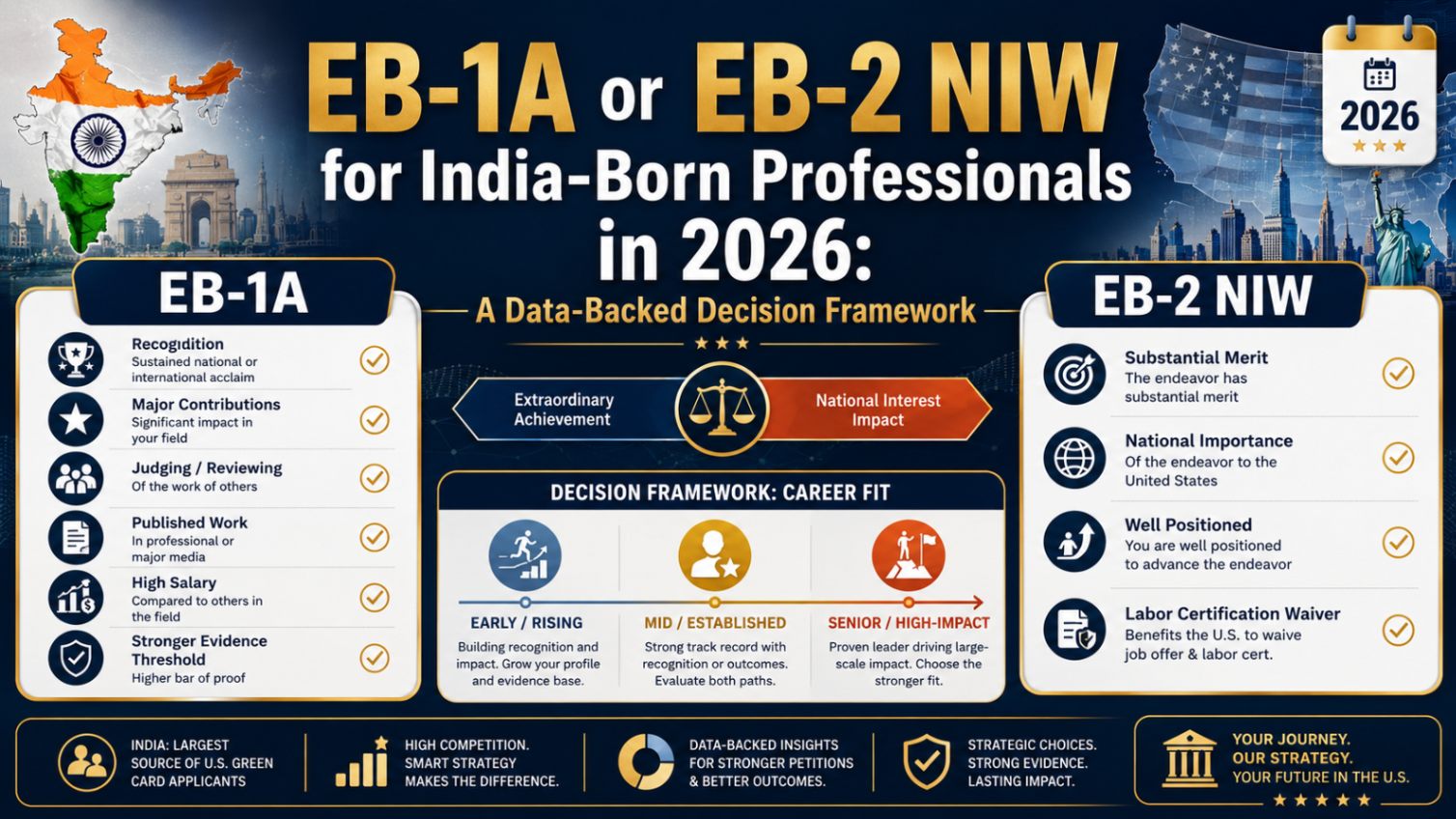
EB-2 NIW might be your answer. It requires exceptional ability (lower bar than extraordinary) and proof that your work benefits the United States. I've successfully filed NIW petitions for early-stage founders, specialized engineers, and researchers who had strong potential but weren't yet at the top of their field. The timeline is longer (12-24 months vs. 6-12), but the approval rate is higher when filed correctly.
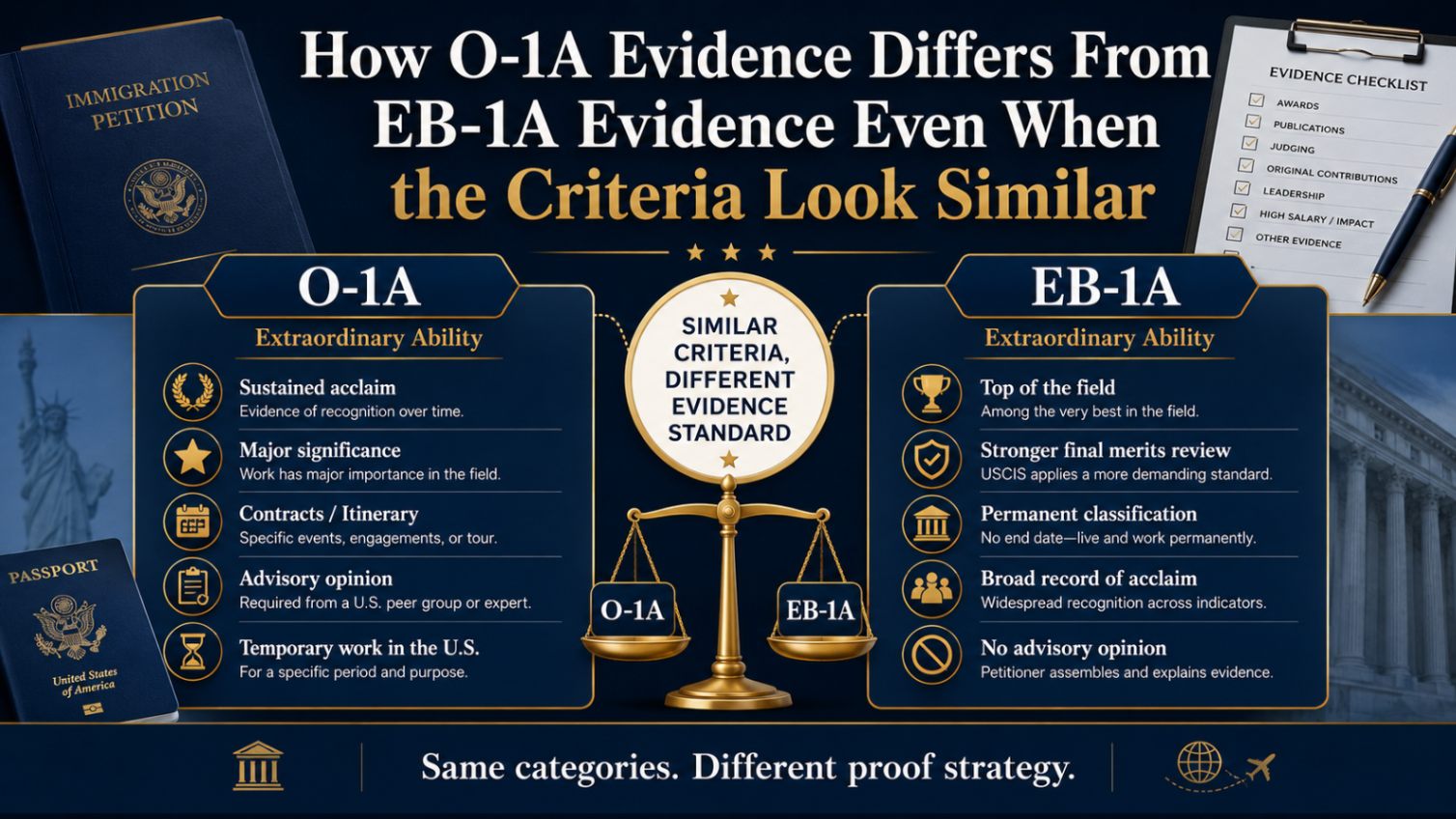
O-1A gives you immediate work authorization. If you need to be in the US now and can't wait for permanent residency, the O-1A is a non-immigrant visa with similar criteria but lower scrutiny. It's often the right first step, letting you build your US-based career while accumulating the evidence you'll eventually need for EB-1A.
Or wait and build real evidence. This is the hardest advice to accept, but sometimes the best strategy is patience. Spend the next 18-24 months focusing on genuine impact: publish research that gets cited, build products that get adopted, lead initiatives that generate measurable results. Then file when your credentials are unquestionable.
The Bottom Line
USCIS doesn't care about your effort. They don't care that you spent $5,000 on PR placements or stayed up until 2 AM completing peer reviews. They care about one thing: Can you prove that you've reached the top of your field through sustained, documented, independently verified achievements?
Manufactured evidence proves the opposite. It proves you're trying to force an outcome rather than documenting an existing reality.
I've seen people with impressive careers destroy their chances by submitting obvious padding. And I've seen people with narrow but deep expertise get approved because they focused on quality over quantity.
Before you file, ask yourself: Would these achievements exist if I weren't applying for this visa? If the answer is no, don't submit them. Find a different path or build a better foundation.
That's the real advice no one wants to hear, but it's what works.
Get Immigration Insights Delivered to Your Inbox
Practical guidance on EB-1A, EB-2 NIW, O-1A, and U.S. immigration — no spam, unsubscribe anytime.