The Kazarian two-step is the framework USCIS uses to evaluate EB-1A cases. Learn how to move past the initial 10 criteria into the final merits determination.
The Kazarian Two-Step in EB-1A Petitions: What It Means and How to Prepare for It
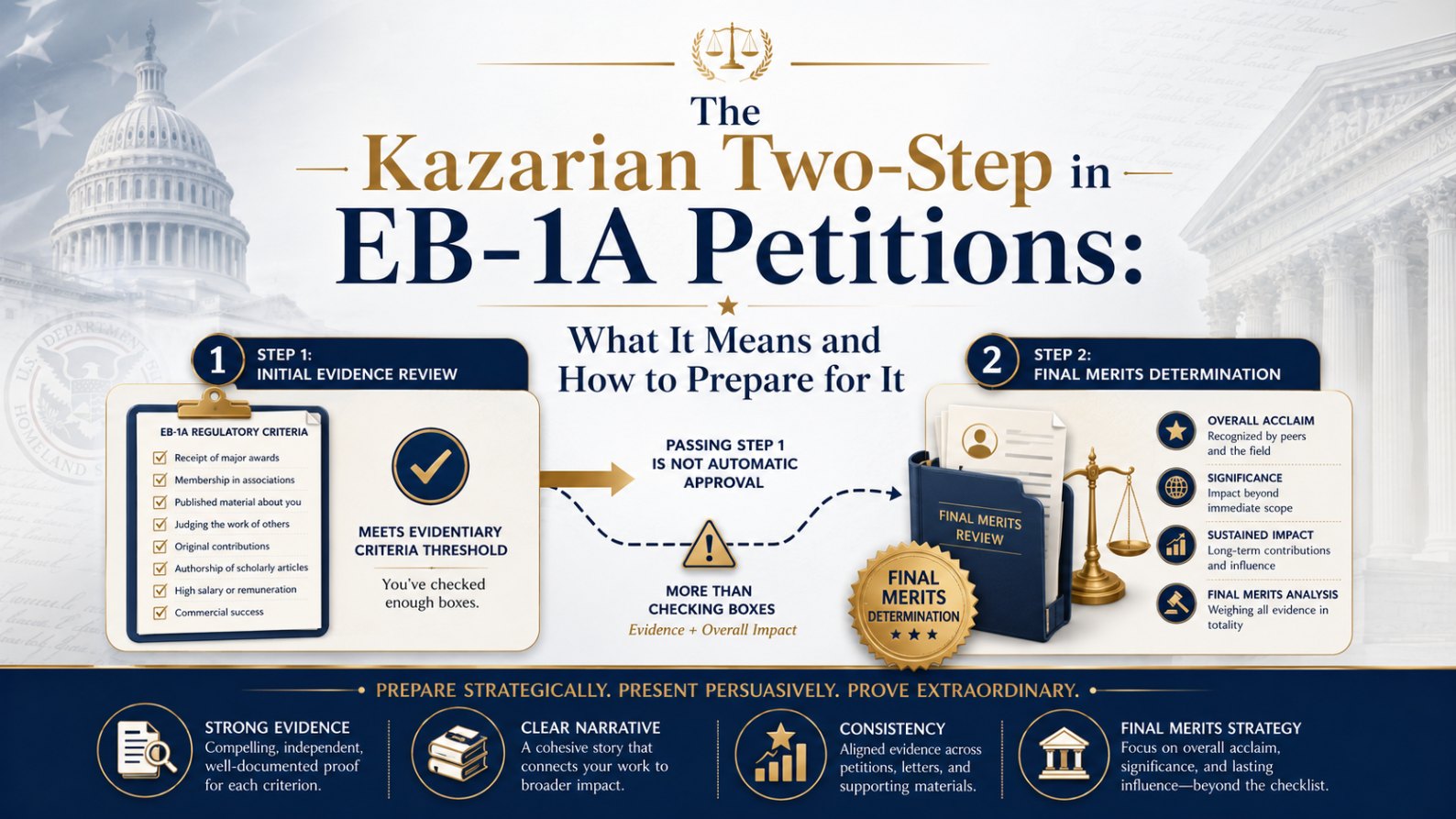
Before 2010, the prevailing assumption among many practitioners was straightforward: submit evidence for three of the ten regulatory criteria, and the EB-1A should be approved. The Ninth Circuit's decision in Kazarian v. USCIS, 596 F.3d 1115 (9th Cir. 2010), ended that assumption. The court agreed that the petitioner — a physicist — had satisfied several criteria, but held that meeting the initial threshold does not create a presumption of eligibility. What followed was a USCIS policy memorandum standardizing a two-part adjudicative process that remains the governing standard today.
The practical consequence is significant. An officer reviewing an EB-1A petition is required to do two things in sequence: first, determine whether the submitted evidence satisfies at least three of the ten criteria (or demonstrates a single major internationally recognized award); second, evaluate whether the record as a whole demonstrates that the petitioner has sustained national or international acclaim placing them among that small percentage who have risen to the very top of their field. Most modern EB-1A denials happen at step two — not because the applicant lacks accomplishments, but because the petition fails to make the quality argument that the final merits determination requires.
Step One: The Quantitative Threshold
At the first step, the adjudicator evaluates whether the submitted evidence fits the legal definitions of each claimed criterion. The officer is not yet deciding whether the work is "extraordinary" — they're determining whether the evidence counts toward a category at all. Evidence that is tangential to a criterion, or that satisfies a criterion in form but not in substance, gets disqualified here before step two is even reached.
The ten regulatory criteria at 8 C.F.R. § 204.5(h)(3) are:
- Receipt of lesser nationally or internationally recognized prizes or awards for excellence in the field
- Membership in associations that require outstanding achievements of their members, as judged by recognized national or international experts
- Published material about the alien in professional or major trade publications or other major media
- Participation as a judge of the work of others in the same or allied field
- Original scientific, scholarly, artistic, athletic, or business-related contributions of major significance to the field
- Authorship of scholarly articles in the field in professional or major trade publications or other major media
- Display of the alien's work at artistic exhibitions or showcases
- Performance in a leading or critical role for organizations or establishments with a distinguished reputation
- Command of a high salary or other significantly high remuneration relative to others in the field
- Commercial successes in the performing arts
Step one failures are more common than they look. An invitation to review a manuscript that the applicant never completed is not evidence of judging — it's evidence of receiving an email. Evidence submitted for "original contributions of major significance" that documents research activity without establishing the significance of the research's impact fails the criterion's own language. Officers are not supposed to weigh the quality of the evidence at this stage, but they are supposed to determine whether it is responsive to the criterion being claimed.
Step Two: The Final Merits Determination
This is where the adjudication becomes genuinely difficult, and where petitions with objectively strong records still fail. Even if the officer agrees that the applicant has published articles, participated in judging, and held a leading role, they can — and frequently do — deny the case by finding that the totality of the evidence doesn't demonstrate sustained national or international acclaim.
What the officer is actually looking for at this stage is whether the quality of the accomplishments matches the quantity. Fifteen publications that have been cited twice collectively do not demonstrate that the field engaged meaningfully with the work. The officer's job at step two is to determine whether the evidence collectively reflects a "high level of expertise indicating that the person is one of that small percentage who has risen to the very top of the field of endeavor" — language drawn directly from 8 C.F.R. § 204.5(h)(2).
| Factor | What USCIS Expects | Common Basis for Step Two Rejection |
|---|---|---|
| Citation count | High relative to peers in the same sub-specialty at the same career stage | Citations concentrated among collaborators or within a single institution |
| Journal prestige | Publications in journals recognized as leading in the field | Journals with low impact factors or that lack independent editorial review |
| Judging frequency | Consistent invitations from reputable journals or major conference program committees | One or two instances over an entire career, or judging through mass-solicitation platforms |
| Leading roles | Documented evidence that the applicant's specific contribution determined the organization's outcome | Senior title at a prominent employer without evidence of irreplaceable individual impact |
| Remuneration | Total compensation above the 90th percentile for the specific job title and geographic market | Benchmarking against a generic occupational category rather than the specific role |
How the Two-Step Affects Specific Evidence
IEEE membership. Membership in the general IEEE grade doesn't satisfy the associations criterion. The organization has over 400,000 members worldwide, and standard membership requires no peer evaluation of achievements. IEEE Fellow status is a different matter — it requires nomination by IEEE members, evaluation by a review panel, and approval by the IEEE Board of Directors, with elevation limited to no more than one-tenth of one percent of voting membership in any given year. The distinction between membership and fellowship is exactly the kind of qualitative assessment step two requires.
Patents. A patent, standing alone, rarely survives the final merits determination. The USPTO grants patents on novelty and non-obviousness, not on field significance. USCIS officers regularly note that a patent filing demonstrates an invention, not that the invention matters to the field. What converts a patent into evidence of major significance is downstream adoption: licensing agreements with independent companies, evidence of implementation in commercial products with documented market reach, or citations of the patent in subsequent patent applications filed by competitors. Revenue from licensing agreements quantifies impact in terms an officer can evaluate without domain expertise.
Leading or critical roles. The organization's reputation is evaluated independently of the applicant's title. A leading role in an organization that lacks a distinguished reputation doesn't satisfy the criterion regardless of the title held. Conversely, holding a senior title at a well-known employer without evidence of individual criticality also fails — if 50,000 engineers work at the same company, being one of them isn't evidence of a critical role. The letter from a C-suite executive that explains why a specific project would have failed or been materially set back without this particular person's contribution, tied to a documented outcome the company can point to, is what distinguishes a leading role argument from an employment verification.
Building a Petition That Survives Step Two
The failure mode to design against is the officer who concedes the criteria and denies the final merits. That officer's reasoning almost always follows the same pattern: the evidence is present but the achievements are consistent with a competent professional in the field rather than someone at the very top of it. The petition has to preempt that reasoning by providing comparative context that the officer can use to reach a different conclusion.
Curate, don't accumulate. A 500-page exhibit package with no clear roadmap signals to an officer that the petitioner is hoping volume will substitute for quality. If the applicant has 50 publications, the petition is stronger when it highlights the five with the highest independent citation counts and explains, using field-specific benchmarks, why those numbers are significant relative to peers. Altmetric scores, Web of Science citation rankings, and field-weighted citation data from Scopus or the NIH's iCite tool provide the comparative context that makes "500 citations" mean something specific rather than something general.
Expert letters need specificity, not adjectives. "I have reviewed this candidate's CV and find their work extraordinary" is a conclusory statement. Officers are instructed to give those letters little weight. A letter that says "The candidate's routing algorithm is now used in our national distribution network and reduced delivery latency by 40%, saving our organization approximately $12 million annually in infrastructure costs" gives the officer a verifiable fact from an independent source. That's probative evidence, not endorsement.
Address step two explicitly in the petition letter. Many petitions argue the criteria thoroughly and then assume the final merits argument follows automatically. It doesn't. The cover letter should contain a dedicated section — after the criterion arguments are complete — that synthesizes the record and makes the comparative case directly: what the citation percentile is relative to peers at the same career stage, which aspects of the record are exceptional rather than merely accomplished, and why the overall body of work places the applicant outside the range of ordinarily accomplished professionals in the field.
EB-1A vs. EB-2 NIW: Which Framework Fits the Record
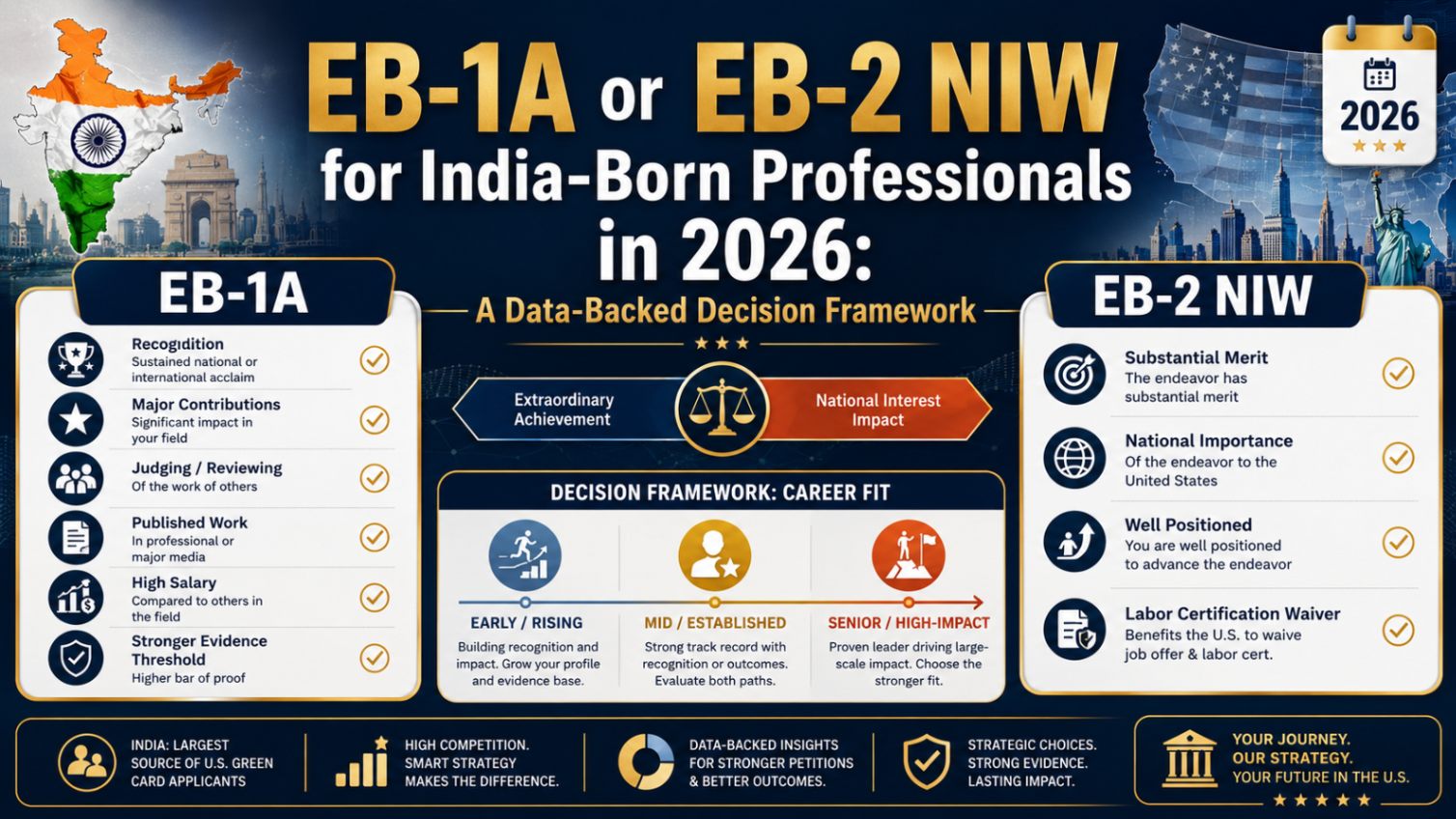
The Kazarian framework is what separates EB-1A from most other employment-based categories. EB-2 NIW, governed by Matter of Dhanasar, 26 I&N Dec. 884 (AAO 2016), asks whether the proposed endeavor has substantial merit and national importance and whether the applicant is well-positioned to advance it. That's a different question than whether the applicant has reached the very top of their field.
A researcher with a strong track record, good citation numbers, and genuinely important proposed work who isn't yet at a level that distinguishes them from other competent professionals in the field may be a stronger NIW candidate than an EB-1A candidate. The NIW doesn't have a final merits determination requiring proof of elite outlier status. That distinction should factor into the filing decision before a petition is prepared, not after an RFE is received.
Frequently Asked Questions
Is a PhD required for the EB-1A? No. The category is open to professionals in business, athletics, and the arts, as well as researchers. In business contexts, the most common evidence clusters around high compensation, leading roles in distinguished organizations, and original contributions demonstrated through commercial impact rather than scholarly publication. The Kazarian two-step applies equally — a business professional must show that their achievements are as rare and impactful in their sector as a top researcher's are in theirs. The form the evidence takes is different; the standard isn't.
What happens if three criteria are satisfied but the petition is still denied? The denial reflects a step two finding: the officer concedes criterion satisfaction but concludes that the evidence doesn't collectively demonstrate sustained national or international acclaim. Challenging that finding requires showing either that the officer applied the wrong legal standard, ignored submitted evidence, or failed to account for the comparative context that reframes the record. This is the most common scenario in EB-1A motion to reopen or appellate proceedings before the AAO.
How many citations are needed? There is no published threshold, and the Kazarian framework doesn't establish one. The relevant question is what the applicant's citation numbers mean relative to others in the same sub-field at a comparable career stage. For a theorist in a specialized area of physics, 100 citations may place the applicant in the top percentile. For a researcher in a high-volume field like oncology, 1,000 citations may be near the median. Tools like Clarivate InCites, Scopus's field-weighted citation impact metrics, and NIH's iCite can establish that comparative position with data the officer can verify.
Does a single instance of judging satisfy the criterion? Technically, one documented instance of judging — a completed peer review for a recognized journal, for example — is responsive to the criterion in step one. It will rarely survive step two. One review across an entire career doesn't reflect the kind of sustained engagement with the field's gatekeeping function that the final merits determination looks for. A consistent history of reviewing for journals recognized in the field, or repeated service on program committees for major conferences, is the standard that actually holds up under step two scrutiny.
The correct mental model for building an EB-1A petition is not "how do I satisfy three criteria" but "how do I prove I'm an outlier." The criteria are evidence categories. The final merits determination is the actual standard. A petition built around the first question often fails the second. A petition built around the second — what does it take to show this person is among the small percentage at the very top — usually satisfies the first as a byproduct.
A VangaVault profile assessment reviews the existing record against both steps of the Kazarian framework and returns a written gap analysis within 48 hours, identifying which criteria are currently supportable and what the final merits argument would require. Schedule a consultation to start that evaluation.
Get Immigration Insights Delivered to Your Inbox
Practical guidance on EB-1A, EB-2 NIW, O-1A, and U.S. immigration — no spam, unsubscribe anytime.