Receiving an RFE is a common step in the US immigration process. Learn how to dissect the USCIS notice and identify the specific evidence gaps needed to secure your approval.
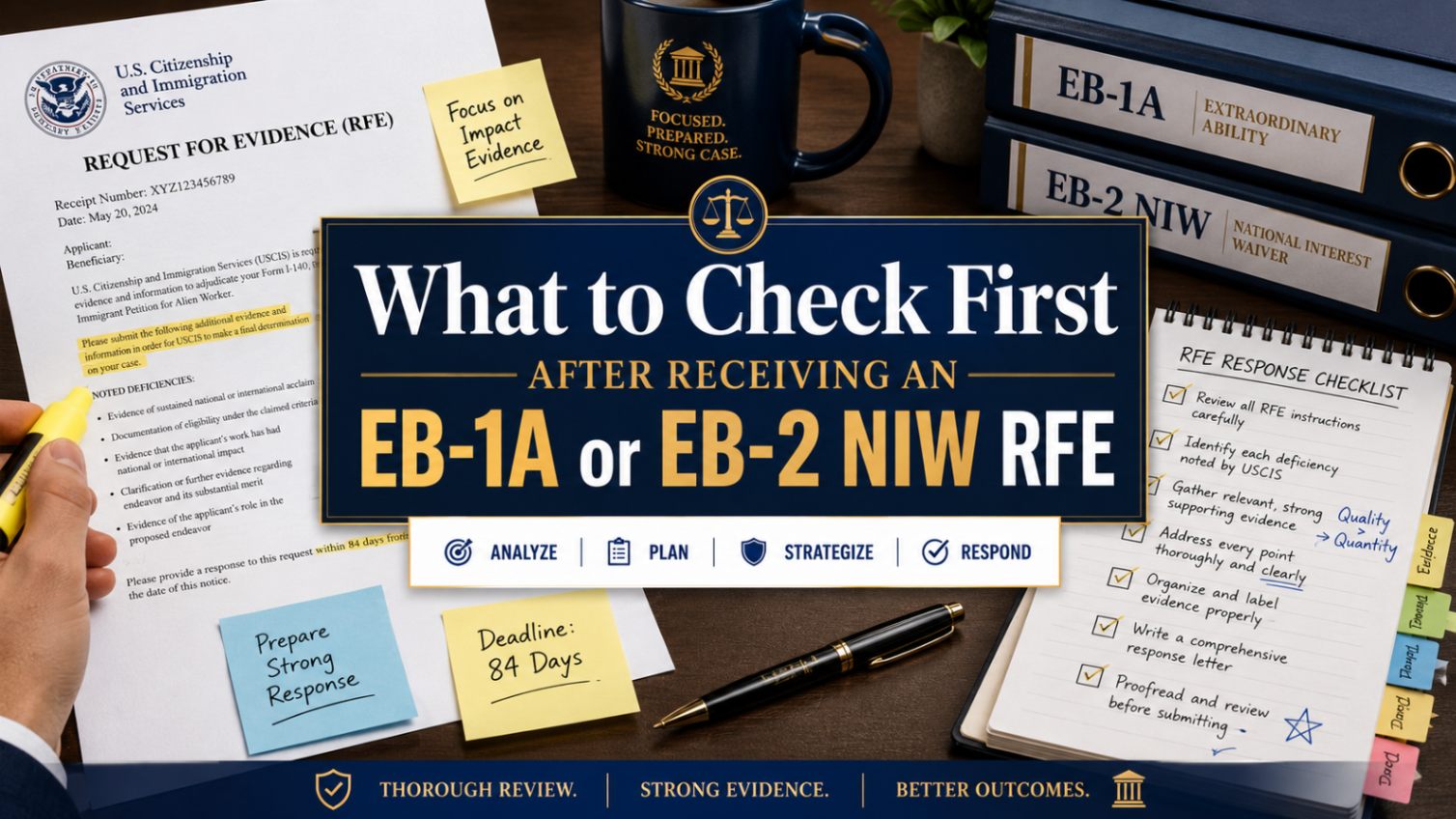
What to Check First After Receiving an EB-1A or EB-2 NIW RFE
An RFE is not a denial. It's a specific set of instructions from an adjudicator identifying exactly what they found unconvincing in the initial filing. That distinction matters, because the way you read the notice determines the quality of the response — and a poor response to a manageable RFE can produce a denial that a stronger original petition would have avoided entirely.
The first thing to understand is that most RFEs are structured the same way: boilerplate legal definitions at the top, a recitation of evidence already submitted, and then the section that actually matters — the officer's specific reasoning for why that evidence fell short. Everything in the response should address that third section. The first two are preamble.
The Immediate 24-Hour Checklist
Before drafting anything, confirm the logistics. USCIS operates on fixed deadlines that carry no exceptions, and an administrative oversight in the first 24 hours can limit options for the rest of the response period.
Check the response deadline. The date is printed on the first page of the notice. USCIS allows 87 days to respond — 84 days for the response itself, plus three days for mail delivery. That window is calculated from the date on the notice, not the date it arrived. It cannot be extended under normal circumstances. A response that arrives one day late results in a denial for abandonment. Use the date printed in the letter, not a calendar calculation from when the envelope showed up. If the deadline is close, overnight delivery through a trackable carrier is the only reliable option.
Confirm the service center and officer code. This information appears in the header or footer of the RFE. The Texas Service Center and Nebraska Service Center have developed different interpretive patterns over time — TSC tends to scrutinize the final merits determination more aggressively on EB-1A filings; NSC has issued more RFEs questioning the qualifying nature of association memberships. The officer code won't override legal requirements, but it adds context when anticipating what additional challenges the response might face.
Identifying the Specific Grounds
The officer's actual objections are in the commentary — the language that goes beyond the standard legal definitions. That section requires close reading, because how USCIS frames a deficiency determines what kind of evidence fixes it.
For EB-1A, USCIS applies the Kazarian two-step. Step one: did the applicant meet at least three of the ten regulatory criteria? Step two: does the overall record show the applicant has reached the very top of their field? These are different battles. An RFE that acknowledges criteria satisfaction but questions extraordinary ability overall is a final merits problem. An RFE that disputes whether individual criteria were met at all requires rebuilding the evidentiary foundation for those specific criteria first. Conflating the two produces a response that addresses neither cleanly.
For EB-2 NIW, the framework follows Matter of Dhanasar, 26 I&N Dec. 884 (AAO 2016), which established three prongs: (1) the proposed endeavor has substantial merit and national importance, (2) the applicant is well-positioned to advance it, and (3) on balance, it would benefit the U.S. to waive the normal job offer requirement. RFEs almost always target one or two prongs specifically. Identifying which ones allows the response to be targeted rather than comprehensive in ways that don't address what the officer actually asked.
| Case Type | Frequent RFE Challenge | Root Issue | Effective Response |
|---|---|---|---|
| EB-1A | Original contributions | No evidence of "major significance" beyond the applicant's immediate employer | Licensing agreements, independent implementation, citation records showing field-wide adoption |
| EB-1A | Leading or critical role | Organization's reputation not established; applicant's specific impact not documented | Organizational charts, letters from executives naming specific decisions and outcomes |
| EB-2 NIW | National importance (Prong 1) | Proposed work framed too narrowly — appears to benefit one company, not the country | Economic analysis, CDC/NIH reports, government white papers linking the work to a documented national priority |
| EB-2 NIW | Well-positioned (Prong 2) | No concrete implementation plan or track record of comparable success | Letters of intent, secured funding documentation, prior project outcomes |
| Both | Expert letters | Letters contain characterizations without technical specificity | Rewritten letters naming specific projects, the applicant's exact role, and measurable outcomes |
Analyzing the Final Merits Determination
In EB-1A cases, the final merits determination is where genuinely strong petitions most often get stopped. An officer can concede that three criteria are satisfied and still issue an RFE arguing the applicant hasn't demonstrated they belong in the small percentage who has risen to the very top of their field. The language in those RFEs tends toward words like "routine" or "expected" — framing legitimate achievements as ordinary outputs for someone at that career stage.
The response requires comparative data, not just additional evidence of the same type. Two hundred citations means something different depending on the sub-field and the career stage. If 200 citations places the applicant in the top 2% of researchers in their specific area with equivalent years of experience, that's the argument to make — backed by third-party citation analysis tools, journal impact factor rankings, and field-specific benchmarks from sources like Web of Science or Scopus. The goal is to shift the officer's reference frame from "is this impressive in general" to "what does this mean in context."
Missing Evidence vs. Disregarded Evidence
Officers handling high case volumes miss things. If the RFE states that the applicant failed to provide proof of association membership but Exhibit 5 is a membership certificate, the response strategy is different from a situation where that evidence was never submitted.
When evidence was overlooked, the response should respectfully identify it — pointing to the exhibit number, the tab, and the page — while simultaneously supplementing it with new documentation to remove any remaining ambiguity. The tone matters here: the goal is to make it easy for the officer to find the evidence and reach an approval, not to demonstrate that they made an error.
When evidence was considered but dismissed as insufficient, resubmitting it in the same form accomplishes nothing. A membership dismissed because the organization doesn't require "outstanding achievements" for entry needs the organization's bylaws or a letter from its governing board explaining the actual selection criteria. If the RFE questions whether a publication qualifies as "major media," submitting the same article with a cover letter doesn't fix the problem — verified circulation data from Cision or SimilarWeb, alongside the publication's editorial guidelines, does.
Strategy for New Expert Opinion Letters
More letters saying the same things as the original letters is not a response strategy. USCIS adjudicators have become increasingly attentive to template language — letters that use the same phrases, the same structure, and the same level of generality as the first round of submissions. Those letters don't add information; they add volume, which signals to the officer that the petitioner has run out of substantive arguments.
Letters that actually move RFE responses forward have two characteristics. First, they come from independent experts — people who have no professional relationship with the applicant and no personal incentive to support the petition. An endorsement from a researcher who independently encountered the applicant's published work and built on it carries more evidentiary weight than a letter from a former supervisor. Second, they describe exactly how the expert encountered the work and what it produced. Not "I am familiar with her research and consider it groundbreaking," but "I read her 2022 paper on X, implemented the methodology in my own lab, and the resulting reduction in error rate was Y — a result we have since published citing her original contribution."
Documenting National Importance in NIW Cases
Prong 1 of the Dhanasar framework is where the majority of NIW RFEs concentrate. Adjudicators often frame individual professional contributions as local — benefiting an employer, a patient population, or a specific product — rather than national. The response has to bridge that gap explicitly, using language and documentation the officer can point to in an approval.
The most effective approach ties the applicant's specific work to a documented national priority. A software engineer working on infrastructure security isn't just protecting one company's servers — they're contributing to the resilience of systems the Department of Homeland Security has identified as critical national infrastructure. A physician researcher isn't just treating patients — they're addressing a disease burden that the CDC has quantified in published reports. Government-issued documents, congressional testimony, NIH strategic plans, and official agency reports are the most persuasive anchors for this argument because they're independently verifiable and carry institutional authority that a general business case doesn't.
Drafting the Response Letter
The response letter is a navigation document. Its job is to walk the officer through the new evidence in the exact order the RFE raised concerns, making it as easy as possible to reach an approval. Use the same headings and criterion numbering the RFE used. If the officer asked about Criterion 3 and Criterion 7, the response letter should have labeled sections for Criterion 3 and Criterion 7.
Each section should open with a brief statement of the new evidence being provided — listed by exhibit number — followed by a concise argument connecting that evidence to the specific concern the officer raised. The argument should be factual and direct. Officers working through a response are looking for the evidence that resolves the open question; they're not looking for advocacy prose that restates how accomplished the applicant is. Every sentence in the response letter should be doing specific work. If it isn't pointing to an exhibit, establishing legal context, or addressing the officer's stated concern, it's friction.
Frequently Asked Questions
How long is the RFE response window? USCIS allows 87 days from the date on the notice — 84 days for the response plus 3 days for mail. The deadline is fixed and cannot be extended. A response that arrives after the deadline results in denial for abandonment regardless of the strength of the evidence. Mail the response at least one week before the deadline through a trackable carrier, and keep the shipping confirmation.
Can new evidence be submitted that didn't exist at the time of filing? Evidence submitted in the response must establish eligibility as of the original filing date — this is the priority date rule. Clarifications of past work, additional documentation of prior achievements, and new expert letters addressing the same body of work are all appropriate. An achievement that occurred after the filing date cannot be used as the primary basis for satisfying a criterion, though it may be referenced in a final merits argument to demonstrate continued trajectory.
Does receiving an RFE mean the case will be denied? Not inherently. A well-constructed response that directly addresses every concern the officer raised, backed by objective third-party evidence rather than additional subjective characterizations, produces approvals regularly. The risk rises when responses add volume without adding specificity — more letters, more exhibits, more argument, but none of it targeting the actual question the officer asked.
What is the final merits determination and how does it appear in an RFE? In EB-1A cases, it's the second stage of the Kazarian analysis. Even when three criteria are satisfied, the officer can issue an RFE arguing that the overall record doesn't demonstrate someone at the very top of the field. The language in these RFEs is typically subjective — "routine accomplishments," "expected output," "not indicative of sustained acclaim." The response requires comparative data establishing where the applicant's record actually places them relative to peers in their specific sub-field, not just general claims of accomplishment.
The most useful first step after receiving an RFE is building an evidence matrix — a document that maps every concern in the officer's commentary to a specific new exhibit or data point. Nothing in the RFE should go unanswered, and nothing in the response should fail to connect back to something the officer specifically questioned.
A VangaVault profile assessment reviews the RFE line by line against available evidence and returns a written response roadmap identifying the strongest arguments and the specific gaps that remain, within 48 hours. Schedule a consultation to start that process.
Get Immigration Insights Delivered to Your Inbox
Practical guidance on EB-1A, EB-2 NIW, O-1A, and U.S. immigration — no spam, unsubscribe anytime.