
If your visa is expiring but your profile isn't ready for EB-1A, you need a bridge strategy. We examine O-1A, H-1B recapture, and the risks of premature filing.
What to Do If Your Visa Status Is Expiring but You Are Not Ready to File EB-1A or EB-2 NIW Yet
When current non-immigrant status is nearing expiration and the evidentiary record doesn't yet meet the EB-1A threshold, the only sensible move is to secure a bridge — a legal pathway that buys the 6 to 12 months often needed to build out citations, judging history, or the kind of press coverage that survives officer scrutiny. Filing prematurely creates a specific problem that most applicants underestimate: a denial on the record. That denial doesn't disappear. It follows the case into the next filing and gives the next adjudicator a formal prior finding to point to.
The Risk of Filing Before You're Ready
The pressure becomes acute as the six-year H-1B cap or the five-year L-1B limit approaches. What tends to happen is a "kitchen sink" filing — every document gathered, every marginal credential included, submitted in bulk with the hope that something satisfies the standard. It rarely does.
USCIS evaluates EB-1A petitions under the Kazarian framework: first, whether the applicant meets at least three of the ten regulatory criteria; second, whether the full record — taken together — demonstrates someone at the top of their field. A premature filing typically passes step one and fails step two. The problem is what that failure looks like on paper.
If the petition includes salary evidence that ranks in the 75th percentile for the applicant's metro area, the officer's denial will state, explicitly, that this does not constitute extraordinary ability. When the stronger petition arrives a year later with better data, it's fighting against that prior finding. USCIS isn't legally bound to follow a previous denial, but adjudicators do read case history. A bridge strategy avoids creating that history in the first place.
The 60-Day Grace Period and the B-1/B-2 Option
Most employment-based visa holders rely on the 60-day grace period after their position ends. Under 8 CFR 214.1(l), this period begins on the last day of employment and gives the holder time to depart, change status, or find a new employer — not to rebuild a petition from scratch.
For applicants who need more runway, a change of status to B-1/B-2 (Visitor for Business or Pleasure) can add up to six months of authorized stay. This status carries no work authorization, but it keeps the holder lawfully present in the United States while the real preparation work happens: finalizing peer review history, coordinating expert letters, organizing the exhibit file.
The Form I-539 must be filed before the current period of authorized stay expires — including before the grace period ends if that's the basis for presence. Processing times at USCIS for I-539 applications have historically run several months, which can functionally extend the available window. Once the I-140 (the EB-1A immigrant petition) is filed, applicants from countries where the priority date is current may also be able to file the I-485 Adjustment of Status concurrently, which itself confers a period of authorized stay.
One practical note: the B-1/B-2 strategy works best for applicants who are genuinely close to the threshold — within one or two milestones — not for those who need to build a profile from the beginning. A six-month window disappears faster than it looks on paper.
The O-1A as a Strategic Bridge
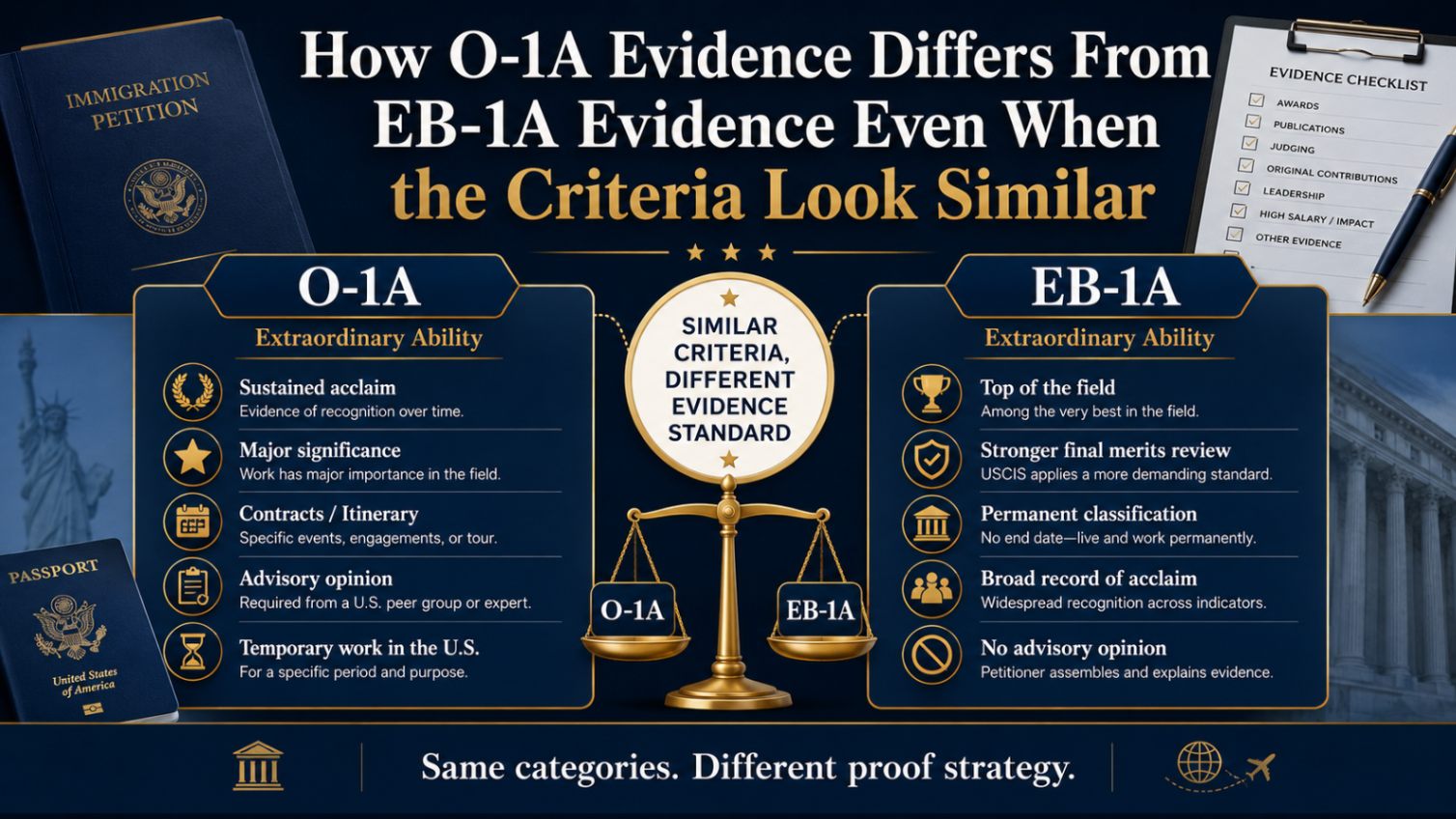
The O-1A visa for individuals with extraordinary ability in sciences, education, business, or athletics is the most stable bridge available to EB-1A candidates. The regulatory criteria for O-1A mirror the EB-1A criteria closely, but in practice, adjudicators apply a somewhat less exacting standard to the nonimmigrant classification — an O-1A approval doesn't guarantee EB-1A approval, and USCIS has said as much, but a well-documented O-1A record does establish that the applicant's credentials have already been reviewed and found credible.
The practical advantages are meaningful. O-1A status is granted in three-year increments with no hard cap on extensions. It provides full work authorization. It allows the applicant to continue building the salary history, professional engagements, and organizational contributions that feed directly into the EB-1A evidentiary record.
The constraint is that O-1A requires a petitioner — an employer or a qualified agent. Self-petitioning isn't available the way it is for EB-1A. For applicants with a supportive employer willing to file, the O-1A is usually the cleanest path. For founders and independent researchers without that sponsorship structure, an authorized agent arrangement is worth exploring, though it adds complexity to the filing.
Recapturing H-1B and L-1 Time
This is the most overlooked tool in the bridge toolkit, and it's often sitting unused in the applicant's own travel history.
Any day spent outside the United States while holding H-1B or L-1 status is technically recapturable — it can be added back to the end of the authorized period. An applicant who traveled internationally for two weeks annually over six years of H-1B status may have recovered three to four months of additional time. That's not a small amount. Three months can be the difference between filing a petition that includes a newly granted patent or a journal article with its first round of citations, versus filing without it.
Recapture requires documentation: I-94 travel history from cbp.dhs.gov, passport stamps, boarding passes if available. The petition must specifically request the recapture and account for each period outside the country. Officers do scrutinize these calculations, so the documentation needs to be complete.
Comparing Bridge Options
| Option | Work Authorized | Typical Duration | Complexity | Primary Use Case |
|---|---|---|---|---|
| O-1A Visa | Yes | 1–3 years per approval, indefinitely renewable | High | Applicants with a sponsoring employer or agent who are close to EB-1A threshold |
| B-1/B-2 Change of Status | No | Up to 6 months | Low | Buying authorized presence for final petition prep |
| H-1B/L-1 Time Recapture | Yes | Varies by travel history | Medium | Recovering unused authorized time from past international travel |
| Day 1 CPT (F-1) | Yes (within program) | 1–2 years | High | Last resort when other options are exhausted; carries scrutiny risk |
| EB-2 NIW Filing | No (independently) | Priority date dependent | Medium | Establishing a priority date while continuing EB-1A profile development |
The EB-2 NIW as a Safety Net
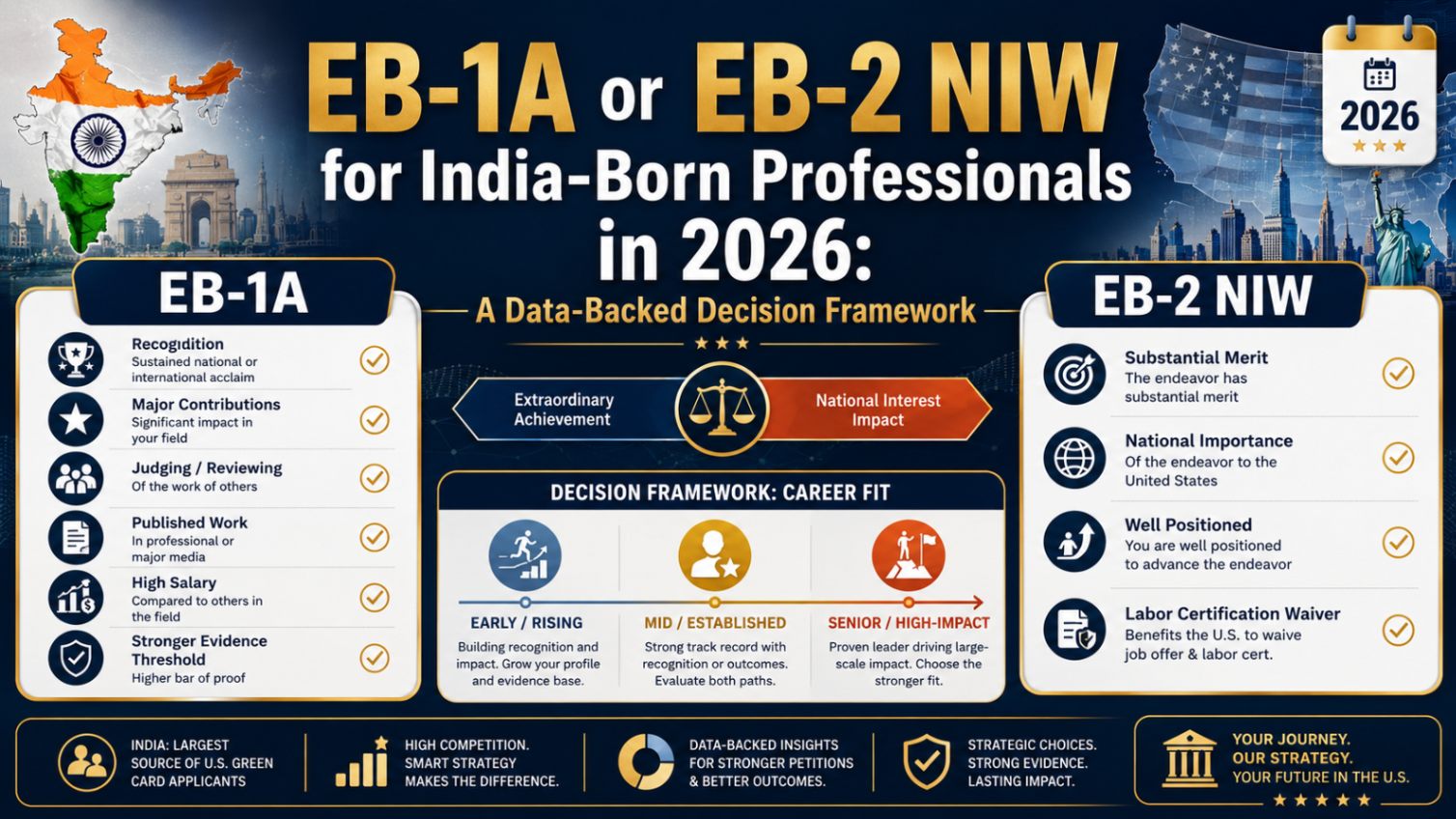
Applicants who aren't yet at the "extraordinary" standard EB-1A requires may already satisfy the National Interest Waiver standard. The EB-2 NIW, adjudicated under the framework established in Matter of Dhanasar, 26 I&N Dec. 884 (AAO 2016), asks three questions: Does the proposed endeavor have substantial merit and national importance? Is the applicant well-positioned to advance it? Would requiring a job offer and labor certification work against U.S. interests?
The NIW doesn't require the applicant to be at the top of their field. It requires a demonstrable connection between the applicant's specific work and a benefit to the United States. That's a different — and generally more accessible — standard.
Filing an NIW serves two purposes. It locks in a priority date, which matters enormously for applicants from countries with EB-2 backlogs. And it creates a baseline: if approved, the applicant has established permanent residency eligibility at the exceptional ability tier, and can continue building toward EB-1A for the classification upgrade later. For applicants from India or China, the EB-1A's historically shorter backlog relative to EB-2 makes this upgrade strategy particularly worth modeling out.
Day 1 CPT: Understanding the Risks
Enrollment in a graduate program offering Day 1 Curricular Practical Training is a legal pathway. It's also one that USCIS has reviewed with increasing skepticism, and that scrutiny intersects directly with EB-1A filings.
The issue isn't the CPT itself — it's what adjudicators infer about the applicant's intent. An individual claiming extraordinary ability in their field who simultaneously enrolls in a lower-tier master's program at a school known primarily for its CPT arrangements will face questions about why. If the academic program has no substantive connection to the professional field underlying the EB-1A, that incongruity will come up — either in an RFE on the EB-1A or in a maintenance of status review during Adjustment of Status.
This option belongs at the bottom of the list, used only when O-1A and B-1/B-2 are genuinely unavailable. If it is used, the program must be academically rigorous and directly relevant to the claimed field of extraordinary ability.
Milestones Worth Waiting For
The most useful reframe for applicants watching the calendar is to stop tracking days remaining and start tracking evidence milestones. A petition filed two months early with incomplete evidence costs far more — in time, fees, and credibility damage — than a petition filed two months late with a clean record.
For researchers, citation count matters more than paper count. The relevant benchmark isn't a round number — it's what the top 1% of the applicant's specific sub-field looks like according to tools like Clarivate's Essential Science Indicators. Getting there at 60th percentile and filing anyway is the mistake.
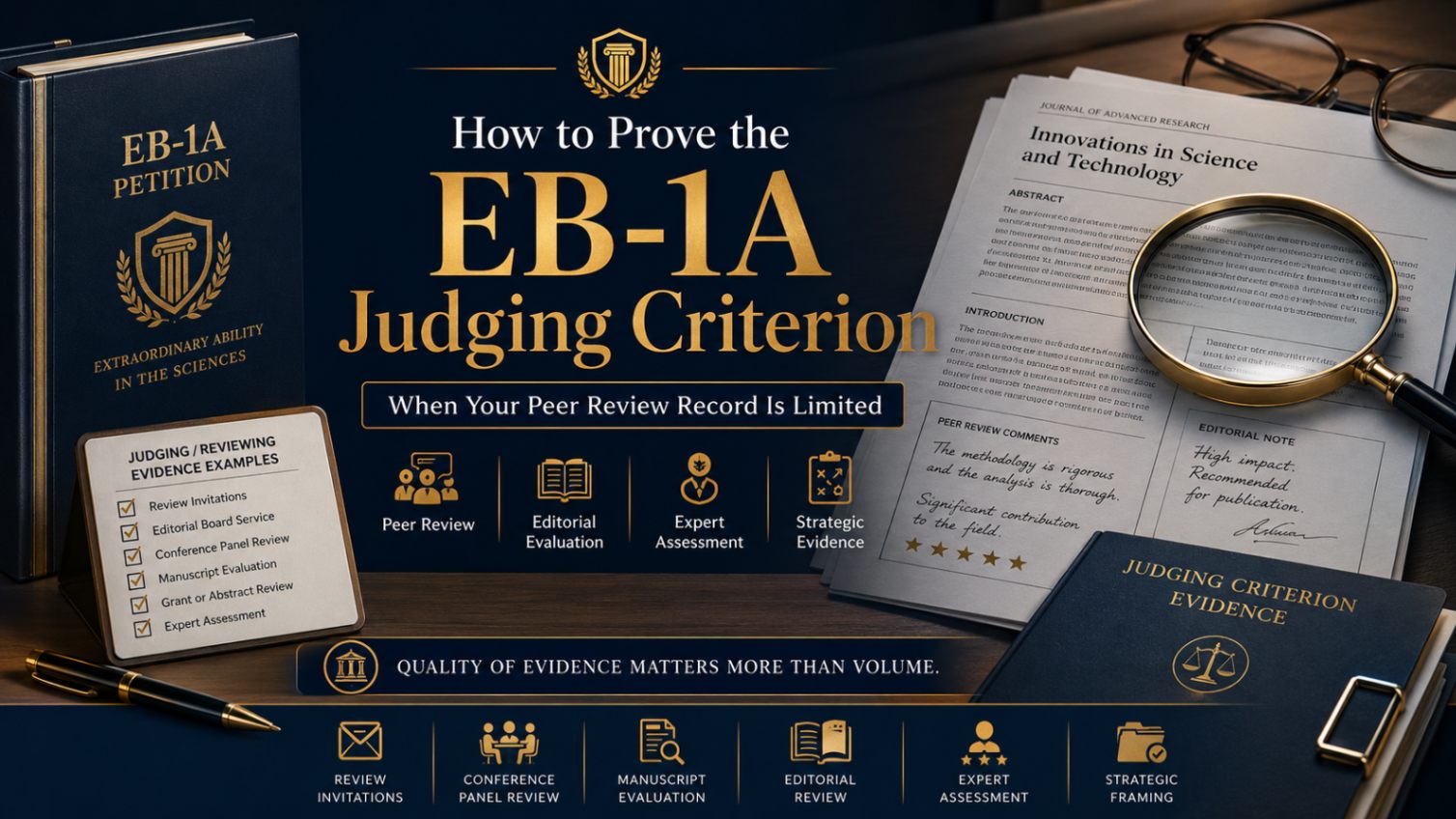
For judging activity, somewhere between 5 and 10 peer reviews for journals the field actually respects, over a natural span of time, is a workable baseline. Three reviews for three obscure journals completed in a single month before filing doesn't meet the standard and signals exactly the kind of manufactured activity that triggers credibility reviews.
For press, the bar is full-length features with verifiable circulation data, editorial independence, and a journalist who can be shown to have found the applicant independently — not placements arranged by a PR firm or distributed through Newswire.
For critical role evidence, the letters need to describe specific decisions and measurable outcomes. Revenue figures, product metrics, funding rounds where the applicant's work was explicitly cited by investors — these are the specifics that give the criterion weight. Titles and org charts without narrative context don't carry the case.
Frequently Asked Questions
Can I stay in the United States after my H-1B expires if I have a pending EB-1A? Filing the I-140 petition alone does not authorize continued presence after H-1B status expires. To remain, a pending I-485 Adjustment of Status application is also required — and the I-485 can only be filed when the priority date is current under the monthly Visa Bulletin published by the Department of State. Applicants from countries with significant EB-1A backlogs must maintain a separate nonimmigrant status independently of the I-140.
Is the O-1A easier to get than EB-1A? The regulatory criteria are nearly identical, but in practice the O-1A is adjudicated with somewhat more deference. This is partly because the stakes differ — a nonimmigrant visa doesn't confer permanent residence, and officers reflect that in how they weigh borderline evidence. An O-1A approval is a useful data point, but USCIS has explicitly held that it doesn't bind a future EB-1A adjudicator.
What happens if the EB-1A is denied while on a B-1/B-2 bridge? If the denial comes while the B-1/B-2 authorized stay is still valid, the applicant can remain until that period ends and then depart. If the I-539 itself is denied, departure is required immediately. Since B-1/B-2 carries no work authorization, there's no employment to return to in the interim. In most cases, a denial in this situation means continuing profile development from abroad and refiling through Consular Processing rather than Adjustment of Status.
How early should bridge planning begin? Six to eight months before the current status expires is the minimum comfortable window. An O-1A petition, properly assembled, takes time to prepare — the supporting letters alone require coordinating multiple independent experts. A B-1/B-2 change of status filed too close to the end of authorized stay risks processing delays that result in a gap. Applicants who start this conversation thirty days out have already narrowed their options significantly.
The strategic delay is almost always less expensive than the premature filing. A VangaVault profile assessment provides a technical breakdown of the current evidentiary record against the ten EB-1A criteria, ranks the available bridge options by fit, and delivers a written 6-month roadmap within 48 hours. Schedule your assessment here.
Get Immigration Insights Delivered to Your Inbox
Practical guidance on EB-1A, EB-2 NIW, O-1A, and U.S. immigration — no spam, unsubscribe anytime.