Meeting three EB-1A criteria is only the first step. We explain why the final merits determination causes many denials and how to build a stronger case for USCIS.
Why EB-1A Petitions Fail in Final Merits Even After Meeting More Than Three Criteria
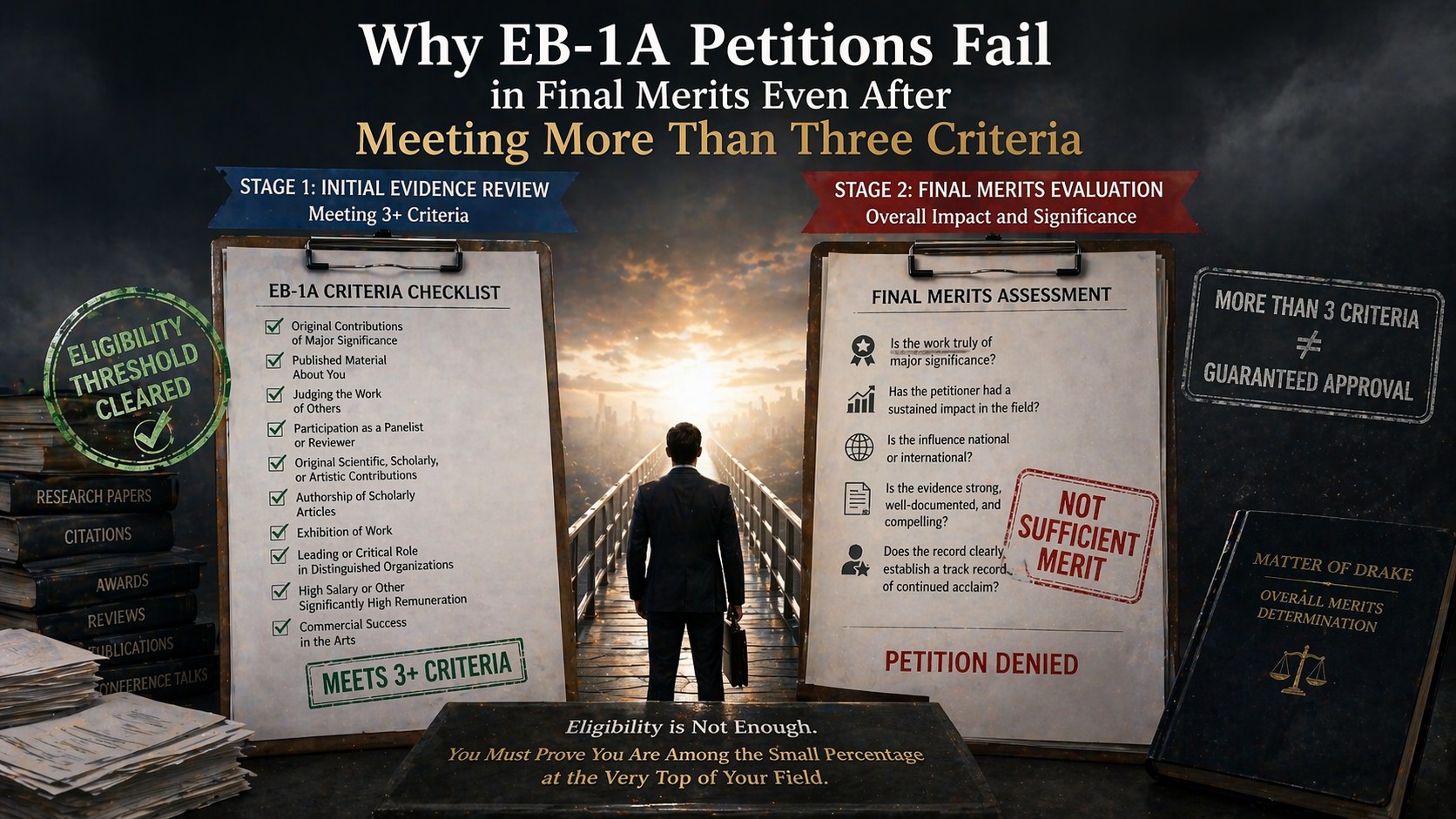
The most frustrating denial letter an EB-1A applicant can receive is one that acknowledges the evidence — agrees, in fact, that three or more criteria were met — and then denies the petition anyway. It reads like a contradiction. It isn't. It's the predictable result of a petition built to satisfy a checklist rather than answer the underlying question USCIS is actually asking: is this person genuinely among the small percentage who have risen to the very top of their field?
Meeting three criteria is the entry requirement for a two-part evaluation. The first part is quantitative. The second part — the Final Merits Determination — is qualitative, and it's where the majority of denials happen. No amount of additional criteria satisfied at a marginal level compensates for weak evidence at stage two.
The Kazarian Framework and Why Both Steps Matter
The two-part adjudicative standard comes from Kazarian v. USCIS, 596 F.3d 1115 (9th Cir. 2010). Before that ruling, adjudication was inconsistent enough that officers were sometimes improperly folding quality judgments into the criteria review rather than separating them. The Ninth Circuit's decision formalized a clean two-step process that USCIS subsequently adopted into its Policy Manual.
Stage One is a threshold check. The officer reviews each of the ten regulatory criteria and determines whether the submitted evidence technically satisfies at least three. This is largely a binary evaluation per criterion: judging activity — yes or no; scholarly authorship — yes or no. If three or more criteria are satisfied at this step, the petition advances.
Stage Two is where most denials happen. The officer steps back from the individual criteria and evaluates whether the totality of the evidence demonstrates someone who has genuinely reached the top of their field — not just a competent professional with an assembled portfolio of credentials. The statutory language in INA § 203(b)(1)(A) sets the bar at "extraordinary ability" shown "through extensive documentation," which courts and USCIS have consistently interpreted as requiring something beyond strong professional credentials. The officer's question at this stage is whether the evidence, read together, makes that case convincingly.
Why Volume Fails the Qualitative Test
USCIS training materials are explicit on this point: satisfying the minimum requirements for a criterion does not mean the applicant is extraordinary. The distinction matters most in the criteria most susceptible to padding.
The judging criterion is the clearest example. Fifteen peer reviews submitted as evidence of judging the work of others technically satisfies stage one. At stage two, the officer looks at those fifteen reviews differently: Are the journals recognized within the field? Is peer review an expected professional norm for anyone with a doctoral degree in this discipline, or does it signal something above the baseline? If every researcher in the applicant's sub-field reviews papers as a matter of routine professional obligation, then reviewing fifteen papers doesn't distinguish the applicant from the rest of the field — it confirms they are doing what the field expects of them.
The original contributions criterion has the same failure pattern. A patent technically satisfies stage one. At stage two, the officer asks what the patent has done: Has it been licensed? Cited in subsequent filings by competitors? Implemented by companies outside the applicant's own employer? A patent that exists in isolation, without evidence that anyone in the field engaged with it, fails the "major significance" requirement at the merits stage. Filing paperwork with the USPTO proves an idea was novel enough to receive protection. It doesn't prove the field noticed.
The Stage One / Stage Two Gap
| Criterion | Passes Stage One | Survives Stage Two |
|---|---|---|
| Scholarly articles | 5–10 published papers in relevant journals | High citation counts relative to field average, citations from independent international researchers |
| Judging | 10 peer reviews for a conference | Consistent multi-year reviewing record for high-impact journals; formal editorial board appointment |
| Critical role | Senior title at a recognized company | Documented specific decisions and measurable outcomes tied to those decisions; C-suite letter with named contributions |
| Memberships | Association membership requiring a degree | Fellow-tier designation or equivalent; bylaws requiring outstanding achievement evaluated by recognized experts |
| High salary | Compensation above the field average | Top 1–5% for the specific role and metro, benchmarked against independently sourced labor data |
The Field Narrowing Problem
Narrowing the claimed field of endeavor is a common tactical choice — defining the specialty tightly enough that the applicant's standing within it looks more impressive. A cardiologist becomes a cardiologist specializing in robotic-assisted valve repair for elderly patients. A software engineer becomes a distributed systems engineer focused on low-latency consensus protocols for financial infrastructure.
Specificity can be legitimate and useful. The problem is when the narrowing is so extreme that the field itself shrinks to a handful of practitioners. Officers recognize this move. If the claimed field is small enough that being "at the top" of it doesn't require any particularly unusual distinction, the final merits argument collapses. The officer will look for evidence that the applicant's work has relevance beyond the narrowly defined specialty — that it has influenced the broader discipline from which the sub-field derives. If that broader impact isn't in the record, the artificially narrow framing makes the petition look evasive rather than precise.
Expert Letters: The Most Commonly Wasted Evidence
Recommendation letters appear in nearly every EB-1A petition. In a significant number of them, those letters are the weakest element in the file — and they drag down the stage two analysis precisely because officers know how they're produced.
A letter that calls the applicant "one of the most gifted minds in the field" without explaining why contributes nothing. A letter from a former manager describing the applicant as a "valuable team member with consistent performance" actively hurts the case by demonstrating that even those closest to the applicant's work can't articulate why it's extraordinary.
What carries weight at stage two is specificity that can't be fabricated. A letter from an independent expert — someone with no professional obligation to the applicant — that describes a specific technical contribution, names the outcome it produced, and explains its significance relative to what others in the field had accomplished before it: that is the standard. "His algorithm reduced server latency by 40% across our infrastructure, which set a new benchmark we've since seen adopted by three competitors" answers the question USCIS is asking. "He is a talented and dedicated engineer" does not.
The independence of the letter writer matters as much as the content. Letters from former advisors, co-authors, and employers carry less weight than letters from experts in the field who encountered the applicant's work without a prior relationship and can speak to its impact on their own research or practice.
Where Final Merits Arguments Break Down
Lack of sustained acclaim. EB-1A requires sustained national or international acclaim — not a single peak. An applicant whose citation record shows strong early work followed by three years of declining engagement, or who hasn't received a conference invitation or peer review request recently, presents a trajectory that argues against current extraordinary status. The officer reading the file will note that what may have been true five years ago doesn't establish that the applicant is at the top of their field now.
Circular evidence. Using a single achievement to carry multiple criteria simultaneously is a structural weakness that shows up clearly in the final merits review. One award that is submitted as evidence of the awards criterion, the original contributions criterion, and the final merits argument itself isn't three pieces of evidence — it's one piece of evidence doing too much work. USCIS looks for a diverse portfolio where independent data points corroborate each other. When the entire claim to extraordinary status rests on a single event or achievement, the final merits determination almost always goes negative.
Ignoring the totality requirement. The final merits review is explicitly a totality test. An applicant who barely clears three criteria with no additional supporting context is presenting a thin totality. Strong petitions include evidence that doesn't fit neatly into the ten criteria but contributes to the overall picture: invitations to present at closed industry forums, informal mentions in trade publications where the journalist independently identifies the applicant as an authority, advisory roles at organizations that don't publicly advertise their structure. These don't satisfy criteria on their own, but they fill out the qualitative picture in a way that matters at stage two.
Building the Cover Letter for Stage Two
The petition cover letter is the document that connects evidence to standard — and most cover letters don't do this adequately. Stating "Exhibit 14 demonstrates Petitioner's peer review activity satisfying the judging criterion" is a stage one argument. It establishes that the criterion is technically met. It says nothing about what the invitation to judge reveals about the applicant's standing in the field.
Stage two requires context the officer doesn't have and won't independently research. If the petition involves judging at a competition, the cover letter should explain the selection process for judges — what expertise is required, how many applications are received, who evaluates candidates. If it involves citations, the letter should compare the applicant's citation count to the field average for researchers at the same career stage, using a named database and methodology. Officers are not specialists in the applicant's discipline. Without the benchmark, they default to skepticism.
The standard this context-building must achieve is demonstrating that the applicant's accomplishments are superior to those of peers — not just present. The comparative argument is what the stage two standard demands, and it must be explicit, specific, and documented.
Frequently Asked Questions
Can I be approved if I only meet exactly three criteria? Yes, but the margin for error at stage two disappears almost entirely. When three criteria are the entirety of the evidentiary foundation, the officer has more room to find the totality insufficient — particularly if one of the three is relatively weak. Meeting four or five criteria, each with strong supporting evidence, produces a richer totality argument and less vulnerability to a single criterion being discounted at stage two.
What does the Final Merits Determination mean in USCIS terms? It's the stage two qualitative review established under Kazarian, where the officer evaluates whether the full body of evidence — taken together, not criterion by criterion — demonstrates that the applicant has reached the very top of their field. It exists specifically to prevent the category from being satisfied by applicants who are highly competent professionals but not extraordinary ones.
Why did USCIS acknowledge that I met the criteria but still deny the petition? This is the stage one / stage two split in practice. The denial is saying: the technical threshold is met, but the qualitative standard is not. The evidence shows a strong professional — not someone at the top of the field. This outcome almost always reflects either weak evidence of impact (peer reviews for low-impact journals, uncited patents, generic expert letters) or a failure to present the comparative context that makes the evidence meaningful.
How do I prove contributions of major significance? Through documented impact that originates outside the applicant's own organization. Independent citation by researchers who have no connection to the applicant, licensing agreements with companies that had no obligation to license the work, implementation of the methodology by competitors, or shift in clinical or industry practice that is traceable to the applicant's published findings — these are the forms of evidence that satisfy "major significance" at stage two. Letters from independent experts who can describe specific ways the work affected their own research or practice are the most persuasive supporting documentation.
Does a high salary at a major tech company satisfy final merits on its own? No. High salary satisfies one criterion at stage one. At stage two, the officer evaluates why the salary is high. Compensation at companies with broad market-rate pay scales doesn't distinguish the individual from the thousands of other employees at the same company earning similar amounts. What survives stage two is evidence that the salary reflects something specific about the applicant's unusual value — a negotiated package tied to a particular expertise that the market compensates above peers in the same role and market, documented through independent labor data.
A VangaVault profile assessment provides a criterion-by-criterion review of the current evidentiary record, identifies which criteria are stage-two ready and which require stronger impact documentation, and delivers a written strategy report within 48 hours. Schedule your profile assessment here.
Get Immigration Insights Delivered to Your Inbox
Practical guidance on EB-1A, EB-2 NIW, O-1A, and U.S. immigration — no spam, unsubscribe anytime.