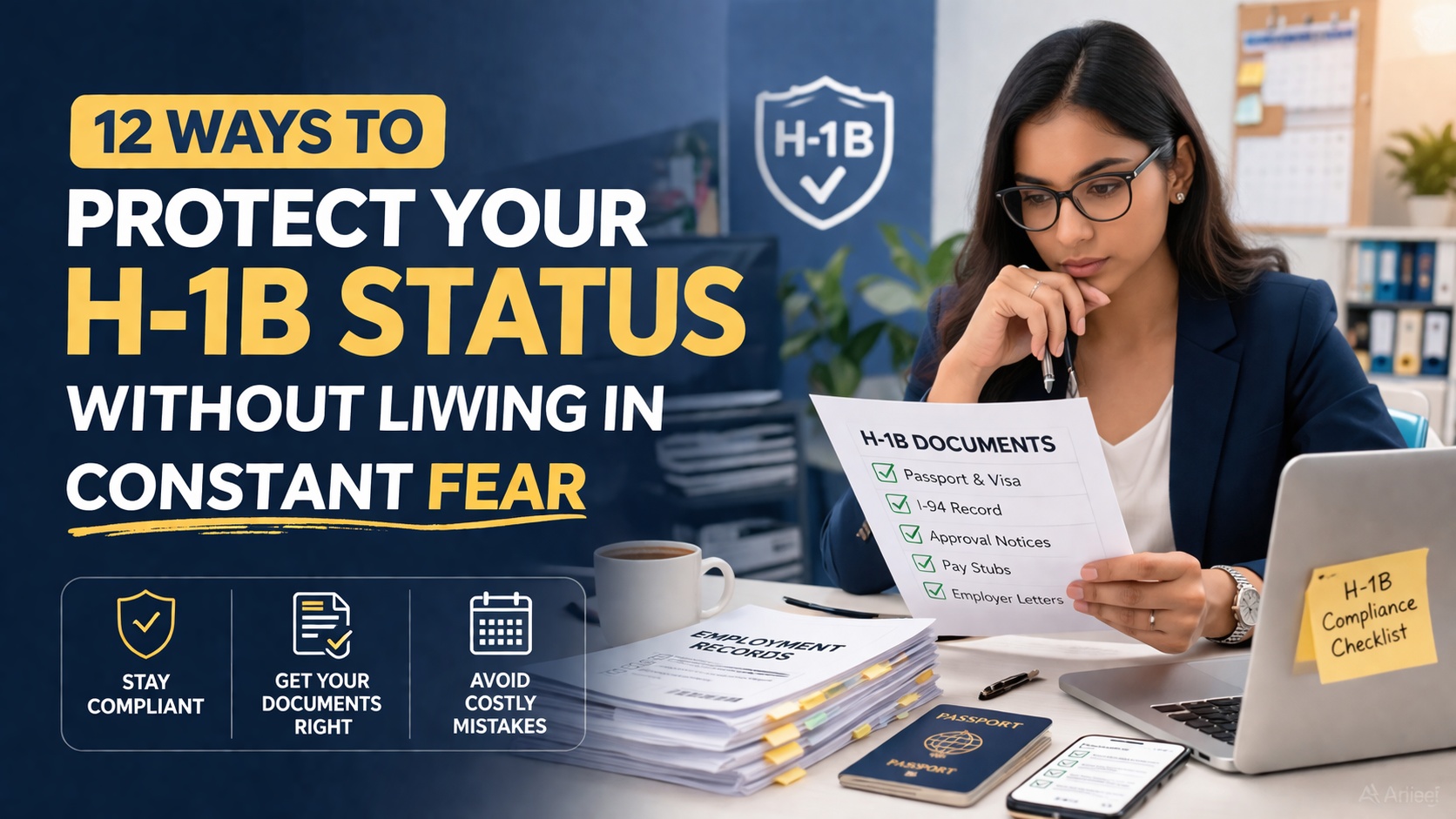
H-1B security is rarely about luck. It usually comes down to awareness, documentation, timing, and small decisions that people delay until they become urgent. This guide explains 12 practical ways to
12 Ways to Protect Your H-1B Status Without Living in Constant Fear
For most H-1B professionals, the anxiety isn't really about immigration law. It's about not knowing what they don't know.
People worry about layoffs, stamping delays, job changes, RFEs, travel complications, extensions — and whether one overlooked detail could quietly unravel everything. That fear is legitimate. But the professionals who handle H-1B pressures best aren't the ones who worry more carefully. They're the ones who've built systems so the worrying becomes unnecessary.
Most H-1B problems aren't caused by dramatic single mistakes. They're caused by smaller issues that got delayed, assumptions that never got verified, or decisions made under time pressure that a little earlier preparation would have avoided. Your employer sponsors your petition, but your employer's attorney doesn't represent you. That distinction matters more than most people realize until it suddenly does.
Below are 12 practical protections that reduce avoidable risk — not through luck, but through structure.
1. Check Your I-94 Expiry Date, Not Just Your Visa Stamp
This is the most common source of silent H-1B problems, and it costs people status they didn't know they'd already lost.
The visa stamp in your passport is an entry document. It authorizes you to seek admission at a port of entry. The I-94 — the electronic record CBP creates when you enter — is what actually controls your authorized period of stay once you're inside the country. Those two dates are not always the same, and the I-94 is the one that matters.
If your passport was close to expiring when you entered, if a CBP officer issued a shorter I-94 than your petition approval covers, or if there was any data entry issue at the border, your lawful stay may end months before the date on your approval notice. By the time someone notices, the overstay is already a problem.
Check your I-94 at cbp.dhs.gov after every single entry into the United States. Save a copy. Verify the date matches what you expect. Do not assume it was issued correctly.
Your first line of protection costs ten minutes and is entirely within your control.
2. Get Sponsorship Terms in Writing
Verbal assurances drive more H-1B problems than most people want to admit.
A hiring manager says the transfer will be filed immediately. A recruiter says location changes won't be an issue. An HR contact says the company will start the green card process within the first year. These conversations happen constantly, and professionals make major decisions based on them — resigning from jobs, relocating, turning down other offers — only to find that the commitment was never as firm as the conversation implied.
Immigration-related representations that materially affect your decisions need to be documented. That doesn't require a confrontational legal contract. It means getting confirmation in writing — an email, a letter of understanding, something that creates a record — before you make an irreversible move based on it.
This becomes most critical when changing employers, negotiating relocation, or expecting multi-year green card sponsorship. Employers and their counsel operate in their own interest. That's not inherently adversarial, but it's not the same as someone acting in yours.
Documented expectations are easier to enforce than remembered conversations.
3. Keep Copies of Every Immigration Record
Your immigration file should not exist only on your employer's system, in your attorney's portal, or in one email account you might someday lose access to.
The records you should personally maintain, organized and accessible, include: all I-797 approval notices, petition filings, Labor Condition Applications, I-94 records, passport biographic pages, visa stamps, paystubs covering your sponsored employment, offer letters, prior EADs if applicable, and any correspondence related to extensions, amendments, or transfers.
These records surface as critical at unpredictable moments — during a future filing, consular processing abroad, an employer transition, a dependent's application, an audit, or immediately after a layoff when access to internal systems disappears. That last scenario is particularly important. When employment ends abruptly, access to HR portals and internal document systems can be cut off within hours. Discovering you don't have your own copies at that moment is a bad time to find out.
Keep key records in at least three places: a secure cloud folder, an encrypted local device, and a location you can reach quickly without relying on your employer's infrastructure.
4. Understand What Your Employer Can and Cannot Control
The perception that an employer controls everything about H-1B status is one of the main reasons people don't protect themselves adequately.
An employer controls the sponsorship for the specific role and worksite described in the petition. They don't control your right to seek independent legal advice, your ability to understand your own status documents, your long-term immigration strategy, or your options if employment ends.
Employer-retained immigration counsel represents the employer. That's not a conflict by definition, but it's also not personal representation. In straightforward cases, the interests align closely enough that the distinction doesn't matter much. In complicated ones — an RFE on a sensitive criterion, a layoff, a role change that might require an amendment, a disagreement about green card timing — that distinction can matter considerably.
Understanding where your employer's authority ends and your own decision-making begins isn't about distrust. It's about clarity. Professionals who understand this boundary make better decisions because they're not waiting for permission they don't actually need.
5. Keep Your Passport Valid
An expired passport doesn't automatically affect your underlying H-1B status, but it creates a cascade of practical problems that are entirely avoidable.
Passport validity affects international travel, visa stamping eligibility, reentry planning, and in some cases the length of the I-94 issued upon admission. A passport expiring at the wrong time can compress timelines that would otherwise be manageable and introduce complications into filings that were otherwise straightforward.
Renewing a passport well in advance is a routine administrative task. Failing to do it and then managing the downstream effects — particularly when travel is already booked, a stamping appointment is needed, or an extension filing is being prepared — is an avoidable problem.
Track the expiration date. Renew early. This is genuinely one of the simplest H-1B protections available.
6. Track Your Priority Date and the Visa Bulletin Regularly
Even when the immediate focus is maintaining valid H-1B status, the long-term immigration picture deserves regular attention — not obsessive monitoring, but consistent awareness.
If an I-140 is approved or in process, the priority date becomes a strategic variable. The Visa Bulletin affects when certain filing opportunities open, when AC21 portability becomes available, when a dependent can file independently, and when long-pending cases can move forward. Bulletin movement can create narrow windows that close quickly. Missing them isn't always recoverable.
The practical requirement is modest: know your preference category, your country of chargeability, your priority date if one has been assigned, and roughly what movement in your classification means for your case. USCIS publishes the bulletin monthly at travel.state.gov. Checking it regularly takes a few minutes.
Short-term status maintenance and long-term green card strategy are most effectively managed as connected decisions, not separate concerns.
7. Build a Relationship With an Independent Immigration Attorney Early
The worst time to start learning your options is when something has already gone wrong.
A layoff happens. An amendment issue surfaces. Travel becomes time-sensitive. A filing gets delayed and the employer's explanation doesn't fully make sense. Under those conditions — high stress, short timelines, incomplete information — the quality of decisions tends to decline and the cost of mistakes tends to rise.
Having an independent attorney relationship in place before any of that happens is a different experience entirely. Questions can be asked in advance. Employer filings can be reviewed with your own interests in mind. Portability timing, travel risks, and extension strategies can be evaluated without urgency driving the conversation.
This doesn't mean constant legal intervention or duplicating everything the employer's counsel does. It means having access to advice that's oriented toward your situation rather than the employer's process.
8. Learn AC21 Portability Before You Actually Need It
Most H-1B professionals first encounter serious discussion of AC21 portability when they're about to change jobs or have just lost one. That timing makes a difficult situation harder.
AC21 portability — codified under the American Competitiveness in the Twenty-First Century Act of 2000 and further clarified by USCIS policy memoranda — generally allows an I-140 beneficiary whose petition has been approved for 180 days or more to change employers or job roles under certain conditions without losing the priority date and underlying petition. The specifics matter significantly: same or similar occupational classification, valid underlying petition, no approved adjustment application, and clean status history.
The point isn't to memorize the statutory language. It's to understand that job transitions, petition timing, and green card strategy interact in ways that become consequential when circumstances change suddenly. Knowing the basic framework before a situation becomes time-sensitive allows for better decisions than learning it under pressure.
If future career transitions are at all plausible — and for most professionals over a multi-year H-1B period, they are — portability belongs in the baseline of what you understand.
9. Use Premium Processing Strategically
Premium processing is not the right choice for every filing. But treating it as an unnecessary expense regardless of circumstances is a mistake that sometimes costs far more than the filing fee.
There are situations where faster adjudication materially reduces risk: job changes with timing-sensitive starts, status windows close to expiry, dependent applications that need to move in sequence, pending travel with reentry implications, urgent amendments triggered by role or location changes. In those situations, the cost of delay — payroll gaps, onboarding disruptions, travel cancellations, extended uncertainty — can significantly exceed the cost of expedited review.
The right evaluation isn't simply whether premium processing is expensive. It's whether faster resolution meaningfully reduces the cost or risk of your specific situation. In some cases it doesn't. In others it clearly does, and the decision to skip it turns out to be false economy.
10. Check Your Travel Position Before You Book International Trips
International travel is not a routine administrative matter for H-1B holders, and treating it as one creates predictable problems.
Reentry after international travel depends on a combination of factors: current petition validity, passport validity, visa stamp validity, any pending filings, prior travel history, and current consular processing realities in the destination country. An expired visa stamp doesn't terminate your status while you're inside the United States — but it does mean you'll need a new stamp before you can return. If that stamping appointment runs into administrative processing delays, what was planned as a two-week trip can become a two-month disruption.
Travel planning should include a review of your current status, documentation you'll carry, whether any petition is pending, whether stamping will be required, and whether the consulate in your destination country has any current processing anomalies worth accounting for. This review takes less time than booking the flights, and it routinely prevents situations that would otherwise be entirely avoidable.
11. Update Your Address and Maintain Basic Compliance
Compliance obligations that seem administrative often turn out to matter at the worst possible times.
Address changes are the clearest example. People relocate for work, move apartments, stay temporarily elsewhere, and assume the information will update through some automatic channel. It doesn't always. USCIS notices, receipt communications, and identity matching across systems depend on consistent, accurate address records. An important notice sent to a prior address is still a notice you were responsible for receiving.
The principle extends beyond addresses. H-1B protection isn't only about major filings. It's also about maintaining accurate records, clean compliance history, and organized documentation across the full duration of status. Small administrative oversights compound quietly. The same habits that keep everyday records accurate also reduce exposure when larger issues eventually surface.
12. Keep a Liquid Backup Fund and a 60-Day Layoff Plan
Job loss on H-1B creates a time problem that financial pressure makes worse.
The 60-day grace period following involuntary termination — established under 8 CFR 214.1(l) — allows H-1B holders to remain in the United States to pursue a transfer, change of status, or departure. That window sounds workable until the decisions actually involved become clear: evaluating transfer options, coordinating dependent status, deciding whether travel is strategically better than waiting, reviewing portability eligibility, potentially changing visa categories. None of those decisions improve when made simultaneously with financial urgency.
A liquid backup fund covering three to six months of expenses doesn't solve the immigration complexity. But it eliminates the financial pressure that degrades decision quality at exactly the moment when clear thinking matters most.
Equally important is having a response plan before the situation arises: knowing where your documents are, knowing who you'd contact in the first 24 hours, having a rough map of the decisions that would need immediate review. The 60-day window rewards people who begin from preparation. It punishes people who begin from confusion.
Protection Is a System, Not a Posture
H-1B status feels fragile to a lot of professionals because it genuinely depends on regulated timelines, employer relationships, government processing, and documentation that many people only partially understand. That's exactly why structure matters more than vigilance.
Reactive approaches to immigration — checking things only when something seems wrong, asking questions only when situations become urgent, assuming the employer's process covers everything relevant to personal risk — consistently produce worse outcomes than proactive ones. The difference between the two is usually not legal complexity. It's habits and timing.
Know your exact expiration dates. Keep your documents accessible. Understand what your employer controls and what they don't. Review travel before it's booked. Build the relationship with independent counsel before the emergency. Prepare for job transitions while the current one is stable.
None of that requires living under constant anxiety. It requires treating immigration as a professional system with its own maintenance requirements — which is what it is.
If you're navigating H-1B status, employer transitions, long-term green card planning, or documentation concerns, VangaVault provides strategic immigration documentation and petition support to help you prepare with greater clarity and confidence.
Get Immigration Insights Delivered to Your Inbox
Practical guidance on EB-1A, EB-2 NIW, O-1A, and U.S. immigration — no spam, unsubscribe anytime.