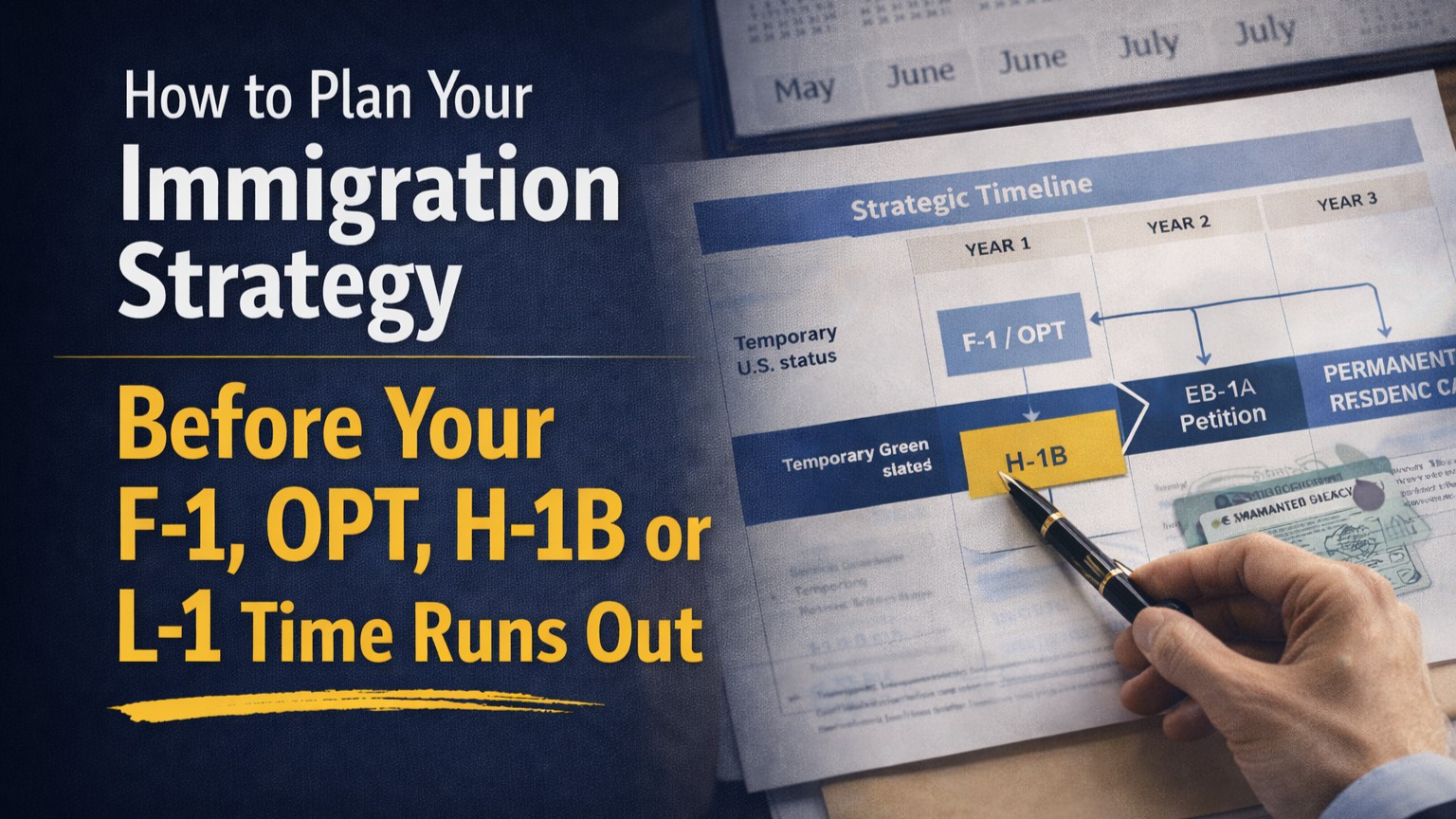

Missing the H-1B lottery while your OPT expires is a common challenge for tech professionals. We outline the mechanical steps for O-1, EB-1A, and cap-exempt alternatives.
What to Do If Your H-1B Was Not Selected and Your OPT Is Expiring
Missing the H-1B lottery while OPT is running out is not an edge case anymore. With registration numbers consistently exceeding 700,000 for roughly 85,000 available slots, the majority of applicants don't get selected — and that majority includes people with strong credentials, legitimate employers, and no immigration violations. The lottery doesn't evaluate any of that.
What comes next depends on how much time remains on the Employment Authorization Document (EAD) and what the professional profile actually looks like. For high-skilled professionals who weren't selected, this is often the moment to move away from the lottery entirely and onto a pathway that rewards documented achievement.
What the 60-Day Grace Period Actually Allows
When OPT or STEM OPT ends, a 60-day grace period begins automatically. During this window, work authorization is gone. The grace period exists for one purpose: to allow orderly departure or timely filing of a change of status application. It is not a work authorization extension, and it cannot be used to continue employment.
Cap-Gap protection — which extends OPT status for H-1B registrants awaiting October 1 start dates — only applies when a timely filed H-1B petition is pending. A registration that was simply not selected in the lottery creates no Cap-Gap eligibility. Without a selected and filed I-129, status ends 60 days after the OPT EAD expiration date.
If a change of status application (such as to O-1 or B-2) is filed before those 60 days expire, the applicant enters a period of authorized stay while the application is pending. Work authorization doesn't automatically carry over, but unlawful presence doesn't begin to accrue either — which matters significantly for any future visa applications or admissions.
The O-1A Visa: No Cap, No Lottery
The O-1A is the most direct alternative for professionals whose credentials can support it. There's no annual cap, no filing window, no lottery. Petitions can be filed year-round, and Premium Processing returns an initial decision in 15 business days.
Qualification requires meeting at least three of eight criteria demonstrating extraordinary ability in sciences, education, business, or athletics. For software engineers, data scientists, and researchers, the criteria that most frequently appear in successful petitions are:
High salary. Total compensation — including equity — must place the applicant in the upper tier for their specific role and geographic market. USCIS verifies against Bureau of Labor Statistics data and private compensation surveys such as Radford or Levels.fyi data. The relevant benchmark is the specific job title in the specific metro, not a national average.
Critical role. The applicant must have held a lead or critical role at an organization with a distinguished reputation. Generic employment letters listing daily responsibilities don't satisfy this. What works is a letter from a senior executive that identifies specific technical decisions the applicant made and connects them to measurable outcomes — a product launch, a revenue figure, a system now in production across the organization.
Original contributions. Patents that are licensed, implemented, or cited in subsequent patent applications carry weight. Research with a citation record that colleagues in the field have actually built on carries weight. A patent filing made two months before the petition submission, with no evidence of adoption, does not.
Membership in associations. The association must require outstanding achievement — evaluated by recognized experts — as a condition of admission. Organizations where membership requires a degree and a payment don't qualify. The association's own bylaws need to reflect a genuine vetting standard.
USCIS evaluates O-1A petitions under the Kazarian framework: first, whether the applicant mathematically meets three criteria; second, whether the full record demonstrates someone in the small percentage at the top of their field. The second step is where self-filed cases most often fail. Satisfying the criteria technically doesn't build the narrative that survives the final merits review.
The EB-1A: Bypassing the Employer Requirement Entirely
Applicants with a profile strong enough for O-1A should at least model whether EB-1A is already within reach. The criteria overlap substantially, but EB-1A offers one advantage that the O-1A cannot: self-petitioning. No employer sponsorship required. For professionals whose current OPT employer is unwilling to commit to a green card process early in the employment relationship, this matters enormously.
The evidentiary bar for EB-1A is higher than O-1A. Officers apply stricter scrutiny because the outcome is permanent residence, not temporary work authorization. The same body of evidence that earns an O-1A approval may not satisfy the EB-1A final merits determination. The distinction tends to show up in the weight given to marginal evidence — a mid-tier conference speaking invitation, or a peer review for a journal with a low impact factor, carries less in the EB-1A context.
For applicants from India or China, the EB-1A also addresses a structural problem: priority date backlogs in EB-2 and EB-3 can stretch for decades. The EB-1 category has historically maintained much shorter backlogs, and for certain birth countries, it represents the only realistic path to a green card within a working career.
Cap-Exempt H-1B Employment
Not every H-1B position goes through the lottery. Institutions of higher education, nonprofit entities affiliated with universities (including teaching hospitals), and nonprofit or governmental research organizations can file H-1B petitions outside the annual cap at any time of year.
For OPT holders who receive offers from qualifying institutions, this path stops the clock entirely. Employment begins without waiting for a lottery cycle, and the H-1B can be maintained for as long as the position and status requirements are met. The constraint is the employer type — private for-profit employers don't qualify, and moving later from a cap-exempt position to a standard tech company triggers the lottery requirement at that point.
This path also has a practical benefit for EB-1A preparation: continued employment in a relevant, high-level role means the salary, critical role, and original contribution evidence keeps accumulating while the petition is being built.
Comparing Post-OPT Pathways
| Feature | H-1B (Cap) | O-1A Visa | EB-1A Green Card | Cap-Exempt H-1B |
|---|---|---|---|---|
| Selection Method | Random lottery | Merit-based review | Merit-based review | Employer type |
| Annual Cap | 85,000 | None | None (per-country limits apply) | None |
| Sponsor Required | Yes | Yes (employer or agent) | No (self-petition) | Yes |
| Typical Prep Time | 1–2 months | 2–4 months | 4–8 months | 1–2 months |
| Filing Window | March registrations only | Year-round | Year-round | Year-round |
The B-2 Bridge: Buying Time Without Working
For applicants who need additional weeks to finalize an O-1A or EB-1A petition, a change of status to B-2 (Visitor) keeps lawful presence intact without requiring a job offer or employer cooperation. The Form I-539 must be filed before the 60-day grace period ends.
Once filed, the applicant is in a period of authorized stay pending adjudication. Work authorization doesn't attach to B-2 status, but unlawful presence stops accruing. This window — which, given current I-539 processing timelines, can extend several months — can be used to secure recommendation letters, finalize the exhibit file, and coordinate the expert opinion letters that O-1A and EB-1A petitions depend on.
The B-2 bridge is a tactical tool, not a long-term strategy. It works when the applicant is genuinely close to filing a credible petition and needs weeks, not years.
Day 1 CPT: The Risks Outweigh the Convenience
Enrollment in a graduate program offering Day 1 CPT provides work authorization through F-1 status, which is why it's frequently mentioned in forums and immigration groups. It's legal, but it carries a paper trail that follows the applicant into future filings.
USCIS has increased scrutiny on CPT arrangements, particularly at schools known primarily for offering Day 1 authorization. In future H-1B or green card filings, officers may request tuition payment records, syllabi, course schedules, and travel records to the campus — all aimed at establishing whether the F-1 status reflected genuine academic enrollment or was maintained primarily for work authorization. If the conclusion is the latter, the consequences range from RFEs to status violation findings that require consular processing abroad rather than Adjustment of Status.
For someone building toward an EB-1A, a status violation in the immigration history creates exactly the kind of complication that an extraordinary ability petition doesn't need. This path belongs at the bottom of the list.
Building Credentials on a Short Timeline
Applicants with three to six months remaining on OPT can still make meaningful additions to the evidentiary record. The most valuable moves are the ones that satisfy a specific criterion clearly and leave a documented paper trail:
Peer reviewing for academic journals or serving as a judge at a recognized technical competition satisfies the judging criterion for both O-1A and EB-1A. The review needs to be for a venue the field actually recognizes — a high-impact journal or a competitive conference with a genuine selection process — not a low-impact open-access platform that accepts review volunteers through mass solicitation.
Press coverage in trade publications — TechCrunch, Wired, MIT Technology Review, or relevant industry outlets — satisfies the published material criterion, but only when the article is primarily about the applicant and their specific work. A company announcement that mentions the applicant's name doesn't qualify. An independently reported piece where a journalist covers the applicant's technical contribution is what USCIS looks for.
Technical white papers and internal research that have never been formalized can often be adapted for industry conference submissions or open-source repositories with peer review components. This is one of the faster ways to establish authorship in the record, provided the venue has editorial standards that USCIS will recognize.
Frequently Asked Questions
Can I apply for an O-1A if my H-1B wasn't selected? Yes. The O-1A is entirely independent of the H-1B system. There's no lottery, no annual filing window, and no cap. Petitions can be filed at any time with a qualifying employer or agent, and Premium Processing returns an initial decision in 15 business days.
Is the O-1A only for Nobel Prize winners? The "extraordinary ability" standard is frequently misread as requiring international celebrity. Legally, it covers individuals in the top percentage of their specific field — which, depending on the field and the evidence, can include senior engineers at prominent companies, researchers with meaningful citation records, or founders who have built and scaled a product others in the industry actively use. The standard is demanding, but it's not reserved for a handful of globally recognized names.
What happens if my O-1A is denied after my OPT grace period has passed? If the O-1A is denied and no other status is maintained, departure is required immediately. There is no additional grace period that follows an O-1A denial. This is why filing a B-2 change of status before the grace period ends — as a protective measure while the O-1A is pending — is worth considering seriously for applicants who can't afford a gap.
Can I self-petition for an O-1A? No. Unlike EB-1A, the O-1A requires a petitioner: a U.S. employer or a qualified U.S. agent. Freelancers and independent professionals can use an authorized agent to file, which allows petitioning without a single traditional employer, but self-petitioning in the way EB-1A allows is not available for the nonimmigrant classification.
The most useful shift in perspective is to stop treating immigration status as something that happens to you — lottery in, lottery out — and start treating it as something that responds to documented professional achievement. The H-1B lottery is luck. The O-1A and EB-1A are not.
A VangaVault profile assessment provides a criterion-by-criterion breakdown of the current evidentiary record, identifies specific gaps, and delivers a written 12-month roadmap within 48 hours of CV submission. Get your profile assessment here.
Get Immigration Insights Delivered to Your Inbox
Practical guidance on EB-1A, EB-2 NIW, O-1A, and U.S. immigration — no spam, unsubscribe anytime.