Waiting until your final year on an H-1B or OPT to plan your green card is too late. Learn the specific mechanical timelines and visa alternatives necessary to secure your permanent residency.
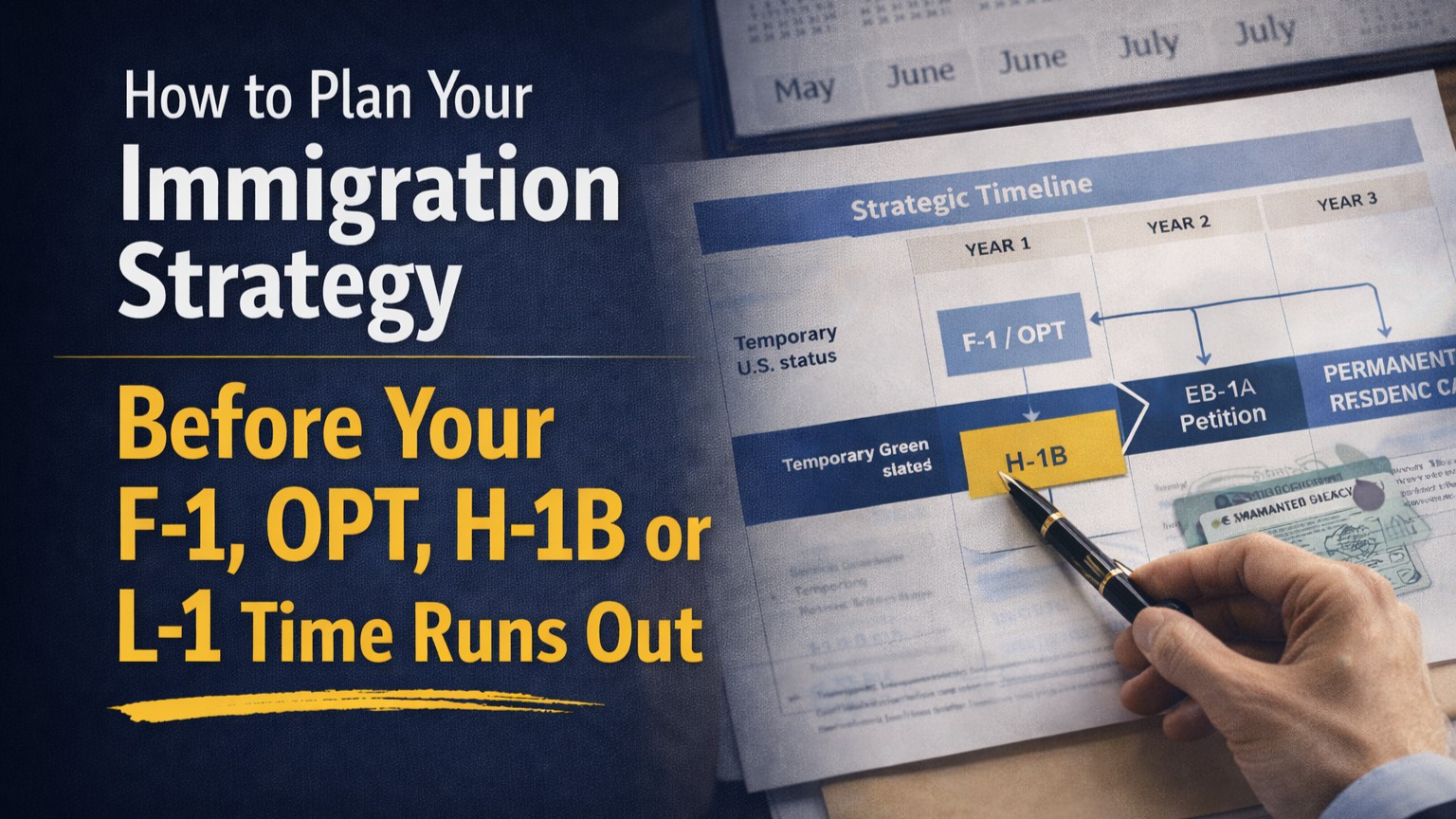
How to Plan Your Immigration Strategy Before Your F-1, OPT, H-1B, or L-1 Time Runs Out
The professionals who end up forced to leave the United States rarely ran out of options. They ran out of time to use the options they had.
A viable immigration strategy isn't built in the final year of H-1B status or during the last months of OPT. It's built by working backward from hard deadlines — the six-year H-1B limit, the five-year L-1B cap, the OPT expiration — and identifying, years in advance, which pathways are realistically available and what each one requires to succeed. The structural delays in the U.S. employment-based immigration system don't accommodate last-minute planning. PERM labor certification alone currently takes the better part of two years before a case even reaches the I-140 stage. By the time most people start that conversation with HR, the margin for error is already gone.
The Structural Realities That Dictate Your Timeline
Employer-sponsored EB-2 and EB-3 petitions through the PERM process are the most common permanent residency pathway for skilled workers — and the most time-constrained.
The current Department of Labor timeline for a prevailing wage determination runs approximately six to seven months. The recruitment phase and Form 9089 adjudication add another twelve to thirteen months. That puts the realistic timeline from PERM initiation to I-140 filing at close to two years, before accounting for any audits, requests for additional information, or administrative delays.
For H-1B holders, this creates a specific problem. Under AC21, an H-1B holder can obtain extensions beyond the six-year maximum only if a PERM application or I-140 was filed at least 365 days before the six-year limit expires. That means the PERM needs to start no later than the end of year four — and that's assuming no delays. A single Department of Labor audit, a corporate restructuring, or a layoff after year five with nothing filed typically results in departure.
The solution isn't to push harder on a single employer-sponsored pathway. It's to identify overlapping options early enough that a setback on one track doesn't close the others.
F-1 and OPT: Getting Past H-1B Lottery Dependency
Most F-1 students treat the H-1B lottery as the default next step. With annual registration numbers consistently far exceeding the 85,000 available cap slots — USCIS reported over 780,000 unique registrations for FY2025 — treating a random selection process as a primary career strategy is a structural problem, not just bad luck.
Standard 12-month OPT provides a short window. STEM OPT's 24-month extension creates more room, but only for graduates in qualifying STEM fields, and only if the employer is enrolled in E-Verify. Neither solves the underlying problem of H-1B lottery dependency.
Cap-exempt H-1B sponsorship. Universities, nonprofit research organizations, and affiliated hospitals and research facilities can sponsor H-1B petitions outside the annual cap. These institutions can file year-round, without lottery selection. A position at a cap-exempt institution provides immediate, stable work authorization while the applicant builds toward other categories. For researchers and technically specialized professionals, this pathway is underused.
The O-1A as a bridge. The O-1A visa for extraordinary ability in sciences, education, business, or athletics has no annual cap, no prevailing wage requirement, and no fixed maximum duration — extensions are granted in one-year increments without a statutory ceiling. To qualify, an applicant must satisfy at least three of eight regulatory criteria, including commanding a high salary relative to peers, judging the work of others, authoring scholarly articles, or making original contributions of major significance. The O-1A is routinely available to specialized researchers, technical founders, and engineers coming directly out of doctoral or master's programs with a strong publication record and independent recognition. It's not the norm for recent graduates, but it's more achievable at that career stage than most assume.
Filing the EB-2 NIW during OPT. An F-1 or OPT holder can self-petition for an EB-2 National Interest Waiver without employer sponsorship. The NIW waives both the job offer requirement and the PERM labor certification. Filing an I-140 during OPT establishes a priority date immediately — which matters considerably for nationals of countries with severe visa retrogression, where the difference between a 2024 priority date and a 2027 priority date can represent years of additional waiting. The F-1 is not a dual-intent visa, which requires careful management of international travel and visa renewals after the I-140 is filed, but the filing itself is permitted.
Managing the H-1B and L-1 Max-Out Deadlines
The H-1B six-year limit. The clock starts at first admission in H-1B status. Time spent outside the United States is not counted against the maximum period of stay — days physically outside the country can be recaptured. Boarding passes, passport entry stamps, and flight itineraries document those absences. Recapturing travel time can provide the exact additional window needed to push a PERM past the 365-day mark and unlock one-year H-1B extensions. Three to four months of recaptured time is common for professionals who travel internationally with any regularity.
The L-1A to EB-1C pipeline. L-1A holders — intracompany transferees in executive or managerial roles — have a relatively direct path to permanent residency through the EB-1C category. The EB-1C criteria closely mirror L-1A requirements, and critically, EB-1C requires no PERM labor certification. The practical constraint is timing: with a seven-year L-1A maximum, an I-140 should be filed no later than year five to allow reasonable time for I-485 processing before status expires.
The L-1B problem. L-1B holders — intracompany transferees in specialized knowledge roles — face a harder deadline. Five years of maximum stay, no direct EB-1 equivalent, and no PERM exemption. L-1B workers need to either initiate PERM by year three, transition to an H-1B, or elevate their professional profile enough to qualify for EB-1A. For L-1B holders who entered the U.S. with a strong technical or research background, building toward an EB-1A profile during years two and three — before the deadline pressure becomes acute — is often the most viable long-term strategy.
Building an EB-1A Profile Before the Deadline
When employer-sponsored pathways stall due to PERM backlogs, priority date retrogression, or layoffs, the EB-1A becomes the most practically valuable option available. It allows self-petitioning, requires no PERM, and the first preference employment category historically has shorter wait times than EB-2 or EB-3 for most countries of birth. For Indian and Chinese nationals facing decade-long EB-2 backlogs, EB-1A isn't just an upgrade — it's often the only pathway with a realistic timeline.
The common misconception is that EB-1A is reserved for Nobel laureates and Olympic athletes. USCIS adjudicates these petitions against specific regulatory criteria, and while the standard is genuinely high, it's not inaccessible to accomplished researchers, technical founders, or domain specialists with documented external recognition. The requirement is satisfying at least three of ten criteria and demonstrating sustained national or international acclaim through a final merits determination.
What makes EB-1A profile-building different from standard career development is intentionality. Evidence doesn't accumulate passively. If two years remain before H-1B max-out, specific professional activities need to be structured to generate the documentation USCIS actually evaluates.
Peer review engagement needs to be with journals that carry meaningful impact factors in the field, and the relationship with editors needs to reflect genuine expertise rather than volume. An adjudicator reading a letter from a journal editor who explains that the applicant was specifically recruited to resolve conflicting reviewer feedback on a technically complex submission carries far more weight than a list of fifty reviews completed over two months.
Media coverage needs to come from independent journalists who found the story through the applicant's work. Features in recognized trade publications or major media, written by reporters who conducted actual interviews and spoke to independent sources, satisfy this criterion. Press releases distributed through wire services don't.
Critical role evidence requires tying specific decisions the applicant made to measurable outcomes at the organizational level — revenue growth, a product launch that drove market expansion, a funding round where investor documentation references the applicant's contribution. An employment verification letter listing job responsibilities doesn't come close to satisfying this.
Visa Pathways and Timeline Constraints
| Visa | Maximum Duration | Dual Intent | PERM-Exempt Options | Critical Deadline |
|---|---|---|---|---|
| F-1 (OPT/STEM OPT) | 1–3 years | No | EB-2 NIW, EB-1A | File I-140 at least 1 year before OPT ends to lock in priority date |
| H-1B | 6 years | Yes | EB-2 NIW, EB-1A | PERM or I-140 must be filed before end of Year 5 to enable extensions |
| L-1A | 7 years | Yes | EB-1C, EB-1A | File EB-1C I-140 by Year 5 to allow I-485 processing time |
| L-1B | 5 years | Yes | EB-2 NIW, EB-1A | Initiate PERM by Year 3, or transition to H-1B or L-1A early |
| O-1A | Indefinite (1-year increments) | Quasi | EB-1A, EB-2 NIW | Transition to EB-1A when profile matures; file annual extensions consistently |
Cross-Chargeability and the Backlog Problem
Green card quotas are allocated by country of birth, not citizenship. Nationals born in India and China face severe priority date retrogression in the EB-2 and EB-3 categories — current EB-2 India wait times, based on the State Department Visa Bulletin, extend well beyond twenty years for new filers.
Cross-chargeability offers a meaningful workaround for married applicants. Under 9 FAM 503.3-4(B), if spouses are applying together for adjustment of status, either spouse's country of birth can be used as the chargeability country for both, as long as neither would be inadmissible under that chargeability. An Indian-born software engineer married to a Canadian-born spouse can use Canada as their chargeability country, bypassing the Indian EB-2 backlog entirely and processing under the "Rest of World" quota, where dates are typically current or within a year or two.
Identifying this option early — before filing — can change the entire structure of a case. A couple who discovers cross-chargeability eligibility in year three of H-1B status has meaningfully more options than one who discovers it in year five.
Changing Employers Mid-Process
Career transitions conflict with employment-based immigration in specific, predictable ways.
A pending PERM labor certification cannot be transferred to a new employer. It's employer-specific and job-specific. Changing jobs while PERM is pending abandons the entire process, and the new employer must begin from scratch — new prevailing wage determination, new recruitment, new Form 9089. On a five- or six-year visa clock, resetting a two-year PERM process in year four is often not recoverable.
An approved I-140 is more portable. Under AC21, if the I-140 has been approved for more than 180 days, the sponsoring employer cannot revoke it to eliminate the priority date. The applicant retains their place in the queue. However, retaining the priority date is different from completing the green card process — the new employer will still need to file a new PERM and I-140 unless the applicant's I-485 has been pending for at least 180 days and the new role is in the same or similar occupational classification under 8 CFR 245.25.
Before accepting a job change that resets a PERM process, the math deserves careful attention. A meaningful salary increase rarely justifies abandoning a two-year PERM filing in year five of H-1B status, when the alternative is potentially departing the country.
Structuring NIW Evidence as a Graduate Student
Graduate students filing EB-2 NIW petitions work with a different evidentiary profile than established industry professionals. The absence of a long employment history shifts the emphasis toward research output, citation record, and the credibility of the proposed endeavor.
Citations matter more than publication count. Publishing and moving on without tracking who cites the work misses the point. Presenting at major symposia where industry practitioners are present, and building relationships with independent researchers who engage with the work, generate the kind of external validation USCIS needs to evaluate. The strongest recommendation letters for student NIW petitions come from researchers who have cited the applicant's work in their own publications but have no supervisory relationship with them. Letters from thesis advisors are viewed with skepticism precisely because the relationship creates an obvious incentive for generosity.
Endeavor framing for student petitions benefits from alignment with documented federal priorities. Research intersecting with areas where specific OSTP directives, DOE initiatives, or NSF priority areas can be cited — AI safety, grid-scale energy storage, semiconductor manufacturing, biodefense — gives adjudicators a concrete framework for evaluating national importance. Vague significance claims are harder to sustain. Alignment with publicly documented government priorities is both easier to argue and easier for the officer to accept.
Frequently Asked Questions
When should H-1B holders start the green card process? The conversation with an employer should begin at H-1B approval, not year four. Given current DOL processing timelines, the PERM process takes close to two years before reaching the I-140 stage. A single audit, layoff, or administrative delay in years four or five with nothing filed typically means departure. There is no safe way to wait.
Can F-1 students file an EB-2 NIW? Yes. An F-1 or OPT holder can self-petition for a National Interest Waiver without employer sponsorship. Filing during OPT establishes a priority date immediately, which is particularly significant for nationals of backlogged countries. Because the F-1 isn't a dual-intent visa, international travel and visa renewals require careful management after the I-140 is filed — but the filing itself is permitted and often strategically advisable.
What happens if the H-1B maxes out before the I-140 is approved? If a PERM or I-140 was filed at least 365 days before the six-year limit, one-year H-1B extensions are available under AC21. If the I-140 is approved but the priority date isn't current, three-year extensions are available. If neither condition is met, departure is required. The H-1B clock can be reset after one full year outside the United States, or the applicant can transition to a different nonimmigrant status if one is available.
Does changing employers reset the immigration process? It depends on the stage. A pending PERM is abandoned entirely if employment ends — the new employer starts from scratch. An I-140 approved for more than 180 days protects the priority date even after a job change, though the new employer will typically need to file a new PERM and I-140 to complete the green card process. I-485 portability — which allows job changes without a new PERM — applies only after the adjustment application has been pending for 180 days and the new role falls within the same or similar occupational classification.
Mapping your current status against these deadlines — and identifying which pathways are actually open given your timeline — is where planning becomes concrete. During a VangaVault profile assessment, we review your credentials, current visa stage, and remaining authorized time against actual USCIS adjudication trends, and deliver a written filing strategy with specific timeline projections within 48 hours. Request your profile assessment to get started.
Get Immigration Insights Delivered to Your Inbox
Practical guidance on EB-1A, EB-2 NIW, O-1A, and U.S. immigration — no spam, unsubscribe anytime.