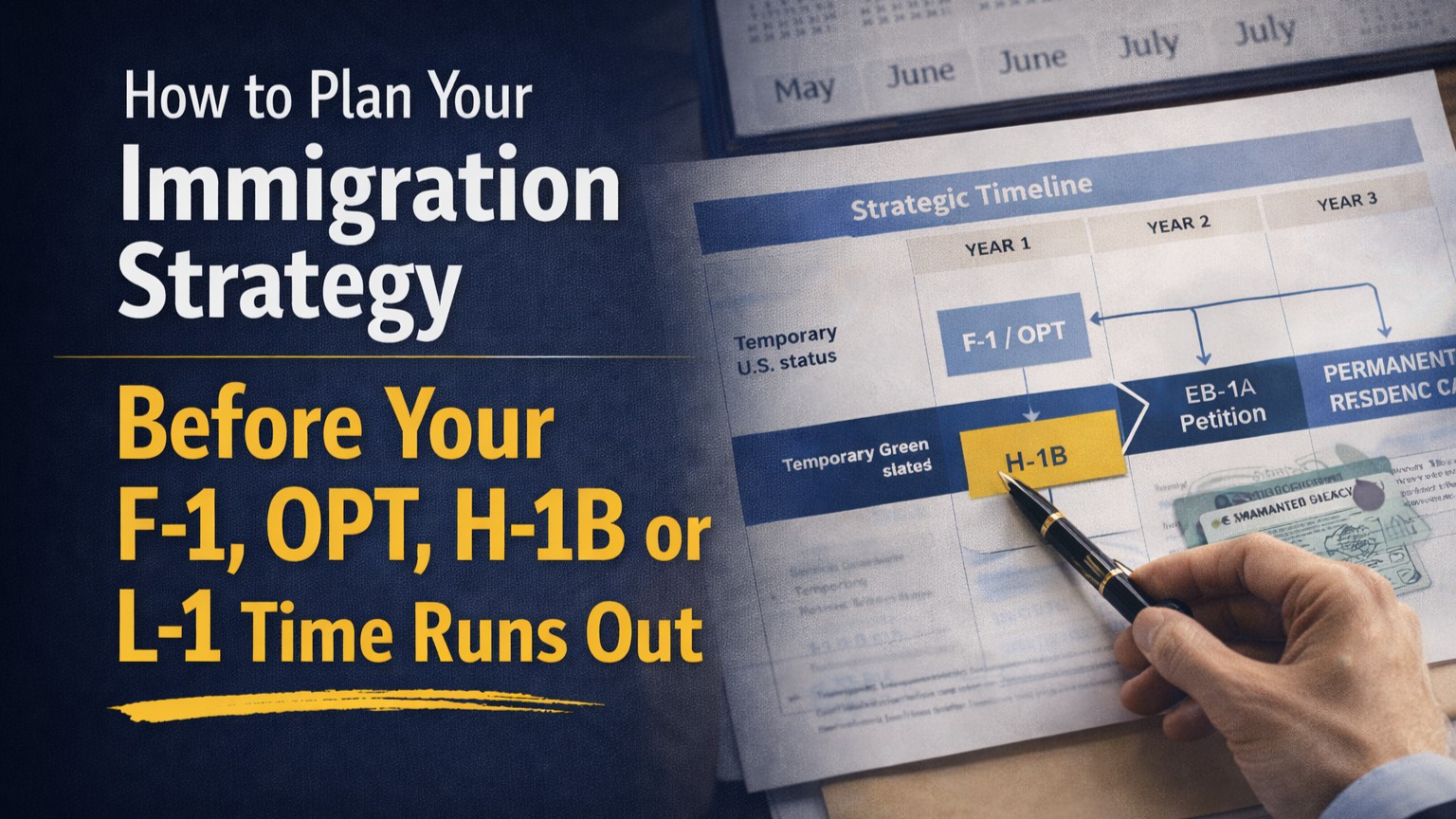

When your F-1 OPT ends, the clock starts ticking. Explore viable visa alternatives like O-1A or EB-1A to transition from student status to a long-term professional career in the U.S.
What to Do If Your F-1 OPT Is Ending and You Still Want to Stay in the United States
F-1 OPT expiration forces a decision that most students aren't prepared to make quickly: change status, leave, or enroll in another program. The H-1B lottery is what most people plan for, but with selection rates that have hovered below 20% in recent years for the advanced degree exemption, treating it as a reliable plan is how professionals end up scrambling with weeks left on their EAD. The alternatives — O-1A, EB-1A, EB-2 NIW — don't require luck, but they do require time to prepare properly. Starting that preparation six months before expiration is the floor, not the ideal.
The Grace Period and Why 60 Days Isn't a Planning Window
After OPT or STEM OPT ends, F-1 holders receive a 60-day grace period. Work authorization ends on the EAD expiration date. The grace period covers only the time needed to either depart the country or file a change of status — it isn't an extension of work authorization, and it isn't a buffer for assembling a petition from scratch.
Any change of status application — whether to O-1A, B-2, or another category — must reach USCIS before the grace period ends. Filing on day 58 of a 60-day window, for a petition that requires multiple expert letters and employer coordination, is not a plan. O-1A petitions in particular depend on recommendation letters from independent experts who may take weeks to draft substantive responses, employment documentation from HR departments, and in many cases, coordination with an authorized agent. A realistic preparation timeline starts 180 days before the EAD expiration date.
The H-1B Reality for OPT Holders
The H-1B cap sits at 85,000 annual slots — 65,000 under the regular cap, 20,000 reserved for U.S. master's degree holders. Total registrations in recent years have exceeded 700,000. The math produces a selection rate well below 20%, even for master's degree holders, and the outcome is random regardless of field, salary, or employer reputation.
For those who are selected, the Cap-Gap provision matters: if OPT expires before the October 1 H-1B start date and the employer files the I-129 petition on time, work authorization extends through September 30. For those not selected, Cap-Gap has no application. Status ends 60 days after OPT expiration, and the options narrow quickly.
The practical consequence of relying exclusively on the H-1B is that three lottery losses — which can happen across three years of STEM OPT — exhaust the window during which an applicant can build credentials, work in their field, and establish the kind of career record that feeds an O-1A or EB-1A petition. Using STEM OPT intentionally, rather than as a holding period between lottery attempts, produces a materially different position at the end of year three.
The O-1A Visa: Filed on Merit, Not Chance
The O-1A visa for individuals with extraordinary ability in sciences, education, business, or athletics has no cap and no lottery. Petitions can be filed at any point in the year, and Premium Processing returns an initial adjudication in 15 business days — a timeline that makes it viable even for applicants with limited runway on their grace period.
Qualification requires meeting at least three of eight criteria. For STEM professionals and early-career researchers, the criteria that most often appear in successful petitions are:
High salary. Total compensation must rank in the upper tier for the specific job title and geographic market. USCIS verifies against Bureau of Labor Statistics data and private surveys such as Radford. Equity holdings count if independently valued documentation is provided. The benchmark is the specific role in the specific city, not national averages.
Critical role. A lead or critical role at an organization with a distinguished reputation. The evidence here isn't a job description — it's a letter from a C-suite executive that names specific decisions the applicant made and connects those decisions to documented outcomes. A product the applicant built that's now in production at scale, a technical architecture that reduced latency by a specific percentage, a research direction that resulted in a funded grant.
Original contributions. Research with a citation record showing the field engaged with it, patents that have been licensed or cited in subsequent filings, or methodologies adopted by organizations outside the applicant's employer. A paper published two months before filing with zero external citations doesn't satisfy this criterion in a final merits review.
Judging the work of others. Peer reviewing for recognized academic journals or serving on the program committee of a competitive technical conference. The venue matters: a high-impact journal or a selective conference with an established review process carries weight. A low-impact open-access journal that accepts reviewers through mass solicitation does not.
The Kazarian two-step framework applies to O-1A as it does to EB-1A: first, whether at least three criteria are technically met; second, whether the full record demonstrates someone in the top percentage of their field. Satisfying the first step with marginal evidence rarely survives the second.
Transitioning from F-1 to O-1A: How It Works
Moving from F-1 to O-1A is a Change of Status filed with USCIS — Form I-129 with the O classification supplement. If approved, status changes on the validity start date listed in the approval. No consulate visit or new visa stamp is required unless the applicant plans to travel internationally and re-enter. For those who intend to stay in the United States throughout the transition, the change of status keeps the process entirely domestic.
Premium Processing for the O-1A is worth serious consideration for applicants whose OPT is expiring within weeks. A 15-business-day adjudication window provides an answer before the grace period ends, allowing for an informed decision about whether departure is necessary.
Pathways Compared
| Feature | H-1B Visa | O-1A Visa | EB-1A Green Card | EB-2 NIW |
|---|---|---|---|---|
| Lottery Required | Yes | No | No | No |
| Sponsorship | Employer required | Employer or agent | Self-petition possible | Self-petition possible |
| Duration | Up to 6 years | Renewable 3-year terms, no cap | Permanent | Permanent |
| Standard of Proof | Specialty occupation | Extraordinary ability | Top of the field | Substantial merit, national importance |
| Dual Intent | Yes | Quasi-dual intent | Yes | Yes |
Filing for a Green Card While on F-1: What It Costs You
Filing an I-140 petition while on F-1 OPT is legally permissible. The complication is intent. The F-1 visa is a nonimmigrant classification that requires the holder to maintain nonimmigrant intent — the genuine plan to return home after the purpose of the stay is complete. Filing a green card petition signals immigrant intent directly, and consular officers treat it as such.
The practical consequence shows up at the border and at consular interviews. An F-1 holder with a pending I-140 who departs the United States will find it very difficult to re-enter — a consular officer reviewing the nonimmigrant visa application will see the immigrant petition and is likely to deny the F-1 visa. For those who need to travel internationally while the I-140 is pending, this is a serious constraint.
The safer sequence for most applicants is to transition to a dual-intent visa category — H-1B or O-1A — before filing the I-140. O-1A is treated more leniently than F-1 in the context of concurrent immigrant intent, though it doesn't carry the explicit statutory dual-intent protection that H-1B does under INA § 214(b). Once an I-485 Adjustment of Status is filed and an Advance Parole travel document is issued, international travel becomes possible again without jeopardizing the pending green card.
The EB-2 NIW for Recent Graduates
Applicants with advanced degrees who aren't yet at the EB-1A evidentiary threshold should evaluate the EB-2 National Interest Waiver. Adjudicated under the framework established in Matter of Dhanasar, 26 I&N Dec. 884 (AAO 2016), the NIW asks three questions: whether the proposed endeavor has substantial merit and national importance; whether the applicant is well-positioned to advance it; and whether waiving the job offer and labor certification requirement serves U.S. interests.
The NIW doesn't require being at the top of the field — it requires a demonstrable connection between the applicant's specific work and a national benefit. This is a meaningfully different standard, and for Ph.D. graduates working in areas with clear public benefit — clean energy, healthcare research, infrastructure — it's often the more honest fit.
Filing NIW also establishes a priority date. For applicants from countries with EB-2 backlogs, locking in an early priority date while continuing to build toward EB-1A qualifications is a recognized strategy. The EB-1 category has historically maintained shorter backlogs, making an eventual EB-1A filing the priority date workaround for applicants from high-backlog countries.
Using STEM OPT Intentionally
The 24-month STEM OPT extension is frequently treated as three lottery chances. It's more useful treated as 36 months to build a credential record that makes the lottery irrelevant.
The activities that move an O-1A or EB-1A petition forward are specific: peer reviewing for recognized journals, not just doing the job well. Speaking at conferences that require competitive selection, not just internal presentations. Getting profiled in trade publications because of work that journalists independently found interesting, not because of company press releases. Leading a project whose outcomes are measurable and documented in writing by someone above the applicant in the organization.
None of this requires extraordinary natural talent. It requires intentional professional activity over a sustained period. Forty citations on a research paper take time to accumulate — that timeline doesn't compress into six months before a petition deadline. Beginning this work in year one of STEM OPT, rather than year three, produces a materially different petition.
What to Avoid
Day 1 CPT programs provide work authorization through F-1 status and are technically legal. They also create a paper trail that USCIS follows closely during future green card filings. Officers reviewing an Adjustment of Status application may request tuition payment records, syllabi, campus visit documentation, and course schedules to establish that the F-1 enrollment reflected genuine academic intent rather than a mechanism for maintaining work authorization. When the evidence suggests the latter, the consequences include RFEs, denial, and in some cases a requirement to proceed through consular processing rather than domestic adjustment — which for applicants with prior status issues can be a serious complication.
Working without a valid EAD — even a single day — creates unauthorized employment in the record. This can follow a petition through multiple future filings and is grounds for denial of Adjustment of Status. Before the current EAD expires, the applicant must have either an approved change of status, a pending application that carries automatic extension, or departure. The receipt notice for certain renewal categories confirms automatic extension eligibility; this does not apply universally.
Frequently Asked Questions
Can I apply for a green card while on F-1 OPT? Yes, an I-140 petition can be filed while on F-1 OPT. The risk is immigrant intent — filing the I-140 makes it very difficult to renew the F-1 visa at a consulate or re-enter the U.S. as a student after international travel. For most applicants, the safer sequence is to transition to a dual-intent category first.
What happens if the H-1B lottery isn't selected? Status ends 60 days after OPT expiration. The options at that point are an O-1A change of status, a B-2 change of status to buy preparation time, enrollment in a new degree program, or departure. An EB-2 NIW or EB-1A can also be filed, but without concurrent I-485 eligibility, the I-140 approval alone doesn't authorize continued presence.
Does filing an EB-1A petition terminate F-1 OPT? No. An I-140 petition (EB-1A or otherwise) doesn't affect F-1 status or existing work authorization. Employment can continue through the EAD expiration date. If the EAD expires while the I-140 is pending and no other status is maintained, continued presence requires a separately filed I-485 with a current priority date, or departure.
The applicants who navigate this transition well are generally the ones who stopped planning around the lottery early enough to build something that doesn't depend on it. A VangaVault profile assessment reviews the current credential record against the O-1A and EB-1A criteria, identifies specific evidentiary gaps, and delivers a written 12-month roadmap within 48 hours. Get your profile assessment here.
Get Immigration Insights Delivered to Your Inbox
Practical guidance on EB-1A, EB-2 NIW, O-1A, and U.S. immigration — no spam, unsubscribe anytime.