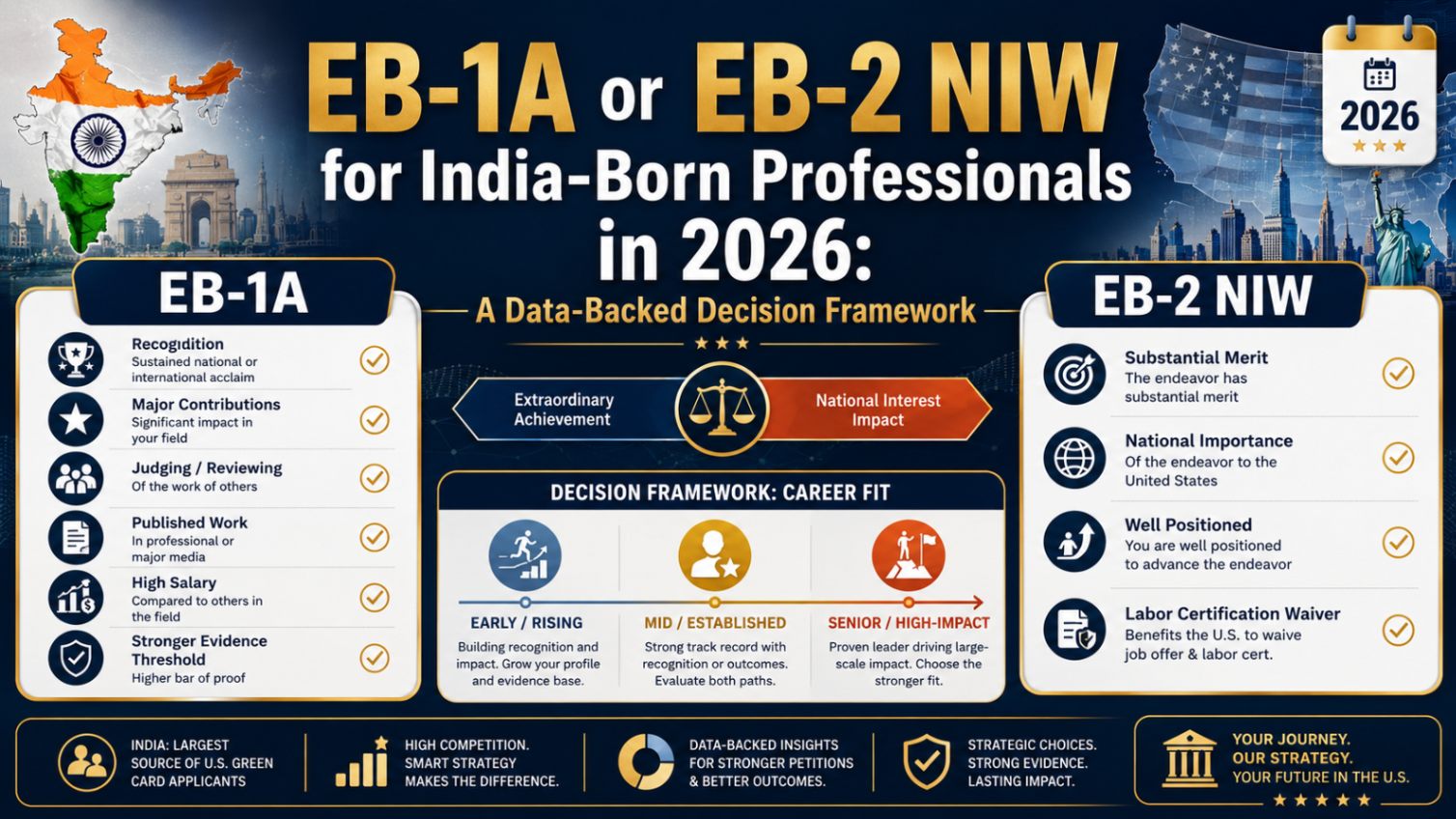

Rushing an EB-1A or NIW petition often leads to avoidable denials. We explain how to build a durable immigration profile through intentional professional achievements.
Why You Should Build a Long-Term Immigration Profile Instead of Rushing a Short-Term Filing
The difference between a petition that gets approved and one that generates a twelve-page RFE often has nothing to do with the quality of the underlying career. It has to do with timing. USCIS adjudicators evaluating EB-1A and O-1A petitions are specifically looking for whether acclaim is sustained — accumulated over a meaningful period through genuine professional activity. When the evidence record shows a flat career history followed by a burst of peer reviews, press mentions, and award nominations in the three months before filing, the pattern is legible. Officers see it regularly enough that it has its own informal name inside the adjudication community: the pre-filing sprint.
A petition built over 12 to 24 months of intentional professional activity looks fundamentally different from a petition built in 90 days of frantic document collection. That difference survives the Final Merits Determination. The sprint rarely does.
What a Compressed Timeline Actually Produces
Petitions assembled in under three months share a recognizable structure. The peer review history begins abruptly. The media features cluster. The association memberships are recent. The expert letters, when read carefully, use similar language and don't reference specific interactions with the applicant's work.
USCIS officers are trained to build timelines. They place every piece of evidence in chronological order and ask a straightforward question: does this look like the record of someone who has been at the top of their field, or does it look like the record of someone preparing a petition? If 70% of the evidence falls within a six-month window that happens to end at the filing date, the answer is usually the latter.
The EB-1A standard specifically requires "sustained national or international acclaim." That word — sustained — is not incidental. A single month of high professional activity, however impressive in isolation, doesn't satisfy it. An adjudicator reading the Kazarian final merits determination framework isn't just counting criteria; they're asking whether the evidence as a whole tells a coherent story about someone who has genuinely risen to the top of their field. A compressed timeline makes that story hard to tell.
The secondary cost is credibility damage. When weak manufactured evidence appears alongside genuine strong evidence, it contaminates the strong evidence. An officer who finds one pay-to-play media placement will scrutinize every other media mention in the file. A cluster of low-impact peer reviews makes the reviewer wonder whether the high-impact ones were equally manufactured.
Scholarly Contributions: Impact Over Volume
The assumption that more publications equals a stronger case is one of the most reliable ways to build a petition that fails the final merits review. Officers reviewing EB-1A petitions check Google Scholar. They look at citation counts, they look at who is doing the citing, and they look at trajectory.
A paper with 50 citations is not self-evidently strong evidence. The relevant questions are: Are those citations from independent researchers across multiple institutions, or are they predominantly from the applicant's own lab and close collaborators? Are citations growing, or has the paper stopped accumulating references? Is the work cited in review articles — the kind that survey a field and identify its key contributions?
Building a profile over 12 to 18 months allows time to increase visibility organically: presenting at selective conferences where other researchers in the field are present, reaching out to colleagues working on adjacent problems, ensuring the methodology is accessible enough that others can build on it. What this produces is citation velocity — a growth rate that shows the work is currently influencing the field, not just historically present in it. A petition filed with 100 citations growing at 10 per month occupies a stronger position than one filed with 200 stagnant citations from three years ago.
Peer Review: The Most Challenged Criterion
Peer review satisfies the criterion for judging the work of others in the same or allied field, and it's also the criterion that generates the most RFEs. The reason is that it's easily gamed, and adjudicators know it.
The specific failure mode is well documented: an applicant with no prior reviewing history creates accounts on one or two journal platforms, accepts every automated invitation that arrives, completes 40 reviews over 10 weeks, and submits the activity logs as evidence of ongoing expert judgment. Officers see this pattern and issue RFEs asking how the applicant was selected, what their relationship was with the requesting editor, and whether any of the journals are on the DOAJ list of predatory publications.
What survives scrutiny is a sustained history of targeted reviewing. A record showing 6 to 10 reviews per year for journals with impact factors above 5, spread across three or four years, where the editor of at least one journal can write a letter explaining that the applicant was specifically recruited because of their published expertise — that is the standard against which the ten-week sprint is measured. The gap between them is significant, and it can't be closed by volume.
Building a meaningful peer review record requires starting early enough that the pattern looks natural. An adjudicator reading a review history that spans 30 months will not ask the same questions as one reading a history that spans 10 weeks.
Comparing Approaches
| Factor | Compressed Filing | Long-Term Profile |
|---|---|---|
| Evidence origin | Documents gathered reactively | Achievements developed with USCIS criteria in mind |
| USCIS perception | Pre-filing sprint pattern | Sustained trajectory of acclaim |
| Peer review | High volume, short window, low-impact journals | Consistent invitations from recognized publications over multiple years |
| Media coverage | Paid placements, press releases, company blogs | Independently reported features with verifiable circulation |
| Final merits outcome | High RFE risk even when three criteria are technically met | Stronger narrative for the totality-of-evidence review |
| Total cost | Higher — RFE responses, refiling, legal fees, processing delays | Managed investment with higher probability of straight approval |
Media Coverage: The Editorial Independence Standard
Press coverage is one of the most valuable EB-1A criteria and one of the most frequently submitted in a form USCIS won't accept. The standard is "published material about the alien in professional or major trade publications or other major media." The operative word is major. Company blogs, local news features, and platforms that accept paid content placements do not satisfy it.
Officers verify publications using third-party traffic and circulation data. They look at editorial guidelines. If a platform has no identifiable editorial staff, accepts sponsored content, or shows the same applicant featured alongside paid advertorials, the feature gets dismissed — and questions arise about why it was submitted.
Building toward meaningful press coverage takes time because the coverage that counts is independently initiated. A journalist at MIT Technology Review or Wired or a recognized industry trade publication covering the applicant's sector needs to independently discover the work and decide it's worth reporting. That doesn't happen because a PR firm sends a press release. It happens because the applicant's work is visible enough — through conference presentations, published research, open-source contributions, or publicly available technical writing — that reporters covering the space find it organically.
A 12-month profile-building timeline creates the visibility that makes organic coverage possible. A 90-day sprint doesn't.
Association Memberships: Finding the Vetted Tier
Standard professional organization memberships — those requiring only a degree and annual dues — don't satisfy the associations criterion. The requirement is membership in associations that require outstanding achievements of members, as judged by recognized national or international experts. The bylaws of the association need to reflect a genuine vetting standard evaluated by people with authority in the field.
Most professional societies have a tiered structure. Fellow status in IEEE, ACM, or equivalent bodies in other fields involves nomination, review by a credentials committee, and a process that can take 6 to 12 months from submission to induction. Steering committee roles at major conferences involve competitive selection. These are the tiers that satisfy the criterion. A standard annual membership, regardless of the organization's overall prestige, does not.
Starting the Fellow application or steering committee nomination process early enough that the designation appears in the petition — rather than "application pending" — requires knowing about the timeline well in advance. This is the type of planning that only happens in a long-term strategy.
The Final Merits Determination: Where Rushed Petitions Collapse
Since Kazarian v. USCIS, 596 F.3d 1115 (9th Cir. 2010), the adjudication process has involved two distinct steps. Meeting three criteria clears the first step. The final merits determination — the second step — asks whether the evidence as a whole demonstrates someone who has genuinely reached the top of their field.
This is where technically sufficient petitions regularly fail. An applicant might have peer review activity (criterion met), a salary in the 80th percentile (criterion arguably met), and an article in a trade publication with modest circulation (criterion marginally met). Three criteria, technically. But the totality reads as a mid-career professional with solid credentials — not someone at the top of the field.
A petition built over 18 months carries more at this stage because the cumulative record builds a coherent narrative. Citations from independent international researchers alongside a consistent peer review record at top-tier journals alongside an independently reported feature in a publication with verifiable circulation — taken together, this reads differently than three boxes barely checked. The adjudicator's job at the final merits stage is to assess whether the whole picture is persuasive. A long-term profile gives them a picture. A rushed filing gives them a checklist.
The Critical Role: Documentation Built Over Time
Satisfying the criterion for a leading or critical role in an organization with a distinguished reputation requires more than a job title and an organizational chart. It requires a letter from a C-suite executive that names specific decisions the applicant made, connects those decisions to documented outcomes, and explains why the role was critical — not just senior — to the organization's direction.
Generic employment verification letters produced by HR departments don't accomplish this. Neither do letters drafted by the applicant and signed by a manager without substantive engagement. What works is a letter written by someone who actually observed the applicant's contributions and can describe them specifically: the product roadmap decision that drove a funding round, the technical architecture that reduced infrastructure costs by a documented percentage, the research direction that produced the company's first licensed patent.
These letters require the kind of relationship and documented track record that develops over months of high-impact work, not weeks of petition preparation. An applicant who has spent 12 months on a major initiative — and has internally documented their role throughout — is in a fundamentally better position to produce this evidence than one who is assembling it retrospectively.
What Quantification Actually Requires
Petition preparation frequently involves the question of whether a given metric is strong enough. Is a salary at the 82nd percentile sufficient? Is 45 citations enough? Is a journal with an impact factor of 4.2 prestigious enough?
None of these questions have universal answers. What matters is how the applicant's numbers compare to the specific sub-field and job title being evaluated. A salary at the 82nd percentile nationally might be at the 91st percentile for the specific metro and role. A citation count of 45 might be exceptional in a narrow specialty where the average is 12. Impact factor benchmarks vary substantially across disciplines — a 4.2 in ecology is strong; in general medicine it is not.
Building a profile over time creates the opportunity to improve the underlying metrics, not just document them. A negotiated promotion from Senior Engineer to Principal Engineer before filing strengthens both the high salary and critical role criteria. Reaching out to collaborators about in-progress work that would naturally cite existing papers increases citation velocity. These moves require lead time. They can't be executed in 90 days.
Frequently Asked Questions
How long does it take to build an EB-1A immigration profile? For most professionals, 12 to 18 months is the realistic minimum. That window allows for natural citation growth, a sustained peer review record across multiple journals, and the time needed to secure organic press coverage or Fellow-level association designations. Applicants with unusually strong existing records can file sooner, but the "sustained" requirement in the EB-1A standard is difficult to satisfy with evidence that doesn't span at least two or three years of professional activity.
Can I still apply if my citation count is low? Citations are one indicator of scholarly impact, not the only one. Applicants in fields where citation cultures differ — engineering subdisciplines, applied research, business — often build stronger cases around patents with documented commercialization, software with verifiable adoption metrics, or professional awards with transparent selection criteria. The long-term strategy in these cases focuses on increasing visibility through invited talks and conference participation, which generates both direct evidence of recognition and, over time, additional citations.
Does USCIS prefer older or newer evidence? Both extremes are problematic. Evidence that is exclusively historical suggests the applicant's period of significant achievement has passed. Evidence that is exclusively recent suggests the acclaim is not sustained. A strong petition presents foundational work from earlier in the career — published research, early patents, initial critical role — alongside high-impact recent activity that shows the applicant is currently operating at the top of their field. The balance between these two layers is one of the structural advantages of a long-term filing strategy.
Do I need a PhD to qualify? No. EB-1A is available to professionals in business, education, athletics, and the arts, not only academia. Business professionals build cases around high compensation benchmarked against independent salary data, critical roles at organizations with distinguished reputations, and contributions of major significance — commercial methodologies adopted industry-wide, products that generated documented revenue at scale, or technical work that competitors independently implemented. The 12-month profile-building timeline for a business professional looks different from a researcher's, but the underlying principle is the same: documented, sustained impact that someone else can independently verify.
A VangaVault profile assessment provides a criterion-by-criterion gap analysis of the current evidentiary record and a written 12-month roadmap within 48 hours of CV submission. Start your assessment here.
Get Immigration Insights Delivered to Your Inbox
Practical guidance on EB-1A, EB-2 NIW, O-1A, and U.S. immigration — no spam, unsubscribe anytime.