
O-1A petitions require a qualifying petitioner — you can’t self-file. Here’s how employer, agent, and founder structures work under USCIS rules.
Who Can Sponsor an O-1A Petition? O-1 Visa Sponsor Requirements Explained
You may have an impressive professional record and a strong reason to work in the United States, but what happens if you do not have a traditional U.S. employer willing to sponsor you? This question frequently arises for startup founders, independent consultants, entrepreneurs, and accomplished professionals whose careers involve working with multiple organizations.
The good news is that O-1A sponsorship is not limited to a conventional employer-employee arrangement. Depending on your circumstances, a U.S. employer, an appropriately authorized U.S. agent, or even a legally separate U.S. company you own may be able to file your petition. However, each arrangement has specific requirements, and choosing the right structure involves more than finding someone willing to sign immigration paperwork.
Under U.S. immigration law, the person or organization filing an O-1A petition is called the petitioner, while the professional seeking O-1A classification is the beneficiary. Although people commonly search for an "O-1 visa sponsor," understanding this legal distinction is important because an O-1A beneficiary cannot personally self-petition.
This guide explains who can sponsor an O-1A visa, how employer and agent petitions work, whether founders can use their own companies, and what documentation is necessary to establish a legitimate proposed employment arrangement.
Understanding O-1A Visa Sponsor Requirements: Who Can File Your Petition?
The governing regulation, 8 C.F.R. § 214.2(o)(2), provides for O-1 petitions filed by qualifying U.S. employers, U.S. agents, or foreign employers acting through U.S. agents. The petitioner submits Form I-129, Petition for a Nonimmigrant Worker, together with evidence establishing the beneficiary's qualifications and the proposed U.S. activities.
These arrangements accommodate different professional circumstances. A researcher joining one U.S. institution may have a straightforward employer petition, while an independent specialist working for several organizations may require an agent arrangement. A founder operating a U.S. business may have another potential option through a separate legal entity.
Which O-1A Sponsorship Arrangement Fits Your Situation?
| Professional Situation | Potential Petitioner | Important Consideration |
|---|---|---|
| You have one U.S. employer offering qualifying work | U.S. employer | The proposed employment and contractual terms must be documented |
| You own a U.S. startup or business | Separate U.S. legal entity | The company must be a genuine legal entity with a supportable work arrangement |
| You will work for several U.S. employers | Authorized U.S. agent or separate employers | Contracts, agent authorization, and itinerary requirements must be satisfied |
| You work for an overseas company planning U.S. assignments | U.S. agent acting for the foreign employer | The foreign employer's relationship and the agent's authority must be established |
| You are an independent consultant with project-based engagements | Appropriate U.S. agent | The actual engagements and agent's role must support the filing |
These are potential arrangements rather than automatic eligibility determinations. The petitioner structure must reflect how the proposed work is actually organized, and the beneficiary must independently satisfy the O-1A extraordinary ability requirements.
O-1A Employer Sponsorship: The Direct Employment Route
A U.S. employer may file an O-1A petition when it intends to engage a qualifying professional to perform services in the United States. This arrangement is often relatively straightforward when one company is responsible for the employment and can clearly identify the proposed position, duties, compensation, and employment period.
For example, a U.S. technology company may seek to employ an internationally recognized artificial intelligence researcher to lead a specialized research initiative. The company would file Form I-129 and provide documentation establishing the proposed activities, the terms of the employment arrangement, and the researcher's extraordinary ability in the relevant field.
What Documents Does an O-1A Employer Need?
An employer petition generally requires several categories of supporting evidence. The precise documentation depends on the circumstances, but the following elements are particularly important.
Employment agreement or agreed terms. USCIS requires copies of written contracts between the petitioner and beneficiary or, where there is no written contract, a summary of the terms of the oral agreement. The documentation should establish the services to be performed, compensation, employment period, and other relevant conditions. An offer letter may help establish these terms, but its sufficiency depends on the information it contains.
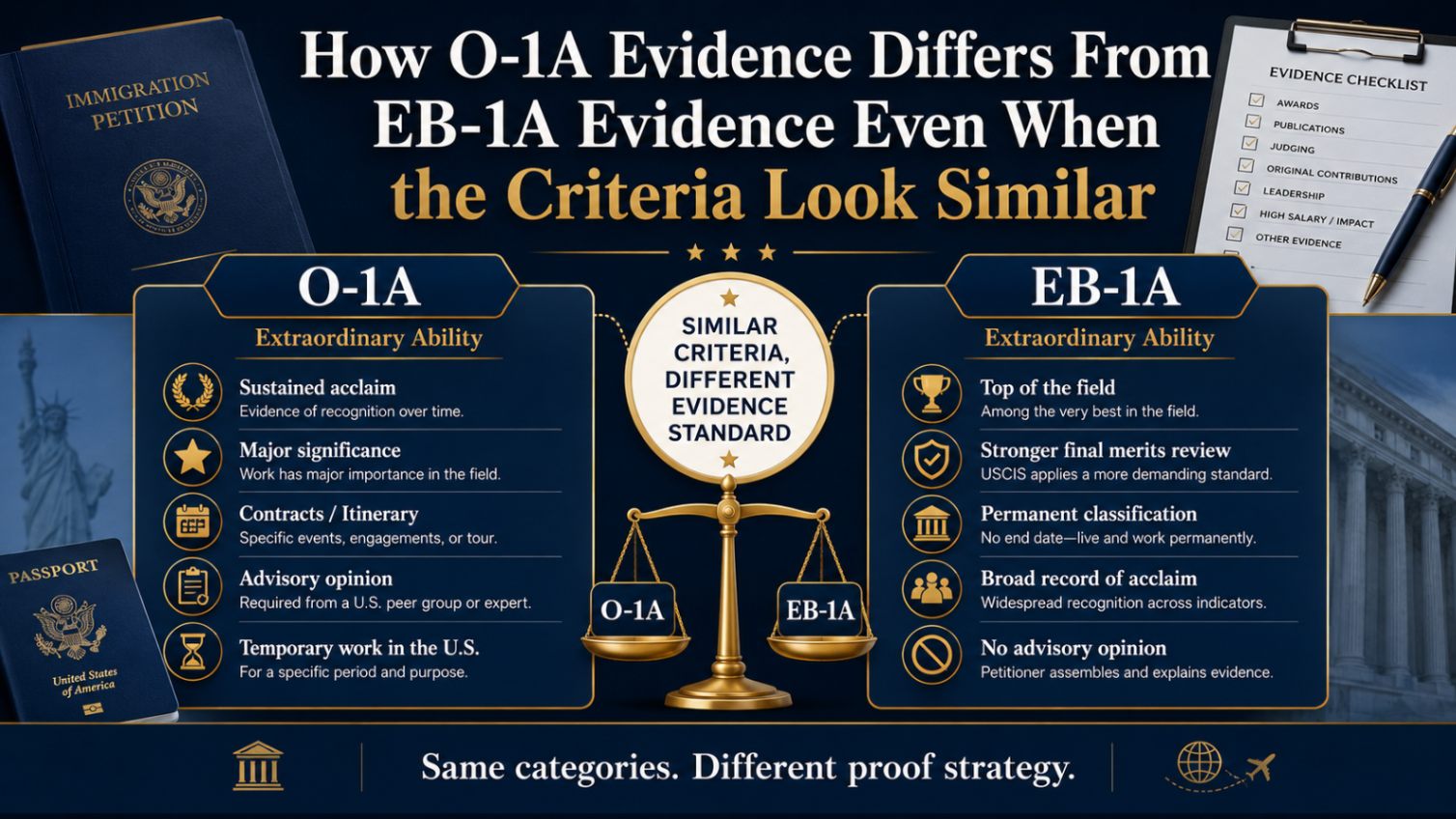
Evidence of extraordinary ability. The beneficiary must demonstrate eligibility for O-1A classification through the applicable regulatory evidence. Depending on the professional background, this may involve awards, published material, original contributions, judging activities, scholarly authorship, leading or critical roles, high remuneration, or other qualifying evidence. USCIS evaluates the evidence as a whole rather than treating the number of categories satisfied as the sole determinant of extraordinary ability.
Consultation or advisory opinion. O-1A petitions generally require a written advisory opinion from an appropriate peer group, which may include a labor organization, or a person or persons with expertise in the beneficiary's field. The opinion addresses the beneficiary's abilities and achievements and the nature of the proposed duties. Applicable regulatory exceptions may permit USCIS to decide a petition without a consultation in certain circumstances.
Proposed activities and itinerary. The petition must explain what the beneficiary will do during the requested period. When the proposed services involve multiple events or locations, the required itinerary should identify relevant dates and locations. For a continuous assignment at one location, the documentation may be less extensive, but the employment must still be sufficiently established.
Direct employer sponsorship is generally appropriate when the underlying relationship is clearly defined. When the beneficiary's work involves multiple organizations or separate consulting engagements, however, an authorized U.S. agent may provide a more suitable filing structure.
O-1A Agent Sponsorship: Three Recognized Arrangements
U.S. agent petitions can accommodate professional arrangements that do not fit a traditional single-employer model. Under 8 C.F.R. § 214.2(o)(2)(iv)(E), an agent may function as the actual employer, represent employers and the beneficiary, or act on behalf of a foreign employer.
The documentation requirements differ according to the agent's actual function. It is therefore important to identify the arrangement before determining which agreements, authorizations, and employment records are needed.
1.The U.S. Agent Functions as the Employer
When the U.S. agent is the actual employer, the filing must establish that employment relationship rather than merely identify the agent as an intermediary. The agent must provide evidence of a contractual agreement with the beneficiary specifying the wages offered and other terms and conditions of employment. Depending on the circumstances, this may consist of a written agreement or an acceptable summary of the terms of an oral agreement.
The agent must also guarantee the wages and other employment terms and provide an itinerary of definite employment, together with information about other services planned during the requested period. These requirements help USCIS determine whether the arrangement represents genuine employment supported by identifiable activities.
For example, a specialized technology professional may be employed by a U.S. agent to provide technical advisory services across several defined projects. The filing should explain who employs the professional, how compensation will be provided, what services are planned, and where and when those services will occur. Merely identifying prospective assignments without establishing a genuine employment arrangement would not adequately address these requirements.
- The U.S. Agent Represents Multiple Employers and the Beneficiary
An authorized U.S. agent may also file a consolidated petition for a beneficiary who will work for several employers. This arrangement can be useful for consultants, researchers, technical advisers, and other professionals whose engagements are organized across multiple institutions or businesses.
In this situation, the petition must establish the agent's authorization to act for the employers and include the required contracts between the employers and beneficiary. It must also provide a complete itinerary identifying the engagements, service dates, actual employers, and establishments or locations where the work will take place.
The central consideration is whether the agent is properly authorized and whether the proposed employment arrangements are sufficiently documented. A consolidated agent filing can cover multiple engagements, but it does not automatically authorize unrestricted work for any future client.
3.The U.S. Agent Files on Behalf of a Foreign Employer
A foreign employer may use an authorized U.S. agent to petition for a professional who will perform qualifying work in the United States. Under the O-1 regulations, the relevant distinction is whether the foreign employer is amenable to service of process in the United States, not simply whether it maintains a physical U.S. office.
The petition should document the foreign employment relationship, the proposed activities, and the agent's authorization to act on the employer's behalf. The U.S. agent must also be authorized to accept service of process in proceedings under Section 274A of the Immigration and Nationality Act on behalf of the foreign employer.
For example, an overseas technology business assigning a distinguished specialist to a U.S. implementation project may potentially use this structure. However, the filing must still establish the qualifying relationship, actual proposed services, and compliance with the applicable O-1A requirements.
Can You Work for Multiple Employers Under One O-1A Petition?
Yes. An O-1A beneficiary may perform services for multiple employers when those activities are properly authorized. The two principal approaches are separate petitions filed by the individual employers or a consolidated petition filed through an appropriately authorized U.S. agent.
Under the separate-petition approach, each employer files Form I-129 for the work it will offer. This may suit organizations that prefer to manage their own employment arrangements, although it generally involves additional filing costs and administrative work.
A consolidated agent petition may be more practical where several employers have defined engagements with the same professional. However, the agent's authority, underlying contracts, and complete itinerary must be documented. Administrative convenience cannot replace the substantive requirements for the filing.
Example: A Software Consultant Working With Two U.S. Companies
Consider a software consultant with recognized expertise in enterprise cybersecurity. One U.S. company engages the consultant to assess its security architecture, while another seeks advice on implementing secure cloud infrastructure. Both projects have identifiable scopes and expected schedules, but neither company employs the consultant for all of the proposed work.
An authorized U.S. agent may potentially file a consolidated petition representing the relevant employers. The supporting documents would need to establish the agent's authority, the contractual relationships between the employers and consultant, the services to be performed, and the relevant dates and locations. Alternatively, the companies could file separate petitions.
The outcome would be different if the consultant had only informal discussions with prospective clients and no sufficiently established engagements. Potential future opportunities may help explain a professional's business plans, but they do not automatically satisfy the contractual and itinerary requirements for a multiple-employer agent petition.
O-1A Founder Petitions: Can Your Own Company Sponsor You? One of the most important questions for entrepreneurs is whether they can pursue O-1A classification without finding an unrelated U.S. employer. A founder cannot personally self-petition, but a legally separate U.S. business owned by the founder may be able to file an O-1A petition.
USCIS clarified this distinction in its January 8, 2025 policy guidance, confirming that a separate legal entity owned by the beneficiary, such as a corporation or limited liability company, may petition on the beneficiary's behalf. Ownership does not automatically make the arrangement prohibited self-petitioning.
For example, a technology entrepreneur developing a specialized AI platform through a U.S. corporation may potentially have that company file an O-1A petition. Nevertheless, establishing a corporation or LLC is only one part of the analysis. The company must be a genuine separate legal entity, the proposed work must be adequately documented, and the entrepreneur must independently satisfy the extraordinary ability standard.
What Evidence Can Support a Founder-Owned Company Petition?
A founder-owned company should be prepared to document its legal existence and the proposed professional activities. Depending on its circumstances, relevant evidence may include formation documents, corporate or LLC records, business operations documentation, client agreements, product development materials, employment terms, and project plans.
Ownership and governance records may also help explain the relationship between the company and the beneficiary. However, an independent board of directors is not a universal requirement for O-1A sponsorship. The appropriate records depend on the actual business structure and the facts of the petition.
An early-stage venture does not necessarily need the same operational documentation as an established company, but its proposed activities must still be genuine and supportable. Forming a company does not, by itself, establish qualifying employment or extraordinary ability.
Can a Founder Use a U.S. Agent Instead?
Potentially, yes. A founder who provides consulting services, works across several organizations, or undertakes defined project-based engagements may be able to use an appropriate U.S. agent arrangement. The petition must accurately reflect the agent's function and include the necessary supporting documents.
Neither founder-owned company sponsorship nor agent sponsorship is universally preferable. The appropriate choice depends on the entrepreneur's actual business activities, the proposed U.S. work, and the documentation available.
How Do You Choose the Right O-1A Petitioner for Your Situation?
Choosing a petitioner should begin with an assessment of the work you intend to perform, rather than a comparison of filing costs alone. A person with one confirmed U.S. employer faces different questions from a consultant with several clients or a founder planning to work through a U.S. startup.
Several considerations can help clarify which structure may be appropriate.
Who Is Responsible for Your Proposed U.S. Work?
Identify the parties offering, organizing, or employing you for the proposed activities. If one U.S. company is responsible for a defined role, direct employer sponsorship may be appropriate. If several organizations independently engage your services, an agent filing may better reflect the arrangement. Founders should assess whether their separate U.S. entities can establish a genuine petitioning relationship.
Are Your Engagements Confirmed or Merely Prospective?
The distinction between actual work arrangements and potential opportunities is especially important for consultants and early-stage entrepreneurs. A signed project agreement describing identifiable services provides different evidence from an email expressing general interest in a future collaboration.
Prospective business relationships may provide context, but they should not be presented as established contractual engagements when they are not. Before choosing a petitioner structure, review what has been agreed, who the parties are, what activities will occur, and whether the available documentation satisfies the applicable requirements.
Who Has Authority to File the Petition?
A U.S. agent must have authority consistent with the role it is performing. An agent representing multiple employers must be properly authorized, while an agent functioning as the actual employer must establish the relevant contractual relationship and employment terms.
Similarly, a foreign employer's U.S. agent must have the required authorization to act on its behalf. A person's willingness to sign Form I-129 does not, by itself, establish a qualifying relationship.
What Evidence Can You Realistically Obtain?
The availability of supporting documents should influence the filing strategy. Relevant records may include employer agreements, contracts, agent authorization, corporate formation documents, project schedules, and evidence of genuine business activities.
If critical documentation is unavailable, the gap should be identified before filing. The most appropriate petitioner structure is the one that accurately reflects your proposed employment and can be supported by reliable evidence. ** O-1A Itinerary Requirements: What Must Be Documented**? An itinerary helps USCIS understand the services and activities that the beneficiary will undertake during the requested O-1A period. The level of detail required depends on the petitioning arrangement, particularly when an agent is involved.
For an agent representing multiple employers, the regulation requires a complete itinerary identifying the dates of each service or engagement, the actual employers, and the establishments or locations where the work will be performed. This information should be consistent with the contracts and other employment documentation.
An agent functioning as the actual employer is subject to a separate requirement to provide an itinerary of definite employment and information about other services planned during the requested period. This should be considered alongside the contractual agreement specifying wages and employment terms.
For example, an itinerary stating only that a technology consultant will advise U.S. companies during the coming year may not adequately identify the proposed engagements. An itinerary naming the actual employers, describing agreed activities, and identifying relevant service periods and locations would provide more meaningful documentation.
Where schedules remain subject to change, estimated dates should be accurately identified and supported by evidence of the underlying arrangements. A statement of possible future interest should not automatically be treated as equivalent to a confirmed engagement.
What Happens if Your Employment Changes After O-1A Approval?
O-1A employment authorization is tied to the approved petition and its underlying arrangements. Changes may therefore require a new or amended filing, although not every scheduling or administrative adjustment automatically creates an amendment requirement.
Material Changes to Approved Employment
When there is a material change in the terms and conditions of employment or in the beneficiary's eligibility, the petitioner generally must file an amended Form I-129. A substantial change in the nature of the professional duties or employment relationship may require this assessment, whereas routine adjustments that do not materially alter the approved arrangement may not.
The specific facts should be reviewed before work begins under substantially different conditions.
Changing Employers
When an O-1A beneficiary changes employers, the new employer generally must file a new petition. The regulations provide a specific rule for agent-filed O petitions: when an agent filed the original petition and the beneficiary seeks to change employers, the agent must file an amended petition with evidence relating to the new employer and, where applicable, a request for an extension of stay.
This should be distinguished from continuing activities that were already covered by the approved petition. In either situation, the beneficiary and petitioner should determine whether the proposed work remains authorized before proceeding.
Adding Further Client Engagements
Consultants and founders may receive new opportunities after their petitions are approved. However, an approved agent petition is not blanket authorization for unrestricted engagements with additional employers.
The parties must evaluate whether the new activity is covered by the existing approval, whether the employment relationship has changed, and whether a new or amended petition is necessary.
Frequently Asked Questions About O-1A Sponsorship
Can I apply for an O-1A visa without a sponsor?
An O-1A beneficiary cannot personally file Form I-129 on their own behalf. A qualifying U.S. employer, authorized U.S. agent, or foreign employer acting through a U.S. agent must file the petition. However, a traditional unrelated employer is not always necessary because a legally separate U.S. company owned by the beneficiary may potentially qualify as the petitioner. Can my own company sponsor my O-1A petition?
Yes. A U.S. corporation or LLC owned by the beneficiary may file an O-1A petition, provided the entity and proposed work arrangement satisfy the applicable requirements. USCIS distinguishes this arrangement from prohibited individual self-petitioning. Although governance records may be relevant, an independent board of directors is not a universal requirement.
Can I apply for an O-1A visa if I have clients but no full-time employer?
Potentially. An appropriately authorized U.S. agent may be able to file for a consultant with qualifying project-based engagements involving multiple employers. The petition must establish the agent's authority, the required contractual arrangements, and the proposed activities. Having prospective clients alone does not automatically establish the necessary employment evidence.
Do I need to establish a U.S. company before applying for O-1A?
No. Forming your own company is one possible approach, but it is not a universal O-1A requirement. An unrelated U.S. employer or an appropriately authorized agent may file the petition where the actual arrangements support that structure. The choice should be based on the proposed employment rather than an assumption that every independent professional needs a corporation.
Can I work for several employers under one O-1A petition?
Yes, an appropriately authorized U.S. agent may file a consolidated petition covering multiple employers when the applicable contracts, authorization, and itinerary requirements are met. Alternatively, employers may file separate petitions. The beneficiary's authorized employment remains limited to the scope of the approved arrangements and applicable immigration rules.
Is an itinerary required for every agent-filed O-1A petition?
The itinerary requirements depend on the agent's function. An agent representing multiple employers must provide a complete itinerary identifying the employers, relevant dates, and work locations. An agent serving as the actual employer must also document definite employment and other planned services during the requested period. General descriptions of speculative future work do not substitute for the required information.
Does having a qualifying O-1A petitioner guarantee approval?
No. Establishing a qualifying petitioner addresses an important filing requirement, but USCIS separately evaluates the beneficiary's extraordinary ability, the proposed activities, and the supporting evidence. A properly structured employment arrangement does not automatically establish eligibility for O-1A classification.
Choosing the Right O-1A Sponsorship Structure Starts With Your Actual Work
The O-1A classification offers potential filing arrangements for accomplished professionals whose careers do not follow a conventional single-employer model. A founder may be able to work through a separate U.S. company, a consultant may have qualifying engagements covered through an authorized agent, and an overseas professional may be able to pursue a U.S. assignment through an appropriate foreign-employer arrangement.
The important consideration is not simply whether a person or organization is willing to file the petition. It is whether the proposed employment, underlying agreements, petitioner's authority, and supporting evidence satisfy the applicable requirements.
For founders, consultants, and professionals with unconventional career paths, identifying the correct petitioner structure is an important part of preparing a well-documented O-1A case.
Not Sure Who Can Sponsor Your O-1A? Let's Explore Your Options Together.
Your professional journey may not fit a traditional employment model. Perhaps you're building your own company, working independently, or collaborating with several organizations. Whatever your circumstances, deciding how to structure an O-1A petition can raise questions that are difficult to answer without reviewing the actual employment arrangements.
At VangaVault Immigration, we take the time to understand your work, professional achievements, and plans for pursuing your career in the United States. We can help you explore which petitioner arrangements may fit your circumstances, identify documentation gaps, and understand what a carefully prepared petition would involve.
You don't need to have everything figured out before speaking with us. A conversation about your background and available options is a good place to begin.
Schedule Your Free Consultation
Get Immigration Insights Delivered to Your Inbox
Practical guidance on EB-1A, EB-2 NIW, O-1A, and U.S. immigration — no spam, unsubscribe anytime.