
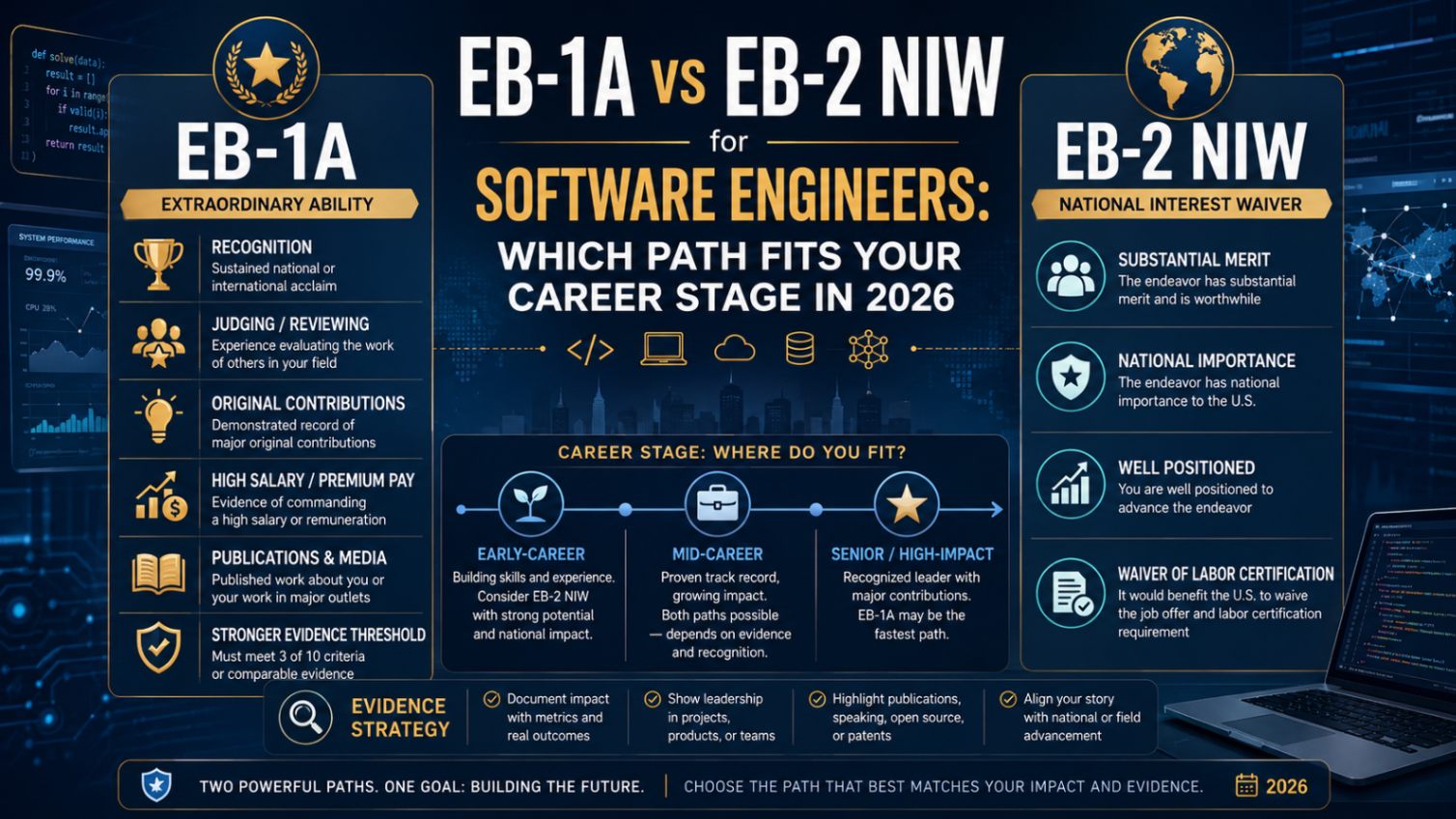
Choosing between EB-1A and EB-2 NIW requires a cold assessment of your career achievements. This guide explains the mechanics of both paths for software engineers in 2026.
EB-1A vs EB-2 NIW for Software Engineers: Which Path Fits Your Career Stage in 2026
Software engineers evaluating immigration options in 2026 are working with two meaningful choices: the EB-1A extraordinary ability category and the EB-2 National Interest Waiver. Both allow self-petitioning without employer sponsorship. Both waive the labor certification requirement. Beyond those similarities, the standards diverge considerably, and filing the wrong one for the wrong career stage is one of the more avoidable reasons petitions fail.
The EB-1A is built for a narrow population — individuals whose professional record demonstrates sustained national or international acclaim and places them among the small percentage at the very top of their field. For a software engineer, that means independent external recognition that extends beyond strong job performance at a prestigious employer. The EB-2 NIW asks a different question: whether the proposed endeavor has substantial merit and national importance, and whether this particular engineer is well-positioned to advance it. A talented engineer building consequential technology in a federally prioritized area can satisfy the NIW standard without having achieved the kind of field-wide recognition the EB-1A requires.
The catch for many engineers — particularly those born in India — is the backlog. EB-2 Final Action Dates for India-born petitioners were more than a decade behind as of early 2026, with no near-term relief visible in the visa bulletin. That math pushes many engineers toward the EB-1A even when the NIW is a stronger evidentiary fit, simply because it's the only path to a green card within a plausible timeframe.
The Core Comparison
| Feature | EB-1A | EB-2 NIW |
|---|---|---|
| Primary standard | Sustained national or international acclaim; top of the field | Substantial merit, national importance, well-positioned to advance the endeavor |
| Sponsorship | Self-petition or employer | Self-petition or employer |
| Labor certification | Waived | Waived |
| Education requirement | None (though typically high) | Advanced degree or exceptional ability |
| 2026 backlog (India-born) | Minimal to moderate | Severe — years to decades depending on priority date |
| Premium processing | Available (15 business days) | Available (45 business days) |
| Ideal candidate profile | Distinguished Engineers, engineering founders, researchers with field-wide impact | Senior engineers, AI/ML researchers, tech leads working in federally prioritized technology areas |
Career Stage and Category Fit
Mid-level engineers attempting an EB-1A because they want to bypass the NIW backlog is one of the most consistent patterns that leads to RFEs. The desire to avoid a 10-year wait is understandable. The problem is that a petition filed before the evidentiary record supports it doesn't become stronger by filing early — it creates a credibility problem that follows the applicant into any subsequent attempt.
Early-to-mid career (roughly 5–10 years of experience). The EB-2 NIW is the realistic target for most engineers at this stage. High compensation is typically the strongest credential, but salary alone satisfies only one criterion in EB-1A and doesn't address the final merits determination. Engineers whose work falls within areas the federal government has identified as national priorities — semiconductor manufacturing, AI safety, clean energy software, quantum computing — have a more tractable NIW argument because the national importance prong of the Dhanasar framework can be grounded in existing federal policy documentation. The CHIPS and Science Act of 2022 and the National AI Initiative Act of 2020 both identify specific technology areas as national priorities, and work that falls within those areas has a stronger Prong One foundation than work that requires building that case from scratch.
Senior, Principal, and Staff Engineers (12+ years, typically). EB-1A becomes viable here. Engineers at this level often have patents, a track record of reviewing for technical conferences or journals, and a role at a company whose reputation can be independently documented. The analysis is usually a criteria count: if total compensation falls above the 90th percentile for the specific role and metropolitan area (verified against Bureau of Labor Statistics Occupational Employment and Wage Statistics data), the high salary criterion is satisfied. If the engineering role was critical to a specific organizational outcome at a company with a distinguished reputation, the critical role criterion is addressable. From there, identifying a third criterion with strong evidence — original contributions with documented field-wide adoption, peer review for recognized conference program committees — determines whether the three-criterion threshold is reachable with defensible evidence.
The EB-1A Evidence Problem for Engineers
The Kazarian two-step applies: first, does the evidence satisfy at least three criteria; second, does the record as a whole demonstrate sustained national or international acclaim? Most engineer petitions that fail do so at the second step, because the evidence satisfies the criteria in form without establishing field-level distinction in substance.
GitHub repositories are the canonical example of high volume and low weight. Fifteen repositories don't constitute an original contribution of major significance. A repository that has been integrated into a major open-source project with a documented adoption base — referenced in the Linux kernel, pulled into a framework used by hundreds of thousands of developers — is a different argument. The adoption has to be documentable and independent: not just stars, but citations in technical literature, integration in named production systems, or endorsement from recognized projects with their own established reputations.
Judging activity frequently fails because engineers joined panels specifically to satisfy the criterion. Officers have become skilled at identifying selection processes that accept anyone with a LinkedIn profile and a relevant job title. The standard that survives the Kazarian final merits determination is selection by a recognized institution based on demonstrated expertise — an invitation from a program committee chair at a major conference like NeurIPS, ICML, or IEEE for a specific technical area in which the engineer has published or contributed, not an open call for reviewers through a form.
Patents carry weight when they're connected to downstream outcomes. A patent filing is evidence of an invention. Evidence that the patent has been licensed to an independent company, integrated into a commercial product generating documented revenue, or cited in subsequent patent applications filed by competitors converts the filing into evidence of major significance. The USPTO filing receipt alone doesn't satisfy the original contributions criterion at the final merits stage.
The NIW Proposed Endeavor for Software Engineers
The proposed endeavor is the structural center of an NIW petition, and "continuing to work as a software engineer" isn't one. USCIS has consistently issued RFEs for endeavor statements that describe a job function rather than a specific problem, approach, and national benefit.
The standard that works: a specific technical problem, a specific approach to addressing it, and a documented connection to a national interest. "Developing decentralized identity protocols to reduce credential-based data breaches in U.S. financial infrastructure" is a proposed endeavor — it names a problem (credential-based breaches), a mechanism (decentralized identity protocols), and a sector with documented national security implications (financial infrastructure). CISA publishes annual reports on critical infrastructure threats; an NIW petition that cites those reports to establish the problem's national significance is making a Prong One argument from federal documentation rather than self-assertion.
Endeavors that fail are those where the benefit is confined to a single employer. Work that optimizes a company's internal tools, however technically sophisticated, doesn't extend to the industry or the public in a way the Dhanasar framework recognizes. The benefit has to be demonstrably exportable beyond the petitioner's employment relationship.
The Filing Strategy: Using Both Paths
Many engineers from high-backlog countries file NIW early and EB-1A later — a sequencing that takes advantage of how priority dates work. Filing an NIW petition establishes a priority date. If an EB-1A is subsequently approved, USCIS permits the petitioner to use the earlier priority date from the NIW filing under the priority date portability provisions of 8 C.F.R. § 245.25(a). An engineer who files NIW at the Senior Engineer level and later reaches Distinguished Engineer or Principal Architect, accumulating the additional evidence needed for EB-1A, can arrive at an approved EB-1A backed by a priority date several years older — potentially making the green card immediately available rather than years away.
This requires treating the NIW filing not as a final destination but as a foundation. The priority date is the valuable thing it produces. The EB-1A case can be built over the years between the two filings.
Exceptional Ability in EB-2 (Without an Advanced Degree)
Engineers without a Master's or PhD can qualify for EB-2 through exceptional ability by satisfying three of six criteria at 8 C.F.R. § 204.5(k)(3)(ii). The criteria include a degree or certificate in the field, ten years of full-time experience, a license to practice, a high salary relative to others in the field, membership in professional associations, and recognition from peers or government entities for achievements. For software engineers, licensing is not standard in the U.S. technology industry, which typically eliminates one of the more straightforward paths. Engineers pursuing this route most commonly rely on the combination of degree plus experience, high compensation relative to the field, and professional association membership — though the associations criterion requires organizations with standards-based admission, not open enrollment.
Frequently Asked Questions
Which path should a software engineer choose? If three EB-1A criteria are supportable with high-quality, independently verifiable evidence, EB-1A is the stronger filing because priority dates move more favorably. If the public-facing credentials — press coverage, judging invitations from recognized institutions, field-wide adoption of original work — aren't yet there, NIW is the realistic entry point. Filing the wrong category with strong credentials is wasteful. Filing the wrong category with evidence that doesn't hold up under the Kazarian final merits standard produces an RFE and delays the priority date.
Can a software engineer switch from NIW to EB-1A later? Yes, and the priority date portability mechanism at 8 C.F.R. § 245.25(a) is the reason the sequencing strategy makes sense. An approved NIW establishes a priority date. A subsequently approved EB-1A in the same or a similar occupational classification can use that earlier date. The EB-1A petition has to be filed and approved independently — the NIW approval doesn't transfer, only the date.
What are the risks of a rejected EB-1A? A denial based on evidentiary insufficiency doesn't bar reapplication or affect existing H-1B or O-1A status. A denial that results from submission of fabricated or misrepresented evidence — manufactured judging invitations, pay-to-play press placements, patents filed solely for the petition — creates credibility damage that carries into any subsequent petition. Officers reviewing a refiled petition have access to the prior record. Four criteria with defensible, high-quality evidence is a stronger petition than eight criteria padded with evidence that invites scrutiny.
Does the employer need to know about the petition? No. Both EB-1A and NIW are self-petitioned categories. The employer's involvement isn't required, and no employer notification is triggered by the filing. Expert letters from colleagues or former managers at other companies are common and don't require the current employer's knowledge. Letters from current colleagues are workable but require those individuals' willingness to participate without employer direction.
A useful first step is mapping existing credentials against the criteria to identify which three are closest to being supportable with objective, independently verifiable evidence — then evaluating whether the combination, taken together, can sustain a final merits argument that the record reflects someone at the top of the field. If that analysis points toward a gap between current credentials and EB-1A requirements, the NIW proposed endeavor becomes the more immediate priority.
A VangaVault profile assessment reviews the current record against both frameworks and returns a written feasibility analysis identifying the most viable path and the specific evidentiary gaps within 48 hours. Schedule a consultation to start that evaluation.
Get Immigration Insights Delivered to Your Inbox
Practical guidance on EB-1A, EB-2 NIW, O-1A, and U.S. immigration — no spam, unsubscribe anytime.