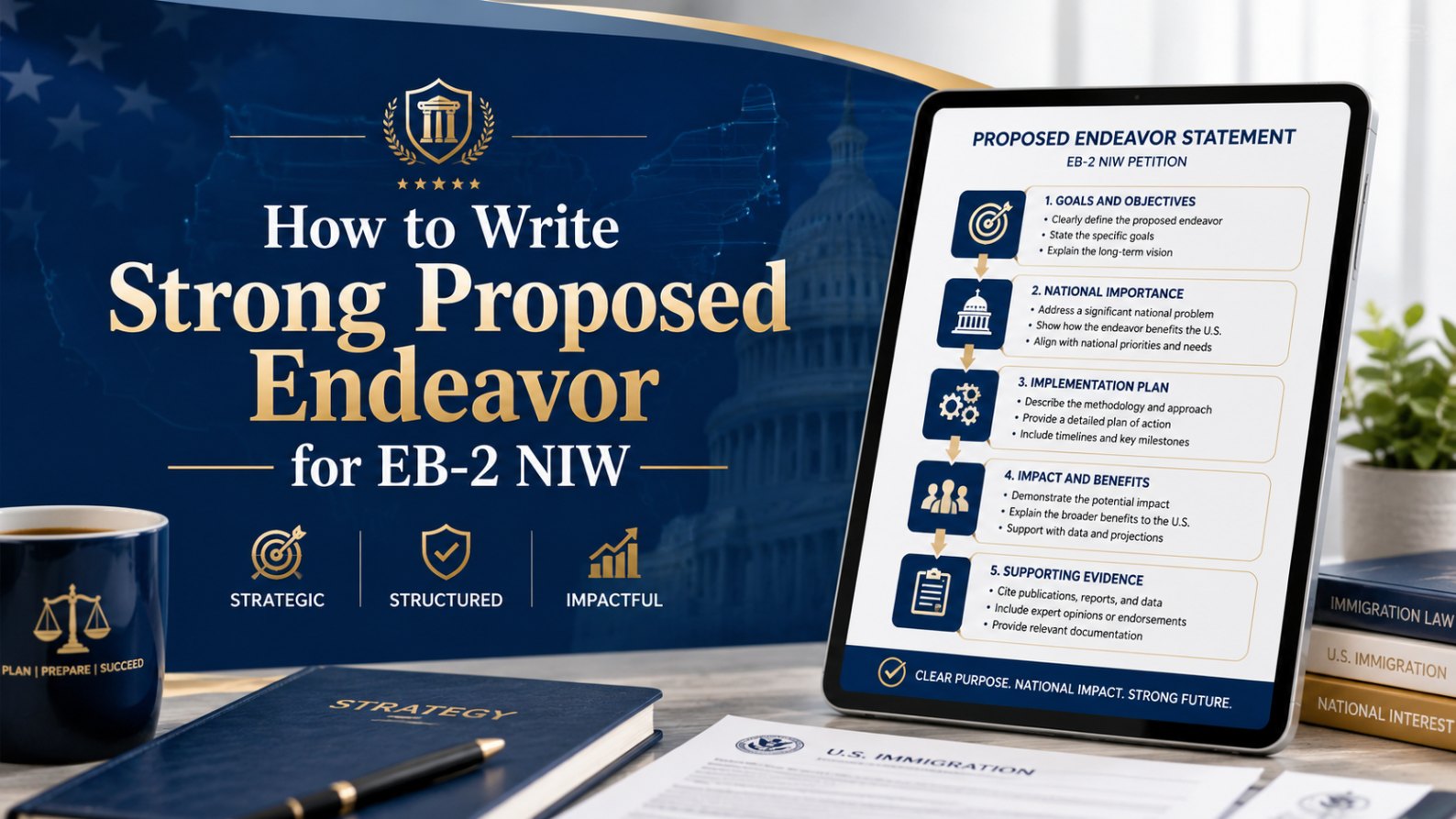
The proposed endeavor is the foundation of your EB-2 NIW case. This guide explains how to define your work to meet the Dhanasar criteria for national importance.
How to Write a Strong Proposed Endeavor for EB-2 NIW
The proposed endeavor is the core of an EB-2 NIW petition, and it's also where the most petitions fail — not because the applicant lacks qualifications, but because the endeavor is written as a job description rather than a national benefit argument. USCIS doesn't grant a National Interest Waiver because someone is good at their work. It grants one because the specific work they intend to do in the United States carries benefits significant enough to justify skipping the standard labor certification process entirely. Those are different arguments, and conflating them is the most common strategic error in NIW filings.
The Matter of Dhanasar Framework
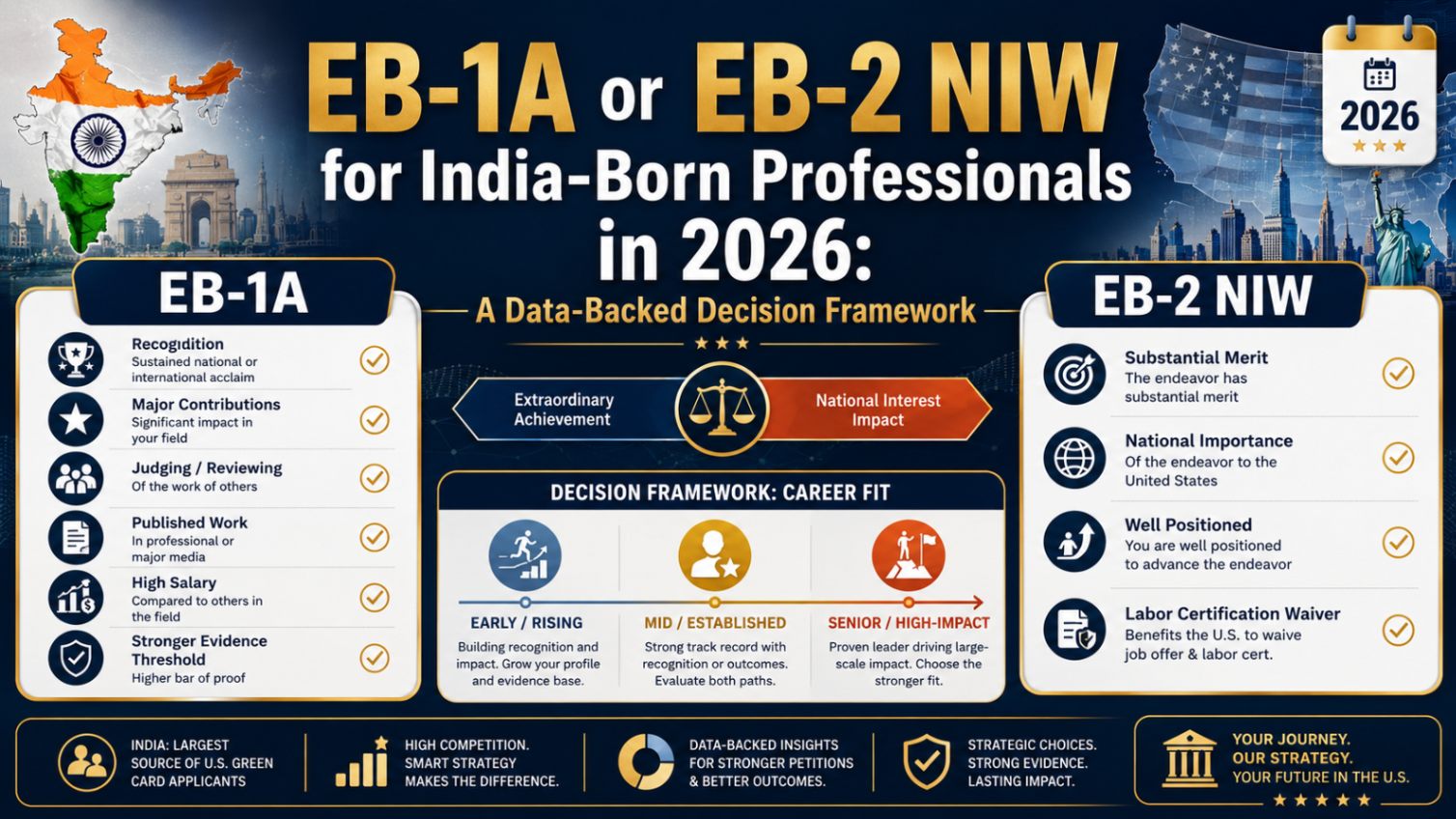
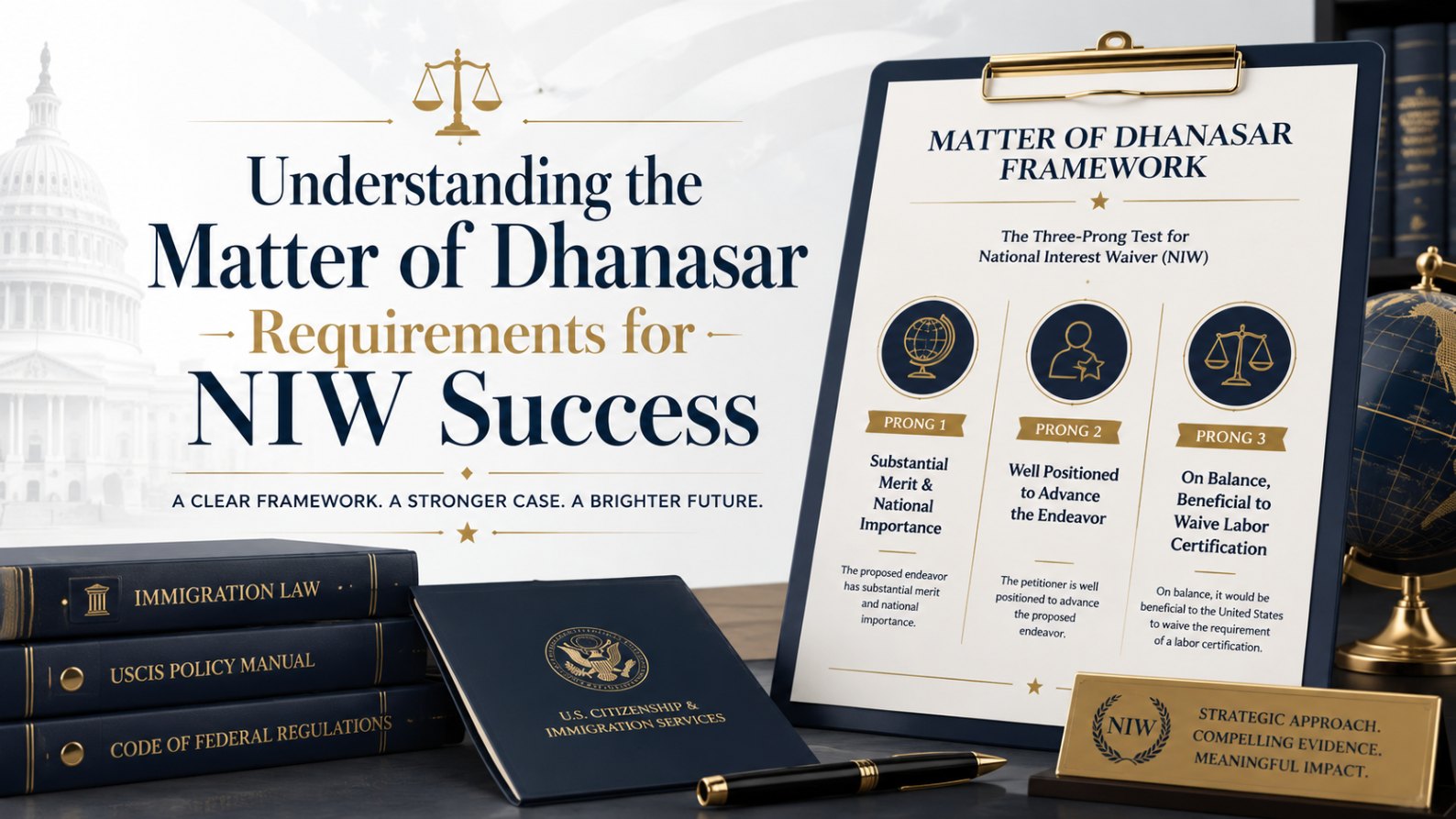
The governing precedent for NIW petitions is Matter of Dhanasar, 26 I&N Dec. 884 (AAO 2016). The Administrative Appeals Office replaced the old New York State Department of Transportation standard with a three-prong test that every petitioner must satisfy:
- The proposed endeavor has both substantial merit and national importance.
- The petitioner is well-positioned to advance the proposed endeavor.
- On balance, it would benefit the United States to waive the job offer and labor certification requirements.
Prong 1 is where most petitions either succeed or get stopped. Substantial merit — the first half of that prong — is generally straightforward. USCIS accepts that medicine, engineering, education, and technology carry inherent merit as fields. National importance — the second half — is where specificity becomes critical. The officer isn't evaluating the applicant's field in general. They're evaluating whether the specific work this applicant proposes to do will produce benefits that extend beyond their employer or immediate professional context.
Being a talented software engineer is a qualification. Developing a specific encryption protocol that secures infrastructure used by U.S. financial institutions is a proposed endeavor with national importance. The difference is the direction of the argument: one is about who the applicant is, the other is about what the work will do.
Specificity Is the Standard
Endeavors that fail the national importance prong almost always fail it for the same reason: they're too broad to evaluate. "Work as a consultant in healthcare technology" tells an officer nothing about what problem is being solved, who benefits from solving it, or how significant that benefit is. RFEs for vague endeavor statements are almost entirely avoidable.
The useful test is whether the endeavor description answers three questions: What specific problem are you addressing? How will you address it? Why does that problem matter to the United States specifically? If the statement doesn't address all three, it isn't ready.
A researcher describing their work as oncology research is too vague. A researcher describing the development of targeted delivery mechanisms for mRNA-based colorectal cancer therapies — where the officer can see what the work is, how it operates, and what it produces — gives the adjudicator something concrete to evaluate against national health priorities. The specificity isn't bureaucratic formality; it's what makes the national importance argument legible.
Geographic scope matters here too. National importance doesn't require that the work affect every person in the country simultaneously. An endeavor with significant regional impact — particularly in federally designated Health Professional Shortage Areas, economically distressed regions, or areas tied to documented federal priorities — can satisfy the standard. What it can't do is benefit only a single employer or a handful of local clients. The impact has to extend outward in some documentable direction. A civil engineer designing one building for one client fails the test. A civil engineer developing seismic-resistant infrastructure protocols for West Coast transportation grids is a different argument entirely.
Weak and Strong Proposed Endeavors
| Professional Role | Weak Endeavor | Strong Endeavor |
|---|---|---|
| Data Scientist | Improve customer churn algorithms for a major bank's internal analytics team | Develop machine learning models to detect fraudulent cross-border transactions across U.S. financial networks |
| Nurse Practitioner | Provide patient care at a private clinic in a suburban area | Implement telehealth outreach programs serving federally designated Health Professional Shortage Areas (HPSAs) in rural regions |
| Supply Chain Manager | Manage logistics for a retail company's warehouse operations | Optimize multi-modal freight frameworks to reduce throughput bottlenecks at West Coast ports, strengthening domestic supply chain resilience |
| Civil Engineer | Structural design for residential buildings in one city | Research and implement low-carbon concrete alternatives for federal infrastructure projects, reducing construction-related emissions at scale |
The pattern across the right column is consistent: a specific problem, a specific mechanism for addressing it, and a specific category of national benefit. None of them mention an employer or describe a job. That's the distinction USCIS draws when evaluating whether a waiver is justified.
Demonstrating National Importance
Prong 1 requires prospective impact — the officer is evaluating what the work will produce, not just what the applicant has already accomplished. Several categories of evidence support this argument effectively.
Governmental interest documentation. If a federal agency has published reports, strategic plans, or legislative language identifying a shortage or priority in the applicant's area, that documentation does more for the national importance argument than almost anything else. An applicant working in semiconductor manufacturing who cites the CHIPS and Science Act of 2022 — which explicitly identifies domestic semiconductor production as a national security priority — is grounding their argument in federal policy rather than self-assessment. CISA threat reports for cybersecurity professionals, NIH strategic plans for medical researchers, and Department of Energy roadmaps for clean energy engineers all serve the same function.
Economic impact projections. For entrepreneurs and startup founders, a detailed business plan with hiring projections, market analysis, and revenue forecasts demonstrates that the endeavor has real-world viability, not just theoretical national benefit. USCIS looks at whether the plan is credible, which means the projections should be grounded in industry data rather than aspirational estimates.
Proof of external interest. Grants, venture capital commitments, and letters of intent from U.S. research institutions or industry partners show that independent parties have evaluated the work and found it worth investing in. This addresses both Prong 1 (others have recognized the importance of the endeavor) and Prong 2 (the applicant has the relationships and resources to advance it).
Research dissemination plans. For academics and R&D professionals, USCIS looks at whether the work will influence the field beyond the applicant's own institution. A commitment to publish in peer-reviewed journals, present at major conferences, or make research data publicly available supports the argument that the work's impact will extend beyond a single lab or employer.
The Job vs. Endeavor Distinction
Because an NIW explicitly waives the job offer requirement, an endeavor that reads like a job description actively undermines the petition. If the statement describes performing duties assigned by a manager at a specific company, USCIS will read that as a PERM case — exactly the process the NIW is meant to bypass.
The endeavor should be something the applicant owns in the sense that it describes work they would continue pursuing regardless of which employer they work for. An employee filing an NIW isn't petitioning on behalf of their job; they're petitioning on the basis that their specialized work — the specific problem they're solving and the expertise they bring to it — serves a national interest that follows them from employer to employer. That framing is what justifies the waiver. An endeavor tied entirely to one company's internal operations doesn't survive that analysis.
Supporting Evidence
The written endeavor statement is the argument. The exhibits are the proof that the argument holds.
Expert letters for NIW cases need to address the proposed endeavor specifically — not the applicant's general reputation or career trajectory. A letter from a government official or recognized industry leader explaining why the specific problem the applicant is working on matters nationally carries more weight than a letter from a former supervisor confirming the applicant is skilled. The distinction is between someone endorsing the person and someone endorsing the work.
Industry reports and agency publications contextualize the endeavor within documented national priorities. The report shouldn't just mention the applicant's field generally — ideally it should identify the specific shortage, gap, or strategic priority the applicant's work addresses. That alignment between the endeavor and the documented need is what makes the national importance argument concrete rather than asserted.
A professional plan is often the most practical tool for non-academic petitioners. A five-to-ten-page document outlining goals for the next several years, the resources and collaborations the applicant will draw on, and the specific milestones they expect to reach gives the adjudicator a framework for evaluating Prong 2 — whether the applicant is actually positioned to do what they're claiming they'll do. The plan should be realistic enough to be credible, specific enough to be evaluable, and broad enough not to be invalidated by ordinary professional changes.
Frequently Asked Questions
What exactly is a proposed endeavor for EB-2 NIW? It's a detailed description of the specific work the applicant intends to pursue in the United States — not their current job title, not their employer's business objectives, but the particular problem they're addressing and the national benefit that work will produce. Under the Dhanasar framework, the endeavor must have substantial merit and national importance. Petitions that describe a job function rather than an impact argument regularly fail Prong 1.
Can the applicant change jobs after an EB-2 NIW is approved? Yes, with an important qualification. Once a green card is approved, the applicant must continue working in the same or a similar occupational field to the one described in the petition. The flexibility that comes with NIW approval doesn't extend to entirely unrelated work. A significant departure from the described endeavor — particularly one visible during naturalization review — creates legal exposure. Any new role should align with the broad goals and field described in the original petition.
How specific does the proposed endeavor need to be? Specific enough that the officer can identify the problem being solved and the mechanism for solving it, but not so narrowly defined that ordinary professional development constitutes a departure from it. The right level of specificity describes a problem and an approach without tying the argument to a single employer, a single project, or a single geographic location. A three-to-five-year professional plan is a practical way to establish that specificity without over-constraining the applicant's professional flexibility.
Does an EB-2 NIW require a job offer? No. The category specifically waives both the job offer requirement and the PERM labor certification process. The applicant must still satisfy Prong 2 — demonstrating they are well-positioned to advance the endeavor — which typically involves showing past success in similar work, existing relationships with U.S. institutions, and a credible plan for carrying out the work. The absence of a job offer isn't a weakness; it's what the visa category is designed for.
A useful first step is to draft a one-paragraph description of the work you intend to pursue in the United States — without mentioning your job title, your current employer, or your past credentials. If what remains clearly identifies a problem, an approach, and a national benefit, the endeavor argument is in viable shape. If what remains is vague, that's the gap the petition needs to close before filing.
A VangaVault profile assessment reviews the current record and the proposed endeavor framing against current USCIS adjudication trends, and returns a written feasibility analysis identifying the strongest angles for the national importance argument within 48 hours. Schedule a consultation to start that process.
Get Immigration Insights Delivered to Your Inbox
Practical guidance on EB-1A, EB-2 NIW, O-1A, and U.S. immigration — no spam, unsubscribe anytime.