A deep dive into the Matter of Dhanasar framework. Learn how USCIS evaluates National Interest Waiver (NIW) petitions and avoid common mistakes in proving national importance.
Understanding the Matter of Dhanasar Requirements for NIW Success
The 2016 Matter of Dhanasar decision replaced a framework that had become almost impossible to use. The old NYSDOT standard — drawn from Matter of New York State Department of Transportation, 22 I&N Dec. 215 (Comm'r 1998) — required applicants to show that the national interest would be adversely affected if labor certification were required, and that they were superior to U.S. workers with the same minimum qualifications. For researchers, startup founders, and specialists in emerging fields, that standard routinely failed because it was built around labor market competition rather than the prospective value of the applicant's specific work.
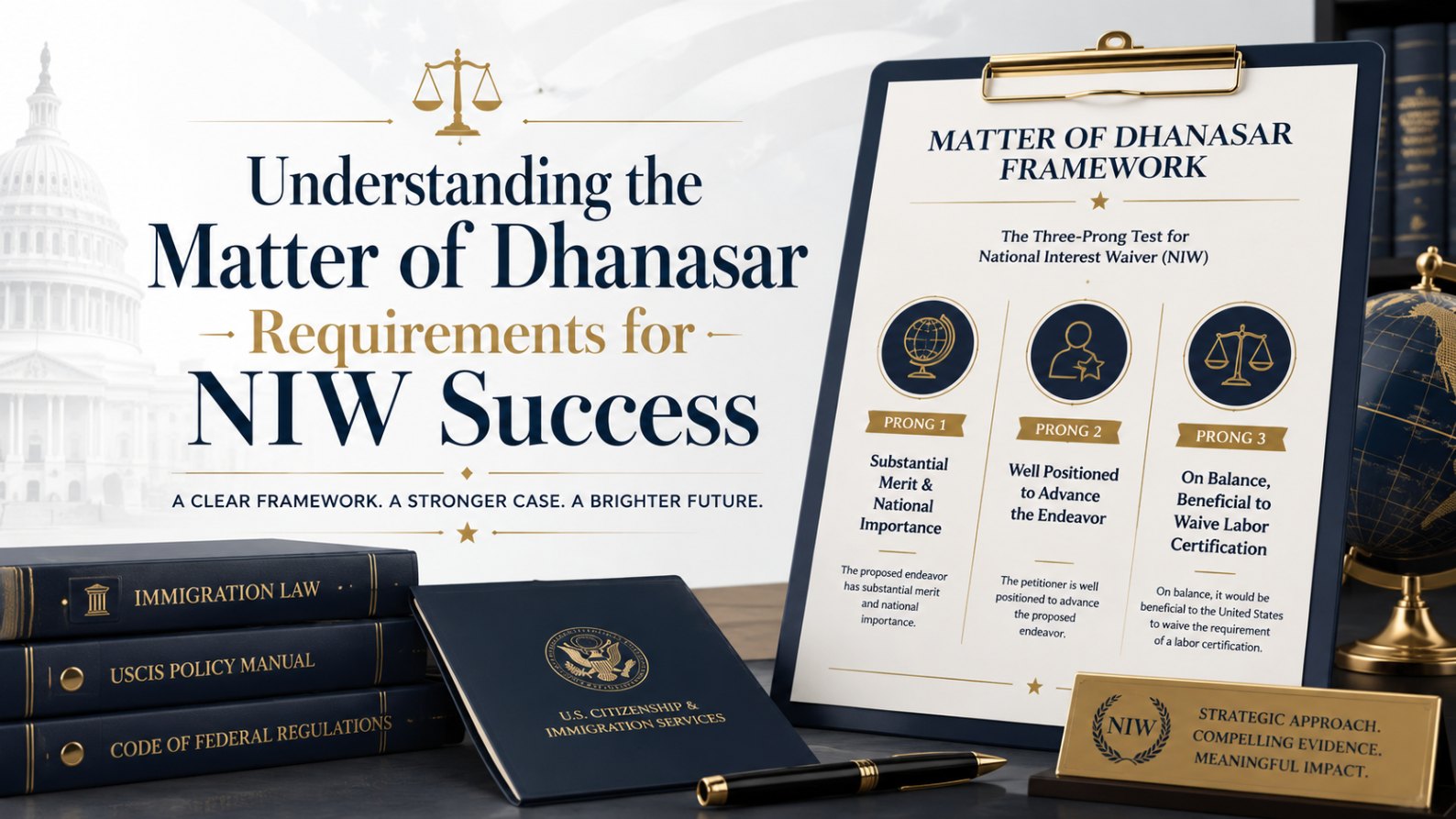
The Administrative Appeals Office recognized the problem and in Matter of Dhanasar, 26 I&N Dec. 884 (AAO 2016), replaced the NYSDOT test with three questions: Does the proposed endeavor have substantial merit and national importance? Is the petitioner well-positioned to advance it? And on balance, would the United States benefit from waiving the standard job offer and labor certification requirements? The shift was real — the new framework centers on the endeavor rather than the person's labor market competitiveness — but the flexibility has been widely misread. The specificity required for a successful petition did not decrease. What changed was the type of argument that satisfies each prong, not the rigor with which the evidence is evaluated.
Prong One: Substantial Merit and National Importance
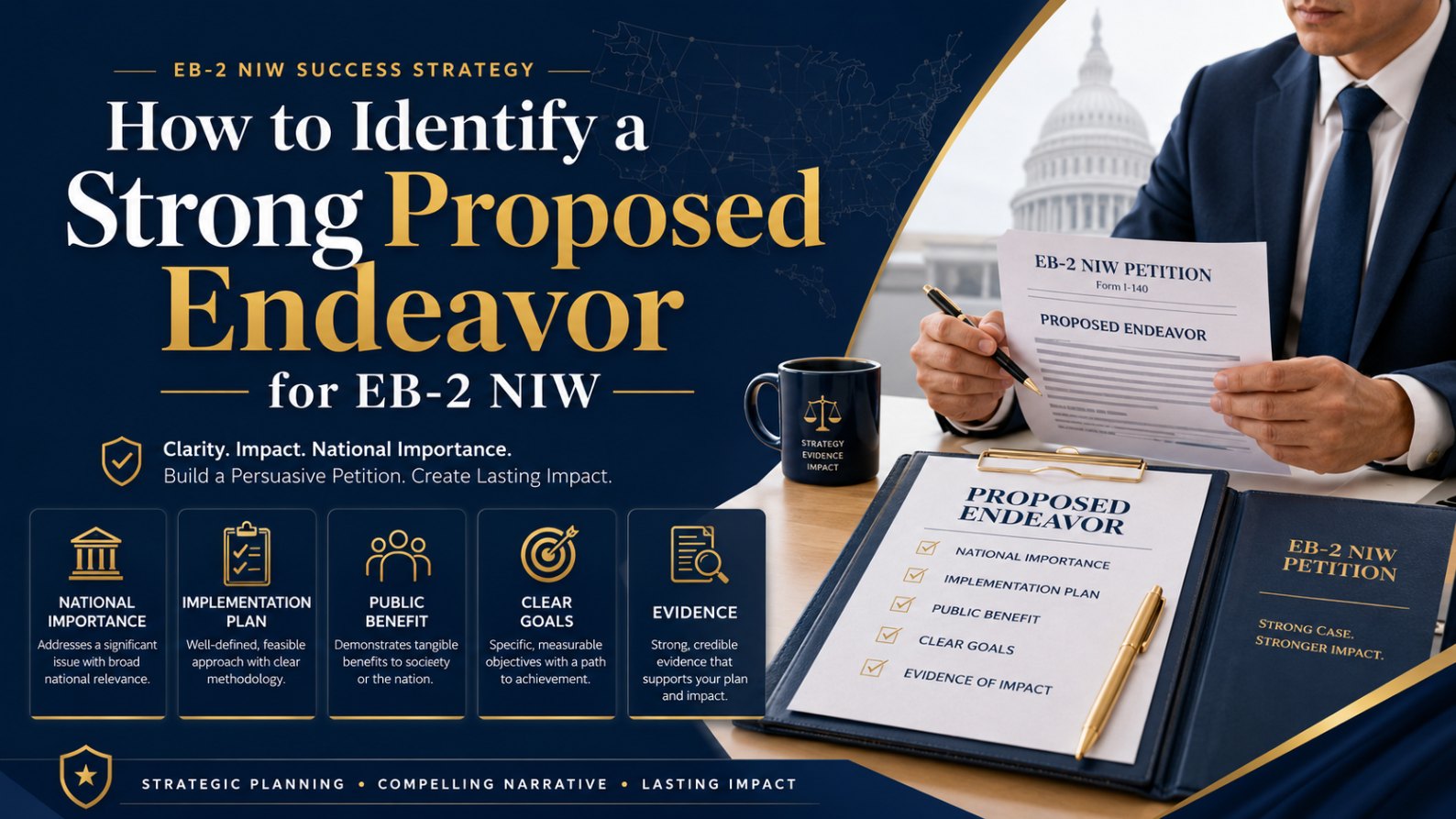
These are two separate requirements within the same prong, and they're not equally difficult to satisfy. Substantial merit — that the field or area of work has inherent value — is rarely contested. USCIS accepts that medicine, engineering, clean energy, and education carry merit as domains. National importance is where most petitions fail.
National importance is not a statement about the field. It's a statement about the specific proposed endeavor. Cancer research has substantial merit. A researcher proposing to develop a targeted mRNA delivery mechanism for colorectal cancer treatment that reduces systemic toxicity compared to current chemotherapy protocols is making a national importance argument. The distinction is the difference between claiming the field matters and documenting what this specific work will produce and for whom.
Prospective focus. Prong One is forward-looking. Past achievements matter — they're central to Prong Two — but the national importance analysis asks what the applicant will do in the United States and what that activity will produce. An AI engineer whose endeavor is stated as "working in machine learning" hasn't described an endeavor at all. An AI engineer whose endeavor is "developing predictive models to detect anomalies in pharmaceutical supply chain logistics, reducing drug diversion and shortage events that the FDA has identified as a documented public health risk" has connected specific work to a specific documented national problem.
Geographic scope. The AAO explicitly stated in Dhanasar that national importance doesn't require simultaneous nationwide impact. An endeavor with significant regional impact — advancing infrastructure in economically distressed areas, addressing a documented health shortage in a specific region, or developing technology in a niche area with national security implications — can satisfy the standard. What it cannot do is benefit only the applicant's employer or a narrow set of private clients. The work has to produce something that extends outward beyond the immediate employment relationship.
Prong Two: Well Positioned to Advance the Endeavor
Once the national importance of the proposed work is established, the question becomes whether this particular applicant is the right person to carry it out. This is where the individual's record becomes central — but not in the way a résumé review works.
Adjudicators aren't simply confirming that the applicant holds relevant credentials. They're evaluating whether the endeavor is actually feasible in the applicant's hands. A petitioner who claims they will launch a biotechnology company but submits no business plan, no evidence of funding, and no letters of interest from potential U.S. partners or collaborators has described an aspiration, not a viable plan. Prong Two requires evidence that the path from here to the stated outcome is credible.
For researchers, the most common form of Prong Two evidence is the citation record — but raw citation counts require context to be persuasive. Two hundred citations from within the applicant's own institution or a small cluster of collaborators signals a local impact that hasn't extended into the broader field. Citations from independent researchers at unaffiliated institutions, from government agencies, from industry R&D teams, or from researchers in different countries carry the weight that justifies a finding of genuine field influence. The qualitative question — who is citing this work and what did they do with it — matters more than the total count.
For entrepreneurs and industry professionals, equivalent evidence includes executed contracts or letters of intent from U.S. entities, secured grant funding from federal agencies like the NIH, NSF, or DOE, and documented track records of successfully completing comparable projects. A five-year professional plan with specific milestones, realistic financial projections, and identified U.S. stakeholders makes Prong Two concrete rather than aspirational.
Prong Three: The Balancing Test
The third prong asks whether, on balance, it would benefit the United States to waive the job offer and labor certification requirements. This is not a perfunctory step. The AAO in Dhanasar explicitly stated that even a petitioner who satisfies Prongs One and Two can fail Prong Three if they don't articulate why the standard PERM process would be a meaningful obstacle to the proposed endeavor.
The most effective Prong Three argument isn't "there's a shortage in my field." That argument works against the petitioner. Labor shortages are precisely the reason the PERM process exists — to document that no U.S. worker is available for a specific role. Arguing scarcity supports the argument for going through PERM, not bypassing it. What Prong Three actually requires is showing that the standard recruitment process would impede the specific work in a concrete way.
Entrepreneurs who own or control their own companies can't sponsor themselves through PERM — the regulatory structure prohibits it. Researchers working on time-sensitive federal grants face a different problem: an 18-month PERM timeline can cause a project to lose its competitive position or miss a funding renewal window, with direct consequences for U.S. research priorities. Specialists in newly emerging technical areas often can't be adequately described by any existing labor certification job description, making the PERM process functionally inapplicable to what they actually do. Each of these is a concrete obstacle, not a general inconvenience, and the petition has to articulate which one applies and why.
Common Misapplications
| Area | Common Misapplication | What Dhanasar Requires |
|---|---|---|
| Scope of impact | Arguing the field is nationally important ("medicine is vital to the U.S.") | Documenting that the specific proposed project produces a national benefit that extends beyond the employer |
| Qualifications | Submitting a degree and a job title as Prong Two evidence | Providing a credible implementation plan, stakeholder interest, or funding evidence alongside the credentials |
| Labor market | Arguing there is a shortage of workers in the applicant's occupation | Explaining why the specific contribution is too unique or time-sensitive for the standard PERM recruitment process |
The shortage fallacy deserves particular attention because it appears frequently in NIW petitions and consistently fails. A documented labor shortage in nursing, engineering, or data science tells USCIS that the PERM process is exactly the right mechanism — it exists to navigate precisely those conditions. To win Prong Three, the argument has to be about the nature of the work, not the size of the labor market.
Evidence Standards
Subjective self-assessment carries minimal weight. "I am a leader in my field" needs to be replaced by an organizational chart showing the applicant's position in a distinguished institution, a government agency's published citation of their work, or a letter from an industry executive explaining a specific decision that the applicant's research informed. The evidence has to be independently verifiable or independently sourced.
Recommendation letters are the most consistently misused evidence type in NIW petitions. When multiple letters from different recommenders use nearly identical language or structure, USCIS treats them as template submissions rather than independent assessments. A letter that carries evidentiary weight describes a specific encounter with the applicant's work — the recommender read a particular paper and implemented a methodology, or their organization licensed a technology based on the applicant's patent — and explains the concrete outcome of that encounter. Endorsements of the applicant's general quality don't satisfy this standard.
Government documents are among the most persuasive Prong One evidence available. If the proposed endeavor falls within an area the U.S. government has publicly identified as a national priority — semiconductor manufacturing under the CHIPS and Science Act of 2022, AI safety under the National AI Initiative Act of 2020, cybersecurity under relevant Executive Orders — citing those documents moves the national importance argument from assertion to documented federal policy alignment. The officer doesn't have to take the petitioner's word for the importance of the work; federal agencies have already said so.
Frequently Asked Questions
Does a high salary prove national importance? No, but it supports Prong Two. A salary in the top decile for a specific role and market demonstrates that independent parties — employers — have assessed the applicant's skills and compensated them accordingly. That's evidence of being well-positioned. It doesn't establish that the proposed work produces a benefit extending beyond the employment relationship, which is what Prong One requires. A highly paid private consultant whose work benefits one client's internal operations remains a Prong One problem regardless of their compensation.
Can an NIW petition be filed from outside the United States? Yes. Dhanasar doesn't require the petitioner to be physically present in the U.S. or to hold a current U.S. job offer. Applicants filing from abroad typically need to provide more detailed implementation plans — letters of intent from potential U.S. partners, evidence of professional relationships with U.S. institutions, and a credible account of how the proposed endeavor will be executed after arrival. The absence of a U.S. employment history isn't a disqualifier, but it shifts the burden toward the forward-looking Prong Two argument.
How many citations are needed for a successful NIW? There is no published threshold. The Dhanasar framework doesn't set one, and USCIS policy guidance doesn't either. Petitions with zero citations have been approved — particularly for entrepreneurs, senior executives, and professionals in fields where academic publishing isn't the primary mode of knowledge dissemination. Petitions with hundreds of citations have been denied when the applicant failed to articulate a clear national benefit for the proposed U.S. activities. Context matters more than count: who cited the work, at what institutions, and what they did with it.
What triggers NIW RFEs most often? Failure at Prong One — specifically, the national importance showing. USCIS regularly issues RFEs conceding that an applicant's work has merit while arguing that the benefits are confined to a single employer or a narrow set of private clients. The response to that RFE is structural: the petition has to document the outward reach of the work with independent evidence, not reassert the importance of the field. Anticipating this challenge before filing by explicitly building the outward-impact argument into the Prong One narrative is more effective than addressing it in a response.
A useful starting point before drafting is articulating the proposed endeavor in one paragraph without referencing a job title, an employer, or past credentials — focusing only on the problem being addressed, the mechanism for addressing it, and who in the United States benefits from that work being done. If that paragraph is specific and legible to someone outside the applicant's field, the Prong One foundation is in viable shape.
A VangaVault profile assessment reviews the current record and the proposed endeavor framing against current USCIS adjudication patterns and returns a written feasibility analysis across all three Dhanasar prongs within 48 hours. Schedule a consultation to start that process.
Get Immigration Insights Delivered to Your Inbox
Practical guidance on EB-1A, EB-2 NIW, O-1A, and U.S. immigration — no spam, unsubscribe anytime.