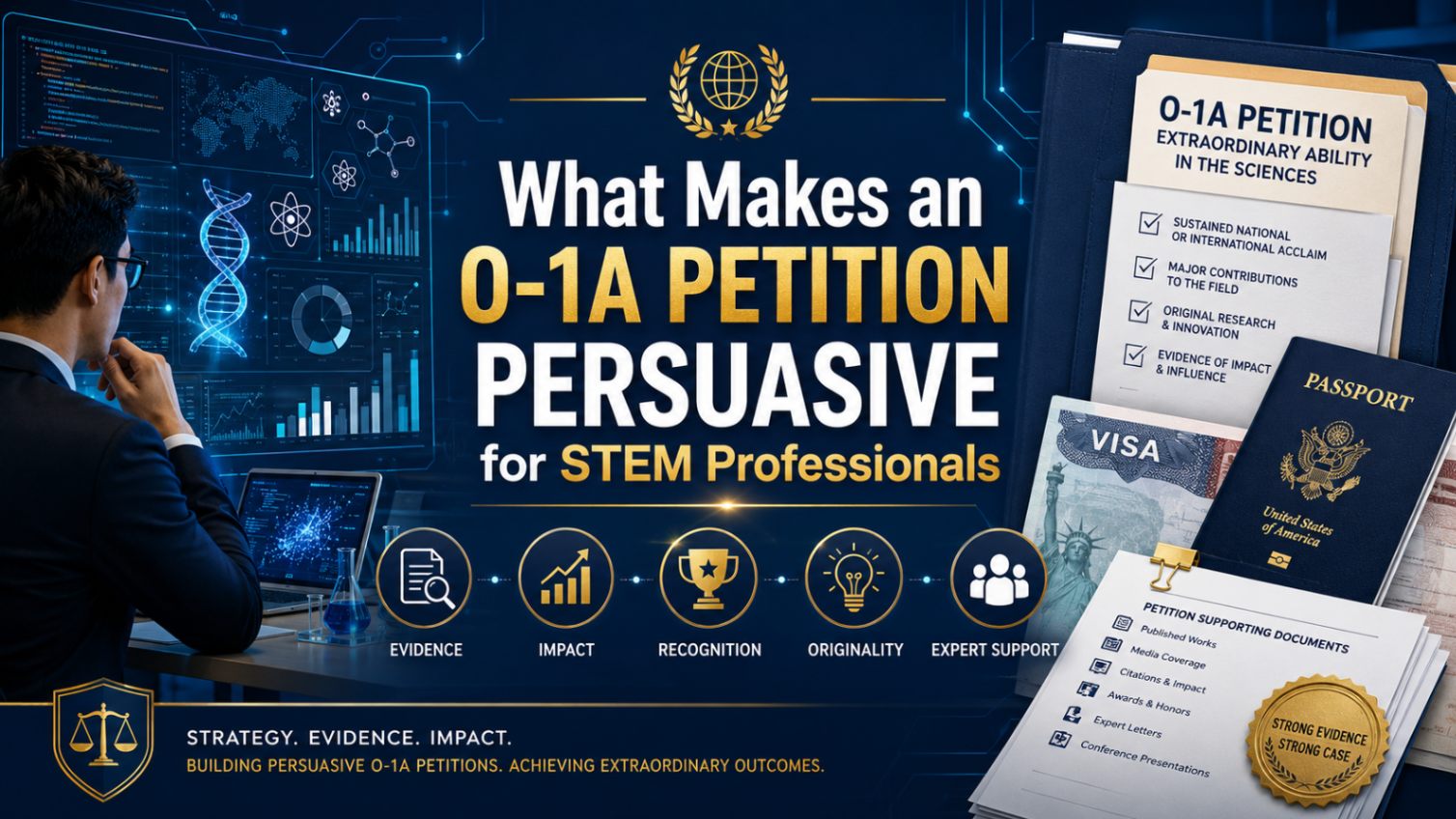
A persuasive O-1A petition for STEM professionals requires more than checking boxes. We analyze the evidence mechanics and final merits determination needed for success.
What Makes an O-1A Petition Persuasive for STEM Professionals
The regulatory threshold for an O-1A — meeting at least three of the eight USCIS criteria — is not the actual standard that determines whether the petition gets approved. It's the entry point. What determines approval is the final merits determination: whether the adjudicator reads the full record and concludes that this person has sustained national or international acclaim in their field. For researchers, engineers, and data scientists, that distinction matters a great deal, because a petition built around technically satisfying criteria without demonstrating genuine field-level impact routinely fails the second step even when it clears the first.
The Two-Step Adjudication Process
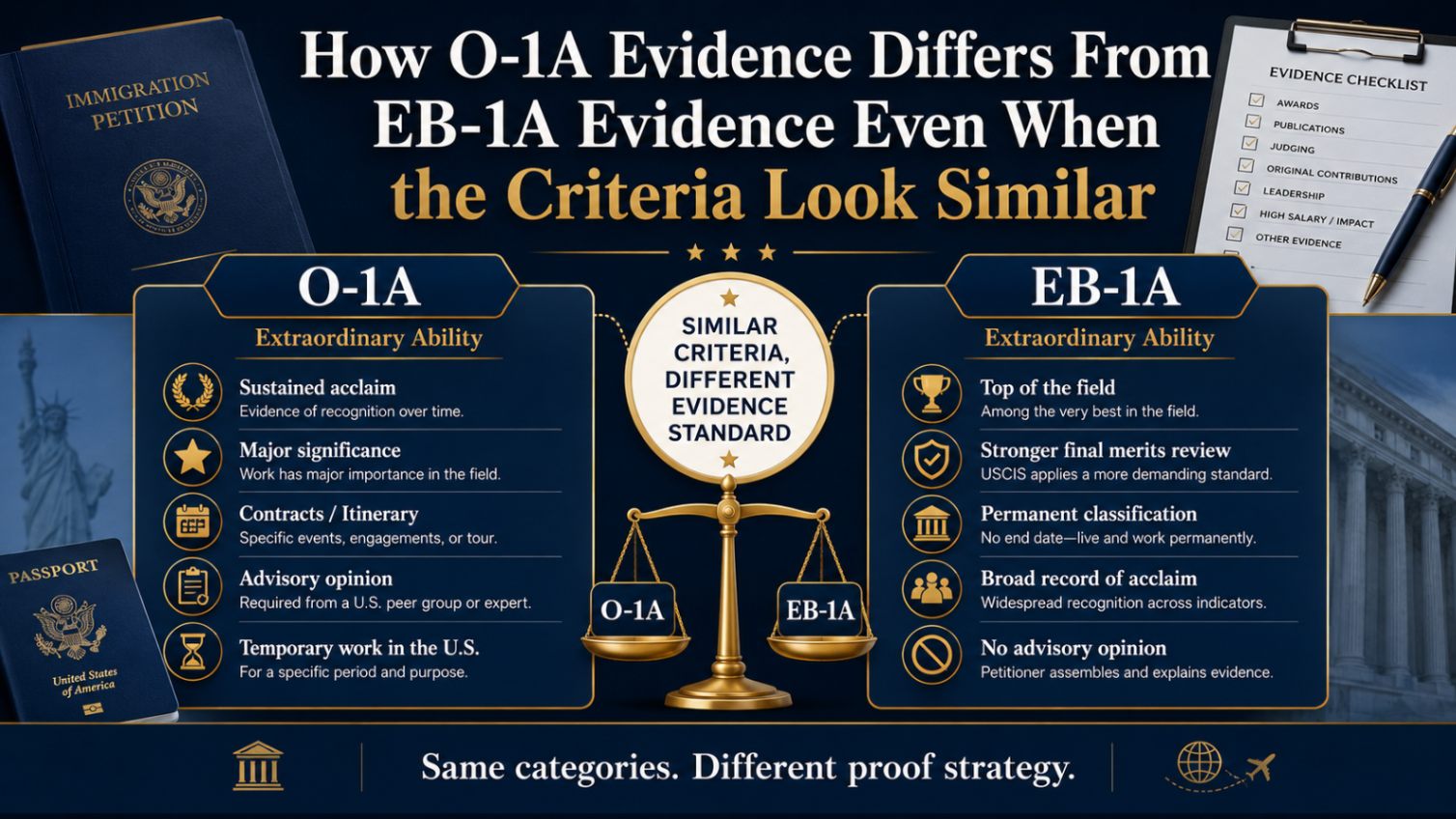
USCIS applies the Kazarian framework to O-1A petitions, the same two-step structure used for EB-1A review. Step one is a threshold check: does the record contain evidence responsive to at least three of the eight criteria? Three peer-reviewed publications, a salary in the top tenth percentile for the role and location, and a documented record of reviewing others' work — that combination passes step one.
Step two is where the actual adjudication happens. The officer evaluates the quality and collective weight of that evidence. Fifty citations means something different depending on the sub-field. In computational fluid dynamics or quantum cryptography, where niche journals have small readerships and cumulative citation counts run lower across the board, fifty citations can place a researcher at the top of their area. In machine learning, where major conference papers routinely accumulate hundreds of citations within two years of publication, the same number raises questions. Early-career AI researchers with genuinely high-impact work get tripped up here regularly because raw numbers don't tell the story the final merits determination requires.
Proving Original Contributions of Major Significance
This is the criterion that appears in the largest share of STEM O-1A petitions and the one that generates the most RFEs. The phrase "major significance" is the operative standard — not "interesting," not "innovative," not "novel." An original contribution satisfies this criterion when there's documented evidence that the broader field engaged with it, adopted it, or changed practice because of it.
Developing a new optimization algorithm isn't enough on its own. If that algorithm reduced infrastructure costs by 30% at a company operating at scale, with a letter from a VP of Engineering explaining the specific implementation and savings, that's a different argument. If the algorithm has been downloaded 50,000 times through an open-source repository and cited in subsequent work by researchers at independent institutions, that's stronger still. The distinction USCIS draws is between work that was technically accomplished and work that the field treated as meaningful enough to build on.
Expert letters are the standard mechanism for translating technical achievement into evidentiary terms a non-expert adjudicator can evaluate. A letter that recaps the applicant's CV accomplishes nothing. A useful letter does four things: identifies a specific project where the applicant was the primary driver of the technical outcome; explains the difficulty of the problem in terms accessible to someone without domain expertise; describes how the solution was adopted by independent parties — not just the applicant's employer; and points to specific patents, publications, or implementations that resulted directly from the work.
Citation metrics require contextual framing. USCIS has no published citation threshold, and raw citation counts submitted without comparison data leave the officer to draw their own conclusions. Field-normalized tools close that gap. The Relative Citation Ratio (RCR), developed by the NIH, benchmarks individual paper impact against the citation patterns of papers in the same field and time period. The Field-Weighted Citation Impact (FWCI) from Scopus applies a similar normalization. If an applicant's raw citation numbers appear modest but their FWCI is above 1.5 — meaning their papers are cited 50% more often than the field average — that metric reframes the argument in a way a raw count can't.
Proving a Critical or Essential Capacity
STEM professionals at well-known companies often assume that employer recognition or seniority satisfies this criterion. It doesn't. The standard is whether the applicant's specific role was critical or essential to the organization or a major division of it — not whether the applicant performed their job well at a prestigious employer.
Senior Engineer is a job title. It describes a position in a hierarchy. The criterion requires showing that what this particular person did in that role produced an outcome the organization couldn't have achieved without them. A lead architect whose cloud migration reduced annual infrastructure costs by $10 million, whose role is described by the CTO as technically irreplaceable during a critical transition window, presents a different case than someone with the same title whose responsibilities overlapped substantially with other members of their team.
Organizational charts are necessary but not sufficient. The officer needs to see where the applicant sat in the structure and then read a letter from someone above them in that structure — ideally a C-suite executive or division head — that explains the specific decision the applicant made, the outcome it produced, and why someone else at the same general level of experience couldn't have produced the same result. Generic performance praise does not satisfy this standard.
The High Salary Criterion in STEM
For professionals working in major tech markets, the salary criterion is often the most straightforward to document — but it still requires the right data sources and the right framing.
| Data Source | What It Provides | Preferred Documentation |
|---|---|---|
| Bureau of Labor Statistics (BLS) | 90th percentile wage benchmarks by occupation code and geographic area | Occupational Employment and Wage Statistics (OES) surveys |
| Radford / Aon Surveys | Role-specific compensation data at a granularity BLS doesn't provide for many specialized STEM titles | Certified data reports obtained through HR |
| Levels.fyi | Real-time total compensation data including equity, by company and level | Screenshots corroborated by W-2 or pay stub |
Base salary alone understates total compensation for most senior STEM professionals. RSUs and performance bonuses often represent a substantial share of actual remuneration — for engineers at major technology companies, equity can exceed base salary by a significant multiple. The submission should include a recent W-2 or pay stub alongside documentation of equity grants and vesting schedules, paired with a salary survey confirming the applicant's total compensation falls in the top tenth percentile for their specific title and market.
Judging the Work of Others
This criterion appears straightforward in research contexts — peer review for academic journals — but it requires specific documentation to be persuasive. Listing journal names without context is the most common way to undersell what is often strong evidence.
For each reviewing activity, the petition should include: the journal's impact factor, the invitation from the editor confirming the applicant was selected (not mass-solicited), and confirmation that the review was completed. Editorial acknowledgment emails or dashboard screenshots from platforms like ScholarOne or Editorial Manager showing review submission status close the loop that an invitation letter alone leaves open.
For industry professionals, equivalent activities include serving on patent review boards, acting as a technical program committee member for major conferences — NeurIPS, ICML, IEEE, ACM — or judging a national-level technical competition. The key is demonstrating that the selection was based on recognized expertise rather than organizational convenience. A technical judge role that came through an internal HR assignment reads differently than one that came through an invitation from the conference's program chair.
Common Pitfalls
Expertise mismatch. If the petition claims extraordinary ability in machine learning but the publications are primarily in hardware security, the adjudicator will identify the lack of coherence. A persuasive O-1A defines a specific field of endeavor — narrow enough to be defensible, broad enough to encompass the strongest evidence — and maps every criterion back to it consistently. Mixed or sprawling evidence across multiple unrelated domains signals dilettantism rather than extraordinary ability in any of them.
Internal awards. Awards given for performance within a company, regardless of how competitive the company's internal culture is, don't satisfy the awards criterion. USCIS requires recognition that extends beyond the applicant's immediate employer. Unless the award draws from an industry-wide candidate pool or has received coverage in trade publications that operate independently of the awarding organization, the better use of that achievement is as supporting context for original contributions or a leading capacity argument.
Frequently Asked Questions
How long should the O-1A petition letter be? A typical persuasive petition letter for a STEM professional runs 25 to 40 pages, not counting exhibits. That length is justified by the need to translate complex technical work into terms an adjudicator without domain expertise can evaluate. An officer who doesn't understand why a particular algorithm or methodology matters to the field can't approve based on what they don't understand. The language should explain significance, not demonstrate it through jargon. If a reader needs a PhD in the relevant field to follow the argument, the petition isn't written for its actual audience.
Can an O-1A be filed through an agent rather than an employer? Yes. O-1A requires a petitioner — a U.S. employer, a U.S. agent, or a foreign employer through a U.S. agent — but STEM professionals who are freelancers, independent consultants, or startup founders regularly use agent-based petitions to satisfy that requirement. An agent-based filing requires a detailed itinerary of services demonstrating that qualifying work is available in the applicant's field of extraordinary ability, along with supporting contracts or letters of engagement.
Is a PhD required for O-1A? No. The visa is based on achievement, not educational credentials. Software architects and founders with undergraduate degrees — or no degree — have received O-1A approvals when the record documented original contributions, high compensation, and critical roles supported by objective evidence. USCIS has specifically noted in policy guidance that non-traditional evidence, including compensation documentation and evidence of critical roles at early-stage companies, should be given meaningful weight in STEM cases.
How many citations are needed? There is no published threshold. Ten citations in a newly emerging research area — room-temperature superconductivity, for instance — can carry more evidential weight than 200 citations in a crowded field with thousands of active contributors, if the context is presented correctly. The argument is about what those citations represent relative to the field: who cited the work, whether any citations came from government agencies, major research institutions, or independent industry researchers, and what the typical citation trajectory looks like for papers published in the same venue during the same period.
A useful first step before filing is identifying which of the eight criteria can be documented with existing evidence today and which ones require additional record-building before a petition is viable. A VangaVault profile assessment reviews the current record against that standard and returns a written gap analysis within 48 hours. Schedule a consultation to start that evaluation.
Get Immigration Insights Delivered to Your Inbox
Practical guidance on EB-1A, EB-2 NIW, O-1A, and U.S. immigration — no spam, unsubscribe anytime.